


Exploring CPA as a Pathway After CA Setbacks
Failing a CA exam is far more common than most students admit and far less personal than it feels. Year after year, thousands of bright, capable, and hardworking students fail not because they lack intelligence, but because the CA system itself is highly laborious, highly dependent on memory, and has a vast syllabus. It is very normal that when you put in a lot of work and get no results, you start doubting yourself. For that, you need to draw a line between capability and outcome. They are two different things.
Many successful professionals got to their goals with a different trajectory in the field of accounting. You can unlock that trajectory with a US CPA designation, which helps you gain not only better salaries but a chance to work with some of the biggest NYSE-listed organizations. It is not about giving up, but about making smart choices and exploring the right alternatives after CA failure.
For CA students who are looking for a globally recognized qualification that offers a better-structured, predictable timeline, which is relevant to an international career, the US CPA has come up as a great alternative. This is why the idea of CPA after CA failure is gaining attention.
This credential is acknowledged and well valued not only in India, but also in more than 150 countries, such as the US and the GCC. It’s a well-organized exam system, the option of booking the test at a datewhich suits you, and the strong correspondence with the accountancy and financial principles make it a very good pick for CA background students.With this clarity guide you will be able to evaluate objectively whether CPA fits your goals, situation, and long-term career after CA failure
CPA After CA Failure – Is It Worth It?
For many CA students, the CPA exam becomes a practical second path-not because it’s easier, but because it’s more structured, predictable, and globally aligned.
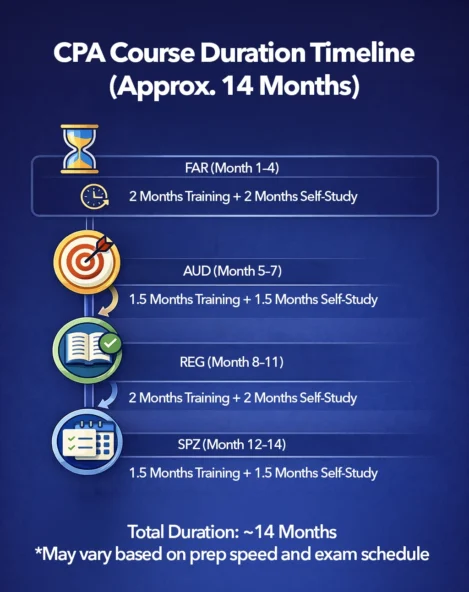
Unlike the open-ended nature of CA, the CPA can typically be completed within 12-18 months, giving students a clear and time-bound roadmap. The exam structure is standardized, computer-based, and MCQ-driven, which shifts the focus from conceptual clarity over rote learning and reduces subjectivity & uncertainty in the exam checking process.
What makes the transition smoother is the strong overlap with CA fundamentals areas like accounting, audit, and taxation already feel familiar, allowing CA students to adapt faster with less new ground to cover. Additionally, most CA students already meet a significant portion of the credit requirements, giving them a clear eligibility advantage and helping fast-track their CPA journey.
Another key benefit is flexibility; multiple exam windows mean that one failed attempt doesn’t cost an entire year, making the process far more predictable and manageable.
From a career perspective, the CPA holds global recognition across the world, Big 4/6 firms, MNCs, and Global Capability Centers (GCCs), global financial institutions & consulting firms opening doors beyond geographical limitations. It is especially valuable in environments driven by US GAAP, IFRS, internal controls, and international taxation.
In essence, for students comparing CPA vs CA after failure, CPA offers a more flexible, time-bound, and globally relevant pathway-making it a strong and strategic alternative.
Why the CPA Credential Works for the Right Profile
- Globally recognized in the US, Canada, Europe, GCC, and Asia-Pacific, thus facilitating cross-border career moves.
- Big 4 firms, Global Capability Centers (GCCs), and multinational corporations are among the most sought-after employers.
- Your career can be aligned with job roles like a Financial Analyst, US Tax Consultant, Audit Associate, Finance Manager, and Advisory/Consultant.
- The exam structure is quite flexible with several testing windows, so you can study while working full-time.
Who CPA Is Ideal For
- Students with an analytical mindset who aren’t good with memorizing but who enjoy data-driven decision-making and application-based learning.
- Aspirants targeting global careers with MNCs, Big 4 firms, or GCC employers.
- Working professionals who need flexible exam windows and a time-bound path.
- CA students who prefer an objective, MCQ-based evaluation over subjective marking.
CPA for commerce students without a CA background is a viable option as well, though CA students enjoy credit advantages.
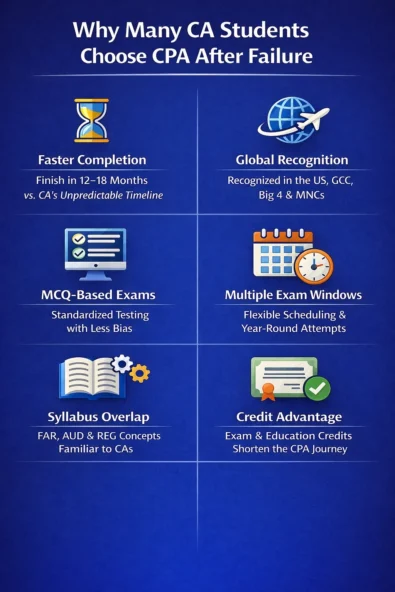
Why Many CA Students Choose CPA After Failure?
1) Faster Completion: The CPA course duration can be in a matter of 12 to 18 months, whereas CA is usually an open-ended timeline that gets extended due to the limited number of attempts and the uncertainty of the results.
2) Global Recognition: The CPA designation is recognized not only in America but also in Europe, GCC countries & the Asia Pacific Region, by Big 4/6 accounting firms, Global Capability Centers, multinational corporations & global financial institutions, which means the CPA can work anywhere around the world.
3) MCQ-Based Exams: The CPA examinations are fully standardized and computer-based, which means that the performance exam checking process is less dependent on the evaluator’s bias. In addition, the examinations focus more on rewarding conceptual understanding and practical learning, unlike the rote learning of Indian exams.
4) Multiple Exam Windows Each Year: There are many testing windows; candidates are able to plan their attempts wisely and not have to waste a whole year just because of one failed paper.
5) Strong Syllabus Overlap for CA Students: Besides, main areas of the CPA Exam such as Financial Accounting & Reporting (FAR), and Auditing & Attestation (AUD), are essentially the same as taught in CA, making US CPA for CA students more about application, based in the real world, without the need for memorizing theory. Thus, CA students will have an edge when learning the new concepts while studying these subjects.
6) Credit Advantage for CA Background: Most CA students meet the CPA eligibility criteria for CA students due to strong accounting credit coverage. This helps them to complete their CPA journey faster than non-commerce students.
CPA vs CA Comparison
|
Parameter
|
CA (India)
|
CPA (US)
|
|---|---|---|
|
Duration
|
Undefined; typically 4- 6+ years depending on attempts
|
Time-bound;12-18 months with structured planning
|
|
Exam Structure
|
Subjective, descriptive exams
|
100% computer-based, MCQ + simulations
|
|
Attempts per Year
|
Limited attempts per level
|
Multiple testing windows throughout the year
|
|
Passing Criteria
|
Group-wise clearing with aggregate rules
|
Section-wise; 75 percentile per section
|
|
Fees
|
Lower upfront cost but extended over years
|
Higher upfront cost, predictable total
|
|
Global Mobility
|
Primarily India-focused
|
High global recognition (US, GCC, Big 4, MNCs)
|
|
Career Flexibility
|
Strong for Indian public practice & compliance
|
Strong for corporate, consulting & global roles
|
|
Work-Life Balance
|
Demanding, especially in practice & peak seasons
|
Relatively predictable in corporate roles
|
|
Risk Profile
|
High due to dependency on limited attempts
|
Lower due to flexibility and retake options
|
CPA Eligibility for CA Students
For CA students, CPA eligibility for CA students is primarily credit and subject-based. The US state boards evaluate your total academic credits and depth of accounting, audit, tax, and business subjects areas where CA students are naturally strong.
Are CA Students Eligible for the CPA Exam?
Yes. In most cases, CA students are eligible to appear for the CPA exam. If you have:
- Graduation plus CA Inter / CA Final
or - Graduation plus CA Final passed
You generally meet:
- Required subject coverage (Accounting, Audit, Taxation, Business)
- Minimum academic rigor expected by most US state boards of Accounting, for both exam & license.
Credit Hours: What CA Students Need to Know
- 1 year of university education is equal to 30 credit hours.
- Most Indian 3-year bachelor’s degrees are equal to 90 credits.
- All US State Boards of Accounting require 120 credits to sit for the exam.
CA studies are often considered advanced accounting credits, helping CA students meet or get close to the 120-credit requirement.
Can CA Students Appear with Fewer Than 120 Credits?
In some US states, yes, kind of:
Certain state boards allow candidates to appear for the CPA exam with fewer than 120 credits if they have strong subject-specific coverage in:
- Accounting
- Business
- Economics
CA students typically satisfy these subject requirements due to the structure of the CA curriculum.
What If a CA Student Is Short on Credits?
By and large CA students will not be short on credits if they have completed both groups of their CA-Inter. If this is not the case, a shortfall in credit hours may emerge but it does not disqualify you. If required, CA students can complete a CPA Bridge Course to:
- Add missing academic credits
- Fulfill US state board eligibility criteria
- Avoid enrolling in an additional full degree
- Move forward with the CPA exam without delays
For most CA students, graduation and CA qualification are sufficient to be CPA exam–ready, with a bridge course used only if needed.
Important Clarifications for CA Students
- CPA exam eligibility is credit-based, not experience-based.
- Work experience strengthens your profile but does not replace academic credits.
- Exam eligibility and CPA licensure eligibility are different.
- Many CA students take the exam at 120 credits and complete 150 credits later for licensing.
Get your free CPA Eligibility Checked Today
CPA Exam Structure
Conceptual understanding, application, and professional judgment are the main focus of the CPA US Exam, not memorization. Its structure integrates a robust accounting basis with the freedom to specialize, thus enabling candidates to map the exam according to their professional objectives.
The CPA exam consists of 4 sections:
- 3 Core sections
- 1 Discipline section
Candidates have to appear for three core sections and can opt for 1 discipline. This ensures depth in accounting fundamentals while giving you the freedom to choose a specialization based on interest and strengths. The core and discipline
Core Sections
- Auditing & Attestation: It covers topics like auditing standards, internal controls, risk assessment, and professional responsibilities.
- Financial Accounting & Reporting: FAR delves into concepts like the financial accounting standards, complex reporting areas, and financial statement analysis. Often considered the most concept-heavy section.
- Regulation: It covers areas like taxation, ethics, and business law. Generally viewed as the most scoring among the core sections due to its structured syllabus.
Discipline Sections
- Business Analysis & Reporting: This discipline covers areas of financial analysis, reporting, and management decision-making.
- Tax Compliance & Planning: It delves into concepts like tax planning, compliance, and advisory for individuals and businesses.
- Information Systems & Controls: The ISC includes areas like IT systems review, internal controls, and cybersecurity risk management.
Learn Which Specialization Works For You?
CPA Exam Pattern
- The CPA exam pattern is structured around 5 testlets, which evaluate conceptual understanding and practical application skills. The five testlets are split into parts, with testlets 1 and 2 consisting of multiple-choice questions, and testlets 3, 4, and 5 consisting of task-based simulations.
- There is equal weightage (50%) placed on the multiple-choice questions and (50%) task- based simulations in all exams except ISC (60% MCQs & 40% TBSs). To pass a CPA exam section, you need a percentile of 75 or higher. This shows you have the skills and knowledge expected of a CPA. A percentile of 75 does not mean you got 75% of the questions right. It reflects your performance compared to the difficulty of the questions, roughly like being at the 75th percentile.
- The CPA exam is adaptive, which means the testlets/groups get harder or easier depending on how you do in the earlier testlet/group. If you do well on the first testlet/group, you may get tougher questions later, which carry more weight and can increase your final score.
CPA Pass Rates and Difficulty Level
2025 CPA Exam Pass Rates (Through Q3)
|
Section
|
Q1 2025
|
Q2 2025
|
Q3 2025
|
2025 Cumulative
|
|---|---|---|---|---|
|
AUD
|
44.30%
|
49.05%
|
50.03%
|
48.01%
|
|
FAR
|
41.67%
|
43.52%
|
43.07%
|
42.80%
|
|
REG
|
62.03%
|
63.58%
|
66.05%
|
63.94%
|
|
BAR
|
37.64%
|
47.26%
|
39.46%
|
42.55%
|
|
ISC
|
61.23%
|
71.96%
|
66.91%
|
68.21%
|
|
TCP
|
74.94%
|
80.63%
|
76.68%
|
78.06%
|
- Core vs. Discipline Sections: The core sections of AUD, FAR, and REG cover discipline accounting and auditing knowledge. In contrast, the specialization disciplines BAR, ISC, and TCP allow candidates to develop deeper expertise in specialized areas.
- Section Difficulty: FAR often shows the lowest pass rates, indicating it is typically the most challenging core section. Conversely, TCP tends to have the highest pass rates among discipline sections, reflecting its narrower focus and alignment with specific professional skills.
- Trends Over Time: Analyzing both quarterly and cumulative averages helps candidates understand how pass rates evolve. This insight can be useful for spotting seasonal trends and planning exam schedules and study strategies effectively.
- Interpretation: A low pass rate does not mean failure is inevitable. These statistics represent the performance of the entire candidate pool, including first-timers, repeat test-takers, and individuals with varying preparation levels. With strategic study, practice exams, and proper timing, candidates can significantly boost their chances of success.
CPA Exam Fees
Understanding the CPA exam fees in India is crucial for planning your CPA journey, especially as an Indian candidate. The overall CPA exam fees cover the application, the evaluation, the fees for each exam section, and charges for international testing. Besides that, your cost will differ slightly depending on which state board you decide to go with.
How CPA Exam Fees Are Structured
Normally, the US CPA Exam charges are split into two main parts:
Category A- One-Time Fees: These are one-time costs associated with the submission of your application.
|
Fee Type
|
USD
|
Approx INR
|
When To Pay
|
Whom To Pay
|
|---|---|---|---|---|
|
Evaluation Fee
|
$250
|
₹22,750
|
To begin with, before applying for the CPA exam, candidates are generally expected to complete this step within 30 days of enrolling. (Tentative Processing Time – 30 Days)
|
evaluation agencies like NASBA (NIES), WES, or FACS
|
|
State Board Registration Fee
|
$140
|
₹12,740
|
Following the evaluation process, this step is usually completed within 90 days of enrolling. (Tentative Processing Time – 4 to 6 weeks)
|
Your assigned State Board of Accountancy
|
*Kindly Note: Prices may vary subject to foreign exchange fluctuations and have been converted using the exchange rate as of 01-01-2026 ($1=INR 91).
Category B- Per Exam Fees: These are costs that you have to pay every time you book or re‑book an exam section:
|
Fee Type
|
USD
|
Approx INR
|
When To Pay
|
Whom To Pay
|
|---|---|---|---|---|
|
CPA Exam Section / NTS Fee
|
$390*
|
₹35,490
|
As/when you're prepared for each exam. (Usually, students take at least 1 exam every 4 months)
|
CPA Exam Centra
|
|
International Testing Fees*
|
$510*
|
₹46,410
|
Payable along with NTS / CPA Exam Fees.
|
CPA Exam Central
|
*Kindly Note: Converted using the exchange rate as of 01-01-2026 ($1 = INR 91), and the prices may vary, subject to foreign exchange fluctuations. All non-US candidates are meant to pay the ITF.
US CPA Fees Grand Total
Planning your total investment upfront helps you stay financially prepared throughout your CPA journey. Here’s a complete breakdown in both USD and INR:
|
Component
|
USD
|
Approx INR
|
|---|---|---|
|
One-Time Fees (Evaluation + Registration)
|
$390
|
₹35,490
|
|
Exam Fees (4 Sections × $390)
|
$1,560
|
₹1,41,960
|
|
International Testing Fees (4 Sections × $510)
|
$2,040
|
₹1,85,640
|
|
Total Estimated CPA Cost
|
$3,990
|
₹3,63,090
|
CPA Salary and Scope
When evaluating a career after CA failure, salary growth and global mobility become important considerations. The US CPA credential can open doors to different sectors, companies, and new technologies across a vast range of industries. Some of the opportunities for the US CPA professionals in demand are as follows:
|
Industry Area
|
Key Area (India & Abroad)
|
|---|---|
|
Big 4 / Big 6 & Financial Services
|
Audit, Tax, Advisory, Risk, Consulting, Financial Reporting, Financial Planning & Analysis
|
|
Outsourcing & Global Capability Centers (GCCs)
|
Audit, Tax, Advisory, Risk, Consulting, Financial Reporting, Financial Planning & Analysis
|
|
Global Corporates & NYSE-Listed MNCs
|
FP&A, Accounting & Reporting, Management Accounting, Risk, Cost, Compliance, Controllership, CFO’s Office, Corporate Finance
|
|
Investment & Treasury
|
Investment, Risk, Treasury, Financial Planning, Management Accounting, Portfolio Advisory/Management, Corporate Finance
|
|
International Tax & Cross-Border Advisory
|
International Tax Consulting, Multijurisdiction Tax, Tax Planning, Transfer Pricing, Expat Tax Advisory, Global Mobility Specialist
|
|
Startups & Venture Capital
|
FP&A, Accounting & Reporting, Management Accounting, Risk, Cost, Compliance, Controllership, CFO’s Office, Corporate Finance, Strategic Finance, Venture Capital, Business Finance Manager, Fund Analyst
|
|
Emerging Technologies in Finance
|
Fintech, Blockchain Audit, Data Analytics, Digital Audit, Information Systems Audit, RPA, RegTech, Agentic AI, Predictive Analytics, Automated Fraud Detection, Triple Entry Accounting, DeFi, Digital Currency
|
CPA opens doors across audit, finance, consulting, global tax, investments, and emerging tech-driven roles.
CPA Salary Ranges
It is important to remember that CPA salaries in India are influenced by multiple factors such as the area of specialization, the level of experience, and the geographical location. CPA certification holders from diverse fields are highly portable globally and enjoy tremendous career growth potential coupled with attractive remuneration differential, hence the CPA credential is definitely a wise career move for professionals interested in international finance, tax, audit, and advisory fields. The CPA salaries by specialization vary and are driven by complexity, risk, and demand. Here’s a typical snapshot for India and abroad:
|
Location
|
Entry-Level
|
Mid-Level
|
Senior-Level
|
|---|---|---|---|
|
India
|
₹7–24 LPA
|
₹25–50 LPA
|
₹50 L-1 Cr PA
|
|
GCC (UAE / Saudi Arabia)
|
AED 12K–20K per month
|
AED 20K–35K per month
|
AED 35K–50K per month
|
|
United States
|
$65K–$90K per year
|
$90K–$150K per year
|
$150K–$250K+ per year
|
Mentor Insight: Is the US CPA Actually Worth It?
For many CA students, the thought of switching to CPA after CA failure comes after repeated attempts at the CA exams. It’s natural to wonder: Is CPA really worth it? The answer is both practical and reassuring – it’s not about quitting, it’s about choosing a path that aligns with your strengths and career goals.
Why Many CA Students Succeed in CPA
The US CPA exam is structured differently from the CA exams. While CA focuses heavily on memorization and theory, CPA emphasizes practical application, problem-solving, and real-world scenarios. Its format is standardized, fully digital, and evaluation-driven, reducing subjectivity and making outcomes more predictable.
This setup works particularly well for students who have a strong grasp of fundamentals but have struggled with CA’s unpredictable evaluation. With consistent preparation, most students find CPA a smoother, faster route to a globally recognized credential.
Which CPA Sections CA Students Find Easier
CA students often find the FAR (Financial Accounting & Reporting) and ISC (Information Systems & Controls) sections most approachable.
- FAR: Indian Accounting Standards, derived from IFRS, align closely with US GAAP – roughly 90–95% overlap in core concepts. This familiarity gives CA students a significant advantage.
- ISC: Structured, logical, and largely objective, ISC tests systems, internal controls, and IT audit knowledge. It rewards clarity and practical understanding rather than rote memorization.
For students strong in accounting logic and structured preparation, these sections feel intuitive and achievable.
Switching from CA to CPA Is a Mindset Shift
Moving from CA to CPA isn’t quitting; it’s a strategic redirection. The difference lies in approach:
|
CA Model
|
CPA Model
|
|---|---|
|
Theory-heavy, memorization-focused
|
Practice-heavy, application-focused
|
|
Limited exam attempts
|
Multiple exam windows per year
|
|
Subjective evaluation
|
Computer-based, standardized testing
|
|
Reading-focused
|
Digital test bank practice & simulations
|
|
Long, uncertain timelines
|
Structured 12–18 month preparation
|
Your daily routine shifts from passive reading to active problem-solving, with real-time feedback. This digital-friendly, practice-oriented method often leads to faster results and higher confidence.
Should You Quit CA for CPA?
You should never give up on something you truly love. But if repeated attempts, usually 4 to 5 or more, have slowed your progress, you will not be considered by the Big 4/6 firms & MNCs. Hence, pursuing the CPA becomes a practical, forward-looking choice. CPA is not a backup; it is a global, high-value credential that lets you continue as a professional accountant, unlocking international opportunities without negating the time, effort, and skills you’ve already invested.
How EduMont Helps You Switch from CA to CPA
Switching from CA to CPA is more than just changing exams – it’s about adopting a new mindset, study approach, and global perspective. EduMont provides structured guidance to make this transition seamless, efficient, and confidence-building.
Pass-in-One-Attempt Philosophy: Our preparation is tailored to your strengths, ensuring you attempt each section only when fully ready. This focused approach minimizes retakes and builds confidence in your CPA journey.
Safety Net System (SNS): EduMont tracks your progress continuously, offering timely interventions and personalized support. From weak-area identification to exam strategy adjustments, the SNS ensures no step is left to chance.
AICPA-Licensed Study Material: Students benefit from unrestricted access to UWorld’s printed study materials, eBooks, digital question banks, and unlimited mock exams, enabling efficient learning and practice until mastery is achieved.
Daily Digital Practice: Task-based simulations and unlimited MCQs give you real-world exam practice. This hands-on approach transforms study time from passive reading to active learning, helping CA students adapt to the CPA’s digital-friendly format.
Mock Analysis & Personalized Mentorship: One-on-one mentorship sessions with certified faculty – led by Mr. Rohan Chopra, CPA, CMA, TEDx speaker, and other expert instructors – provide tailored guidance, review mock performance, and ensure you are fully exam-ready.
End-to-End Support: From eligibility checks and onboarding to exam scheduling, career guidance, and placement assistance, EduMont supports you at every step. Flexible payment options ensure finances never hinder your learning.
Unlike the traditional CA approach, where repeated failures are normalized, EduMont’s structured system is designed to maximize success, save time, and build confidence, giving you a predictable, globally recognized path to CPA licensure.
Conclusion
Being unsuccessful in a CA exam should not be taken as a measure of your intellect or capabilities. It is merely a signal to rethink your strategies and make some wise decisions. The US CPA is an excellent option for getting a globally recognized professional qualification for many CA students, who see it as a suitable credential of their strengths and international career ambitions. Choosing US CPA as a CA dropout is not about changing a career path altogether, but about making a suitable choice for getting global opportunities in the field of accounting.
The US CPA is a ticket to a career in audit, tax, consulting, corporate finance, and multinational corporations. Besides, CPA is a globally recognized credential in over 150 countries, featuring a well-organized, time-bound exam system, and is practice-oriented. The CPA exam sections like FAR and ISC are especially easy for CA students because of the overlap in the syllabus; hence, the transition will be faster and smoother.
Changing from CA to CPA is not surrendering; it is just the way of focusing on a course that rewards practical competencies, offers flexibility, and guarantees measurable, predictable progress. If you have the right support, a well-organized course, and accompanying practice, the CPA can be your springboard to international opportunities, increased income potential, and long-term career growth.
One setback doesn’t signify the end of your journey; instead, it marks the beginning of a global, high-impact professional future.
Your story doesn’t end with a result. It begins with a decision. Start your US CPA journey with EduMont – because your ambition deserves a qualification that matches it.