

Alternative to CS: Why Students Are Exploring Other Paths
The Company Secretary (CS) qualification is one of India’s most respected commerce credentials. But let’s be honest, it’s also one of the most demanding. With a vast structure spanning Foundation, Executive, and Professional stages, CS can take anywhere from 3 to 6 years to complete, and each level comes with low pass rates and a heavily memory-based, theory-driven and law-focused syllabus.
If you’ve been struggling with repeated attempts, feel misaligned with the regulatory and exploring courses after CS failure, or simply want the best alternative to CS qualification that opens global doors, you are not alone, and you are definitely not off track.
The good news? There are multiple structured, globally respected, and career-aligned CS alternatives in India. Credentials like the US CPA (Certified Public Accountant), US CMA (Certified Management Accountant), and EA (Enrolled Agent) are increasingly preferred by Indian students and professionals seeking faster completion timelines, better salary prospects, and international career opportunities.
Why Students Look for an Alternative to CS
Before jumping to the alternatives, it’s worth understanding why so many students start looking for other accounting alternatives to CS.
- High Difficulty & Low Pass Rates: CS exams, especially at the Executive and Professional levels, have pass rates that often fall below 15-20%, leading to multiple reattempts.
- Long Duration: Considering working commitments, it takes around 4 to 6 years to complete all three levels of the CS exam.
- Law-Heavy Curriculum: The course content of CS mainly revolves around corporate law, governance, and compliance. Those with a financial, analytical, or accountancy background might find the law-oriented syllabus challenging to memorize as most of the content needs to be memorized.
- Limited Global Mobility: The CS qualification is largely recognized in India only. Therefore, it does not provide substantial career opportunities in foreign countries or multinational companies.
- Career Scope Concerns: CS roles are niche, primarily secretarial and regulatory compliance positions within Indian companies. The salary ceiling and career growth can be slower compared to finance and accounting peers.
- Interest Mismatch: Many students who initially chose CS based on its prestige later realize their strengths and interests lie more in financial analysis, audit, taxation, or strategic business roles.
| EduMont Expert Insight “CS is a highly respected qualification, but it is not the only path to a successful corporate career. In today’s finance-driven, globally connected job market, credentials like US CPA and US CMA are not just career alternatives to CS, but a smarter choice. The key is choosing a qualification that aligns with your strengths & is highly in demand, rather than one that is conventional but lacks new opportunities.” – Rohan Chopra, CPA, CMA, TEDx Speaker & Founder, EduMont |
Best Alternatives to CS in India: Top Career Options Instead of CS
Here is a structured overview of the top career-focused alternatives to CS, ranging from globally recognized professional certifications to postgraduate programmes:
CPA as an Alternative to CS (CPA vs CS)
The US CPA is generally considered the gold standard in accounting worldwide. The American Institute of Certified Public Accountants (AICPA) awards the CPA, and NASBA regulates it. A CPA license is recognized by Big 4/6 firms, Fortune 500 companies, NYSE-listed MNCs, Global Capability Centers (GCCs), and top financial institutions around the world.
CPA is an attractive option for CS students because:
- Exam Pattern Advantage: CPA uses objective MCQs and task-based simulations-no lengthy theory writing. This suits students who prefer structured, analytical problem-solving over rote learning.
- Shorter Timeline: Significantly fewer years to prepare all the 4 CPA sections (12 to 18 months) than the CS courses (4-6 years) are needed by the average student.
- Global Career Access: CPA confers a wide range of career opportunities in public accounting, corporate finance, audit, US taxation, advisory, etc., not only in India but also globally.
- CS Background is an Asset: Your CS Foundation and Executive background in corporate law, ethics, and governance directly support the REG (Regulation) section of the CPA exam.
CPA Exam Structure
| Section | Full Name | Focus Area |
| AUD | Auditing and Attestation | Audit procedures, internal controls, ethics |
| FAR | Financial Accounting and Reporting | Financial statements, GAAP, accounting standards |
| REG | Regulation | US Tax, business law, professional ethics |
| BAR / ISC / TCP | Discipline (Choose One) | Business Analysis / IT Controls / Tax Planning |
CPA Eligibility for CS Students
CS students who hold a B.Com, B.Com (Hons.), M.Com or equivalent degree are generally well-positioned to pursue CPA eligibility. The key requirement is meeting 90-120 credit hours, which most B.Com graduates satisfy. If there are small gaps, a CPA Bridge Course (6-12 months) fills them efficiently without needing an additional full degree.
Who Should Choose CPA?
When comparing CPA vs CS, the biggest difference lies in global recognition, exam structure, and career flexibility. CS students interested in finance, accounting, audit, US taxation, or advisory roles at MNCs, Big 4/6 firms, or GCCs will find the US CPA credential a suitable fit. Ideal for those wanting a globally recognized qualification with a shorter, structured exam format.
Check Your CPA Eligibility
CMA as an Alternative to CS (CMA vs CS)
The US CMA (Certified Management Accountant) is a certification given by the Institute of Management Accountants (IMA). CMA is also amongst the top qualifications for internal finance professionals, financial planning and analysis (FP&A), strategic decision-making, management accounting, and business controls.
Nowadays, CS is mostly getting you ready to work with India-specific regulatory and compliance roles. On the other hand, CMA enables you to be in the center of a company’s internal operations and work closely with CFOs, finance directors, and business leaders in areas like cost control, performance strategy, and financial forecasting.
- Two-Exam Structure: CMA only has two parts, Financial Planning, Performance and Analytics (Part 1), and Strategic Financial Management (Part 2). Both parts can be finished within 12 to 18 months.
- Business Focused: CS is highly memory-based, whereas CMA covers practical business finance skills, which are the ones most in demand worldwide.
- IMA Global Network: IMA members are spread across over 150 countries, and their network opens up career opportunities not only in the US, the Middle East, Southeast Asia, but also in India’s expanding GCC market.
- Salary Premium: On average, CMAs worldwide earn 20 to 30% higher salaries compared to their non-certified counterparts. The demand is particularly strong in key sectors such as manufacturing, FMCG, technology and financial services.
CMA Exam Structure
| Part | Title | Key Topics Covered |
| Part 1 | Financial Planning, Performance & Analytics | External Financial Reporting Decisions, Planning & Budgeting, Cost Management, Internal Controls, Performance Management, Data Analytics & Technology |
| Part 2 | Strategic Financial Management | Financial Statement Analysis, Corporate Finance, Decision Analysis, Risk Management, Investment Decisions, Professional Ethics |
US CMA Eligibility for CS Students
Any graduate or professional certification holder, like CA, CS, ACCA, with 2 years of relevant work experience, qualifies for the US CMA, and since the experience can be completed & submitted up to 7 years after passing both the exams, even fresh graduates can start right away.
Who Should Choose CMA?
In the comparison of CMA vs CS, CMA focuses more on corporate finance and strategy, while CS remains compliance-driven. CS students with an interest in corporate finance, FP&A, budgeting, cost management, or strategic roles within companies will find CMA a good fit for themselves. Ideal for those who want to move beyond compliance into business strategy.
EA (Enrolled Agent) – A Focused Alternative to CS
The Enrolled Agent (EA) is the highest tax credential awarded by the US Internal Revenue Service (IRS). While not as broad as US CPA or US CMA, it is a highly focused, fast-to-complete qualification for students who have a strong interest in US taxation and want to work in the growing cross-border tax advisory space.
- Fastest Completion: The EA can be completed in as little as 6-12 months, making it one of the quickest routes to a professional credential in finance.
- No Degree Required: Unlike US CPA or CS, the EA has no mandatory educational prerequisite – making it accessible to a wider range of students.
- Growing Demand in India: With India’s booming GCC and BPO sector handling US tax compliance work, EA-qualified professionals are increasingly sought after by leading outsourcing firms.
- Stepping Stone: Many EA students later pursue CPA to broaden their scope, making EA an excellent starting point for a global tax career.
EA Eligibility for CS Students
There is no requirement for a formal degree or a prior qualification in order to be eligible to become a US Enrolled Agent. Any candidate can appear for the Special Enrollment Examination (SEE) and become an EA by passing all three papers.
Who Should Choose EA?
Students who want a fast, focused entry into US taxation and advisory. It is excellent for those targeting roles in tax outsourcing firms, BPOs, or cross-border tax advisory at MNCs.
EA Exam Structure
| Part | Title | Key Topics Covered |
| Part 1 | Individuals | Income, deductions, credits, filing status, and tax rules for individuals |
| Part 2 | Businesses | Business taxation, partnerships, corporations, and retirement plans |
| Part 3 | Representation, Practices & Procedures | IRS procedures, audits, appeals, ethics, and taxpayer representation |
ACCA
Association of Chartered Certified Accountants is a UK-based credential that is recognized globally. It focuses on international accounting standards and covers areas like accounting, auditing, taxation, and financial management. This makes ACCA vs CS a relevant comparison for students targeting international accounting careers. For students interested in accounting and audit careers at international firms, ACCA is a good option. However, it typically requires 2-3 years of dedicated study and 13 examinations, making it a longer path than CPA or CMA. Moreover, students also have to combine ACCA with work experience at Big 4 firms for a well-rounded career profile.
MBA (Finance / Strategy / Corporate Law)
Among CS students an MBA in Finance, Strategy, or Corporate Law is seen as another way of investment for opening doors to senior leadership, investment banking, management consulting, and corporate strategy roles. But in India the market for management graduates is too competitive and saturated. The ROI is heavily dependent on the chosen institution’s brand, and the 2-year full-time programme comes at a significant cost and opportunity investment which is very time consuming and challenging.
CFA (Chartered Financial Analyst)
The CFA is a finance credential from the CFA Institute that is particularly relevant for roles in investment banking, asset management, equity research, and portfolio management. Candidates have to pass three levels of exams spread out over approximately 3 to 4 years. Completing the qualification is a major commitment and requires a lot of effort and self-discipline. Although it is a good way to gain entry into the investment domain, only those students who are sure that they want to become capital markets professionals and are willing to undertake a longer and more demanding path should consider it. Among global courses after CS, CFA is ideal for students targeting investment and capital market roles.
CS Alternative Salary Scope
CS vs Alternatives: Detailed Comparison
| Parameter | CS (India) | US CPA | US CMA | EA | ACCA |
| Conducted By | ICSI | AICPA / NASBA | IMA | IRS (USA) | ACCA Global |
| Duration | 4–6 years | 12–18 months | 12–18 months | 6–12 months | 2–3 years |
| Exam Levels | 3 levels | 4 sections | 2 parts | 3 parts | 13 papers |
| Difficulty | Very High | Moderate–High | Moderate–High | Moderate | Moderate–High |
| Global Recognition | India only | 150+ countries | 150+ countries | US / Global | 150+ countries |
| Career Focus | Law & Compliance | Accounting / Audit / Tax | Corporate Finance / FP&A | US Taxation | Accounting / Audit |
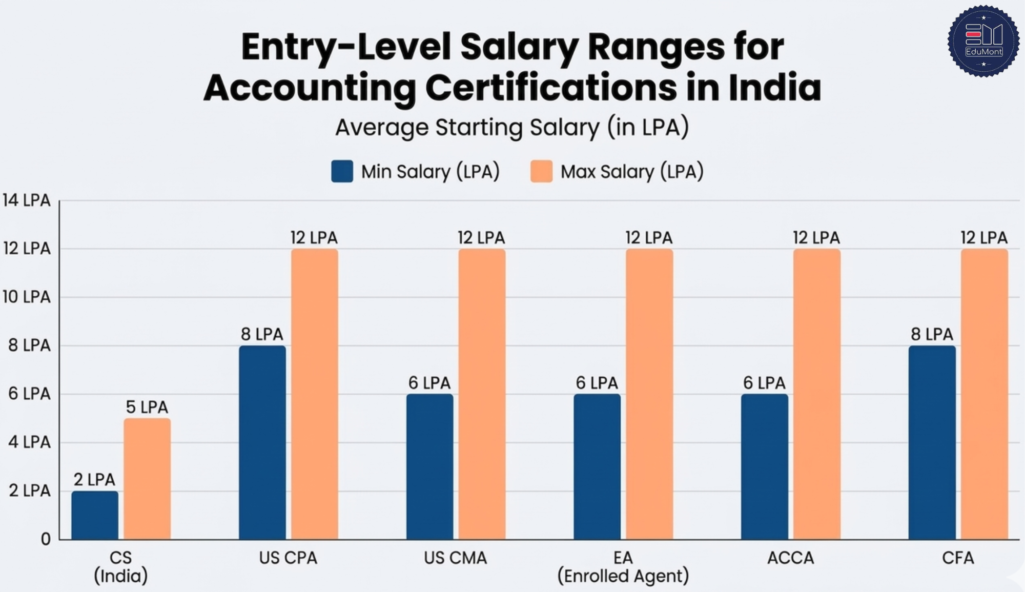
| Starting Salaries (India)* | ₹2–5 LPA | ₹8–12 LPA | ₹6 to 8 LPA | ₹6–8 LPA | ₹8–10 LPA |
| Work Exp. Required | Training required | 1 year (for license) | 2 years (for certification) | No requirement | 3 years (for membership) |
*Note: The salaries indicated above are for guidance only. They may differ from one individual to another depending on their skills, experience, employer, and location.
Other Career Options After CS (Beyond Traditional Paths)
Beyond the certifications covered above, CS students also have career prospects in the following specialized finance domains.
| Certification | Career Roles |
| Financial Risk Manager / Professional Risk Manager | Risk Analyst, Credit Risk Manager, Market Risk Manager, Operational Risk Manager, Risk Controller, Quantitative Analyst, Basel Compliance Analyst, Risk Consultant |
| Financial Modeling & Valuation Analyst | Financial Modeller, Valuation Analyst, Corporate Development Analyst, M&A Analyst, Investment Banking Analyst, Budget Analyst, FP&A Analyst |
| Certified Fraud Examiner | Forensic Auditor, Fraud Investigator, Internal Audit Specialist, Financial Crime Analyst, Anti-Bribery Consultant, Whistleblower Investigation Specialist, Litigation Support Analyst |
| Advanced Diploma in International Taxation | Transfer Pricing Specialist, International Tax Advisor, Tax Structuring Consultant, Cross-Border Tax Manager, Global Mobility Tax Advisor |
| Certified Treasury Professional | Treasury Analyst, Cash Manager, Working Capital Manager, Treasury Operations Manager, Liquidity Risk Analyst, Corporate Finance Manager |
| Sustainability and Climate Risk / Certificate in ESG Investing | ESG Analyst, Sustainability Reporting Specialist, BRSR Compliance Officer, Climate Risk Analyst, Green Finance Advisor, ESG Portfolio Analyst |
| Data Analytics in Finance | FP&A Analyst, Finance Business Partner, Audit Analytics Specialist, Data-Driven Finance Analyst, Financial Reporting Analyst, BI Finance Analyst |
| NISM / SEBI / RBI / IRDAI Certifications | Compliance Officer, Regulatory Analyst, Capital Markets Specialist, Mutual Fund Compliance Manager, Insurance Regulatory Analyst, Securities Law Advisor |
| Credit Risk Certification | Credit Analyst, Lending Analyst, Risk Associate, Credit Underwriter, Portfolio Risk Manager, NBFC Credit Manager, Corporate Banking Analyst |
Which Alternative to CS Is Best for You?
There is no single ‘best’ alternative – the right career after CS depends entirely on your career goals, strengths, and timeline. Here is a goal-based guide to help you decide:
| Your Career Goal | Best Alternative | Why |
| Work at Big 4 / MNCs globally in Financial roles | US CPA | Highest global recognition in public accounting |
| Join corporate finance / FP&A teams | US CMA | Built for management accounting and strategy roles |
| Start quickly in US tax advisory | EA | Fastest path, no degree required |
| Accounting & audit at international firms | ACCA | IFRS-focused, strong in Middle East & UK |
| Investment banking / capital markets | CFA | Gold standard for investment-side finance |
| General Finance/ general financial management | MBA | Broad scope, with impact influenced by the institution you choose |
How EduMont Helps You Build a Global Career
If you have decided to transition from CS to CPA, CMA, or EA, the most important next step is choosing the right preparation partner. At EduMont, we specialize in helping Indian commerce students and CS aspirants make this transition – successfully, confidently, and in the shortest possible time.
You don’t need a CA background or prior accounting experience to start. Whether you have CS Foundation knowledge or are starting from scratch, EduMont’s step-by-step curriculum is built to take you from basics to exam-ready.
Why Choose EduMont for Your Preparation
- Unlimited Access to UWorld Resources: Get unlimited access to printed books, eBooks, digital question banks, and unlimited mock tests to practice until you master every concept.
- Live Chalk-and-Talk Classes: Interactive traditional chalk and talk style bilingual teaching sessions designed for real-time doubt solving and deeper conceptual clarity.
- EduMont LMS Access: Pre-annotated EduMont’s own study material, class notes, and recorded lectures are available until you pass, so you can revise anytime.
- Certified Faculty-Led Training: Learn from experienced, dually qualified professionals led by Rohan Chopra, CPA, CMA, TEDx Speaker, along with other expert CPA faculty, ensuring high-quality mentorship.
- Personalized Mentorship and Safety Net System: Continuous progress tracking combined with one-on-one game plan calls ensures you attempt exams only when fully prepared, maximizing your chances of passing in one go.
- Pass-in-One-Attempt Approach: A structured strategy and guided preparation model designed to help you clear each section confidently without retakes.
- End-to-End Support: From eligibility evaluation and exam scheduling to career guidance and placement assistance, we have you covered throughout till you become a CPA.
- No-Cost EMI Options: Flexible payment plans are provided so finances never become a barrier to your CPA journey.
- Proven Legacy: Backed by over half a decade of consistent results and student success, EduMont has made a highly trusted name in the test-prep industry for US CPA in India.
See how our students are turning our pass-in-one-attempt philosophy into real results.
Your CS Journey Does Not Define Your Global Career
Whether you’ve faced repeated CS attempts, feel misaligned with its memory-reliant structure, or simply want a qualification that offers better career opportunities, the decision to explore alternatives to CS is not a step backward. It’s a step toward clarity.
The world’s leading finance, accounting, and business credentials, like the US CPA, US CMA, EA, ACCA, and CFA, are globally respected, career-accelerating qualifications that are increasingly in demand across India’s GCC ecosystem, Big 4 firms, MNCs, and financial institutions.
Your commerce background, CS foundation, and your understanding of corporate governance are real assets that can be channelled into a faster, better-aligned qualification with the right guidance.
The only question left is: which path fits your goals?
Frequently Asked Questions
1. What are the best alternatives to CS in India?
The best alternative depends on your goals. If you want global recognition in accounting and audit, US CPA is the top choice. For corporate finance and FP&A roles, US CMA is excellent. For a faster entry into US taxation, EA is the quickest path.
2. Can I do CPA after CS failure?
When comparing CMA vs CS, the choice depends on your career goals. Most CS students, even those who have not completed all levels, qualify for CPA with their B.Com degree. Your CS background in law, ethics, and governance is actually an advantage for the REG section of the CPA exam.
3. Is CMA better than CS?
CMA and CS serve different career paths. CMA is better if you want to work in internal corporate finance, strategy, and management roles at companies globally. CS is better suited for India-specific compliance and secretarial roles. For global salary potential and career scope, CMA holds a clear advantage.
4. Which course has a better salary than CS?
US CPA, US CMA, CFA, and even ACCA professionals consistently earn more than CS holders in India and globally. At the senior level, CPAs can earn ₹50 LPA and above in India, significantly more than the typical CS career trajectory. Among the top CS alternatives in India, US CPA and US CMA and ACCA offer the highest salary potential.
5. What are global alternatives to CS?
The most popular global courses after CS include CPA, CMA, ACCA, and CFA. EA is primarily US-focused but has growing relevance in India’s GCC sector.
6. Which alternative is best after CS Executive?
After CS Executive, US CPA is the most natural fit. Your credit hours and academic background typically meet CPA eligibility without any bridge course. You can leverage your law knowledge for the REG section while building finance and accounting skills in other sections.
7. Is CPA easier than CS?
CPA and CS are different types of exams rather than one being easier than the other. CS requires extensive theory writing with low pass rates. CPA uses MCQs and simulations with a structured marking system. Many CS students find CPA’s format more manageable and predictable, which is why the pass-in-one-attempt rate is higher with proper preparation.
8. Can I pursue CPA without completing CS?
Yes. CS completion is not required for CPA eligibility. Your B.Com degree (or equivalent) along with the required credit hours is sufficient. You can begin CPA preparation even if you are mid-way through CS or have paused your CS journey.
9. How long does it take to complete CPA after CS?
With full-time preparation, most students complete all 4 CPA sections in 12 to 14 months. Part-time students may take 16 to 18 months. EduMont’s structured programme is designed to help you pass in a single attempt in the shortest possible time.
10. Does Edumont offer courses for CS students switching to CPA or CMA?
Yes. EduMont has specific onboarding pathways for CS students, including eligibility evaluation, bridge course support (if needed), and a curriculum that builds on your existing commerce foundation. Over half a decade of student success makes EduMont one of India’s most trusted CPA and CMA preparation institutes