


Failed CS Exam; Why CPA Can Be a Smart Career Switch?
Failing the Company Secretary exam can feel heavy, but it is much more common than most students confess. The CS path is full of deep, theory-laden papers and a long preparation period, so a failure at any of the levels-Foundation, Executive, or Professional is quite normal. Notably, this moment does not tell who you are or what you can become in your career. What truly matters is what you choose to do next.
Many commerce students in India, after facing repeated CS attempts, begin exploring more structured and globally aligned alternatives after CS failure. This is where the US CPA for CS students naturally comes into the picture. Unlike CS, which is rooted in corporate law and compliance, a US CPA (Certified Public Accountant) is more focused on areas such as accounting, auditing, taxation, and financial decision-making, which are essentially the core areas that lead to global opportunities. Recognized by leading bodies like AICPA and NASBA, CPA has strong credibility across NYSE & NASDAQ-listed companies, Fortune 500 & S&P 500 firms, Big 4/6 and major public accounting firms, leading MNCs, global capacity centers, and major financial institutions worldwide.
If you’re considering CPA after CS failure, you’re not alone, and more importantly, you’re not off track. You’re simply exploring a path that may align better with your strengths, learning patterns, and long-term career goals.
Before you decide whether CPA is the right path after CS, you need clarity. This guide is designed to give you exactly that. Inside this blog, you’ll understand:
- Whether a CPA after CS failure is actually worth it for your career
- A clear CPA Vs CS comparison, so you can see the difference without bias
- Eligibility for CS students and whether your current background fits
- The CPA exam structure, difficulty level, and pattern
- A realistic timeline to complete CPA after CS failure
- Complete CPAfees breakdown in INR
- Honest insights into salary, career roles, and global opportunities
- A step-by-step roadmap for studying for the CPA Exam
CPA After CS Failure-Is It Worth It?
Yes, if your career goals align with accounting, finance, or global roles. Choosing CPA after failing CS is not about giving up, it’s about making a smarter, more aligned career move.
When is CPA a Good Option?
- When you are interested in roles such as finance, accounting, advisory, audit, international tax or consulting. If you are someone who likes working with figures, carrying out financial analysis, or providing advisory services, a CPA will help you get to work for multinational companies, Big 4 accounting firms, and global finance teams.
- You prefer objective and structured exams over theory-heavy writing. The CPA exam has multiple-choice questions and task-based simulation types of questions, which will allow you to easily plan and keep track of your study progress. Whereas CS is a more theory-heavy course with lots of writing and subjective assessment.
- The CPA exam usually takes less than two years, so if you want to get qualified more quickly, in 12 to 18 months, the US CPA designation could be your chance to get valuable work experience across some of the biggest organisations like Infosys, Wipro, TCS, HDFC, Barclays, ICICI and other multinational brands like Volkswagen, Microsoft, Amazon, Google and many others that are listed on the NYSE.
- If you are interested in pursuing a career abroad, the US CPA is a globally recognized designation, and it is very suitable for students who are planning to work overseas or with multinational clients, thus offering you a wider career choice than CS, which is limited to India.
CPA is not a backup plan. It’s a strategic career in the accounting world that rewards analytical, finance-focused skills. The choice should be based on your strengths, interests, and long-term career goals, not just on the outcome of a single exam.
Why CS Students Choose CPA After Failure
Many CS students transition to CPA not out of compulsion, but out of clarity and alignment with their career goals. Unlike CS, which is heavily law-focused, CPA offers a structured path into finance, accounting, and global opportunities, making it an attractive alternative after CS failure for students looking for global opportunities. Here’s why so many CS students make the switch:
1. Global Career Scope
CPA is recognized internationally and opens doors to high-profile roles, including:
- Big 4/6 firms – PwC, Deloitte, EY, KPMG, Arthur Andersen, Coopers & Lybrand
- Global Capability Centers (GCCs)
- Multinational finance teams
This worldwide recognition implies that CPA professionals have the opportunity to pursue their careers across the globe, in a number of countries beyond India, including the USA, Canada, Australia, the Middle East, and others.
2. Accounting-Focused Curriculum
Unlike the law-heavy CS syllabus, CPA is more about finance and business skills that are practical and in high demand globally:
- Financial reporting
- Auditing and attestation
- Taxation (US-focused)
- Core business and management concepts
This curriculum equips CS students with knowledge that complements their commerce background while building technical expertise in accounting and finance.
3. Exam Pattern Advantage
CPA exams are structured, predictable, and objective, which many CS students find easier to adapt to:
- Fully objective testing- MCQ-based plus task-based simulations
- No lengthy theory writing
- Clear marking scheme and scoring system
- Very little reliance on memory
This pattern allows for better planning, focused study, and fewer surprises during exams.
4. Faster Completion
Typically, a CPA exam can be finished in 12-18 months; however, a CS usually takes 3-5 years, especially if there are several attempts involved. The shorter timeline is a significant benefit for students who want to launch their career earlier.
5. Flexible Attempts
CPA exams are highly flexible, one can schedule exams anytime at authorized Prometric centers, as there is no fixed annual attempt cycle. This allows students to pace their preparation according to their strengths and commitments.
6. Higher Salary and Better Career Growth
CPAs around the world generally make 20 to 40% more than non-CPAs, and besides that, they get to major positions like Finance Manager, CFO, or Director of Finance much quicker. Thus, becoming a CPA speeds up career growth and provides access to leadership positions.
7. Global Recognition & Job Opportunities
US CPA is a designation recognized not only within the US but globally, especially in Canada, Australia, and the Middle East regions. The MNCs, Big 4 firms, and Fortune 500 companies are the key areas where CPAs are highly sought after. CPA professionals enjoy a competitive advantage globally in the employment market.
8. Shorter and More Flexible Than CS
For those meeting US CPA eligibility, the course can be completed in 12–18 months, with only 4 exams to clear, which is much shorter and more flexible than CS, which requires multiple levels and years of preparation. This makes CPA a highly efficient alternative for commerce students seeking a global finance career.
CPA vs CS Comparison
When comparing CPA vs CS after failure, the difference is not just in exams, but in career direction. The CS is heavily focused on law, compliance, and India-specific roles. Whereas the US CPA, on the other hand, opens doors to global accounting, finance, and advisory roles. This is why many students searching for a career after CS failure find CPA more aligned with long-term growth.
| Factor | CPA (US) | CS (India) | Advantage for CS Students |
| Focus / Curriculum | Accounting, Auditing, Taxation (US), Business and Management Concepts | Corporate Law, Secretarial Practice, Governance, Compliance | CPA is more accounting-focused; complements a commerce background, and prepares students for finance roles |
| Exam Pattern | Objective MCQs and Task-Based Simulations | Theory-heavy, subjective writing | Structured and predictable format; easier to plan study strategy |
| Number of Exams | 4 sections | Multiple levels: Foundation, Executive, Professional | CPA is faster to complete; less fragmented preparation |
| Duration | 12-18 months | 3-5 years (depending on attempts) | Enables quicker entry into the workforce and career progression |
| Attempt Flexibility | Schedule anytime at Prometric centers; no fixed cycle | Fixed attempts per year; dependent on the institute’s schedule | CPA allows flexible preparation and exam scheduling |
| Global Recognition | High – USA, Canada, Australia, Middle East, MNCs, Big 4, Fortune 500 | India-focused | Opens international career opportunities |
| Career Roles | Auditor, Financial Analyst, Tax Consultant, Risk Advisory, Finance Manager, CFO | Company Secretary, Compliance Officer, Governance Specialist | CPA opens faster access to senior finance roles and diverse industries |
| Salary – India | ₹7–12 LPA (entry) and ₹25–50 (5 years and above) | ₹4-8 LPA (entry) and ₹10-15 LPA (5 years and above) | 20-40% higher earning potential for CPA-qualified professionals |
| Salary – Global | USA: $55k-90k (entry) and $120k and above (5 years and above) Canada: CAD 60k-100k and 130k and above Middle East: $40k-80k and 120k and above | Not applicable (India-focused roles) | CPA opens high-paying international opportunities unavailable to CS alone |
| Exam Difficulty | Conceptual and application-based | Memory-heavy and writing-intensive | Students with commerce/finance interests may find CPA more aligned with their strengths |
| Completion Speed | 12-18 months | 3-5 years | CPA enables a faster career launch |
| Flexibility and Lifestyle | Can balance job and prep; flexible exam schedules | Longer study commitment; high writing load | CPA allows students to work while studying; a better work-study balance |
CPA Eligibility for CS Students
Understanding CPA eligibility can feel confusing at first, especially if you’re coming from a CS background. But the good news is that the CPA eligibility for CS students is often easier than expected. Most of the CS students already meet or are very close to meeting the requirements.
Basic Requirement
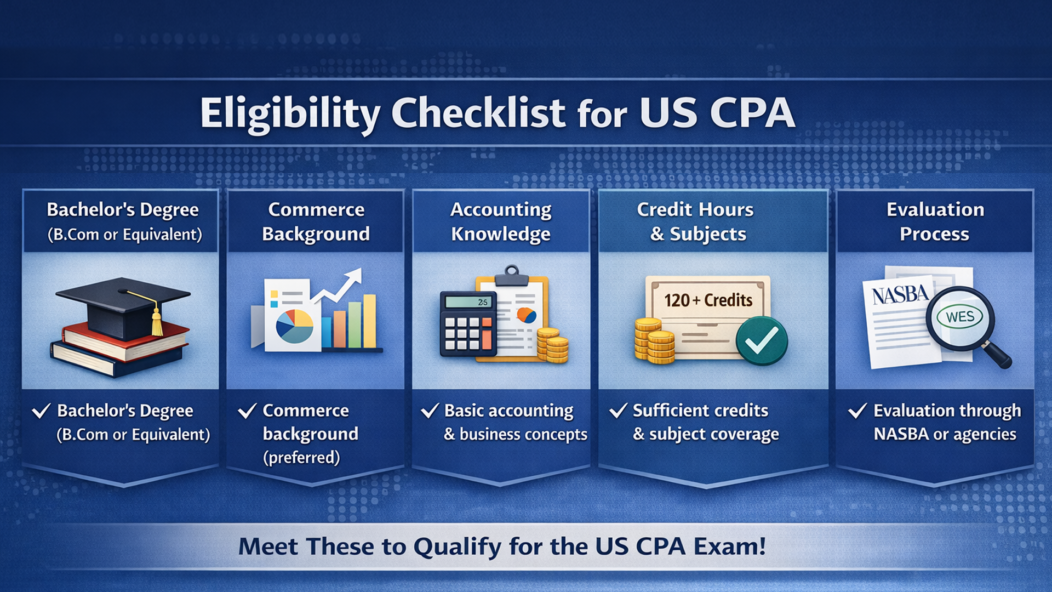
To pursue US CPA, the primary requirement is a Bachelor’s degree, such as B.Com or an equivalent qualification. However, unlike Indian courses, CPA eligibility is not based only on your degree; it depends on your total accounting credits and subject coverage. The CPA eligibility is evaluated through a credit hour system, followed by the US state boards of accounting. Typically, you need 90 to 120 credits to appear for the US CPA exam and licensure.
Here’s how credits are generally calculated:
- Each year of university education gives around 30 credits
- A 3-year Indian degree like B.Com usually provides around 90 credits
- Each subject contributes approximately 2.5 to 3 credits
This means many Indian students need additional credits or subject coverage, but they are often closer than they think.
How CS Background Helps
If you’ve studied CS, your background actually gives you an advantage:
- The CS Foundation and Executive levels build a strong base in commerce, law, and business concepts.
- When combined with a B.Com degree, most students either meet or come very close to CPA eligibility.
- Your understanding of corporate laws, ethics, and governance can also support certain CPA exam sections.
In many cases, CS students don’t need to start from scratch, they just need to align their existing education with CPA requirements.
Eligibility Exceptions and Flexibility
Even if you don’t fully meet the 120-credit requirement, you may still be eligible in certain cases. Some US state boards of accounting allow students to appear with lower credits (around 90) if they have strong subject coverage in:
- Accounting
- Business
- Economics
This is especially relevant for B.Com. and B.Com.(Hons.) graduates with accounting-focused subjects.
If there are gaps in your credits or subjects, you don’t need another full degree. Many students opt for a bridge course. A CPA Bridge Course is a short program designed to help you meet the required credit hours and subject criteria for the US CPA exam. It covers key areas like accounting, auditing, business, and related subjects to fill any academic gaps. The duration typically ranges from 6 to 9 months, depending on your existing qualifications. This course helps students in the following ways:
- Cover missing accounting or business subjects
- Meet eligibility requirements
- Save time instead of repeating years of study
Evaluation Process
Once your academic requirements are in place, your transcripts need to be evaluated by recognized bodies like NASBA or other approved evaluation agencies. This step ensures that your credit hours and subject coverage match US CPA requirements and determines your eligibility for the exam.
Important Clarifications
- CPA eligibility is credit-based, not experience-based
- Work experience helps your career, but not your exam eligibility
- You can appear for the exam at 120 credits and complete additional credits later for licensing.
Not sure if you’re eligible? Get a clear answer based on your profile in minutes.
CPA Exam Structure
The US CPA exam is divided into four sections, designed to test both technical knowledge and practical application skills.
- AUD – Auditing and Attestation
Covers auditing procedures, internal controls, ethics, and attestation engagements. This section focuses on understanding how audits are conducted and how financial information is verified.
- FAR – Financial Accounting and Reporting
Focuses on financial statements, accounting standards, and reporting frameworks. It is often considered the most comprehensive section as it tests core accounting concepts in depth.
- REG – Regulation
Covers US taxation, business law, and professional responsibilities. CS students often find parts of this section relatable due to their background in law and governance.
- Discipline Section – BAR or ISC or TCP
Candidates choose one discipline based on their interest and career goals:
- BAR – Business Analysis and Reporting
- ISC – Information Systems and Controls
- TCP – Tax Compliance and Planning
CPA Exam Format
The CPA exam is designed to test both conceptual understanding and real-world application. The format includes:
- Multiple Choice Questions (MCQs) -These assess your conceptual clarity and technical knowledge across topics.
- Task-Based Simulations (TBS) – Case-based questions that evaluate your ability to apply concepts in practical scenarios like financial analysis and problem-solving.
Passing Criteria
Each section of the CPA exam is scored on an adaptive scale of 0 to 99, where the scoring adjusts based on the difficulty level of questions. To pass, you need a minimum percentile of 75, which reflects competency across the section.
CPA Course Duration After CS Failure
One of the biggest advantages of choosing CPA after CS is the shorter and more structured timeline. Unlike traditional courses with fixed cycles, CPA allows you to progress at your own pace. A typical CPA course duration can look like this:
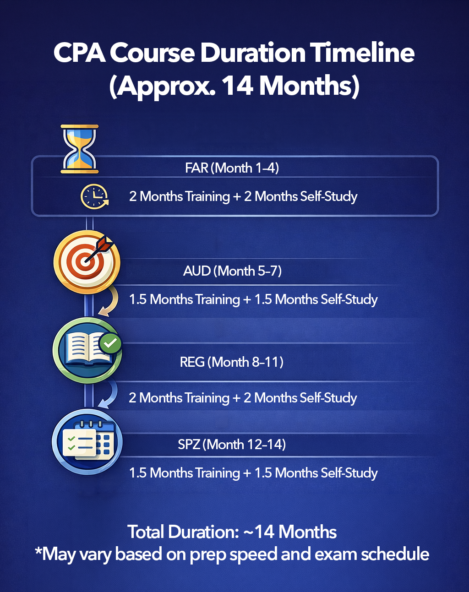
Most students complete the CPA within 12 to 18 months, and unlike many Indian professional exams, reattempts in the US CPA exam are very unusual. With the right preparation strategy, mentorship, and study plan, it is entirely possible to pass each section in a single attempt.
CPA Fees in India
Total CPA exam cost in India comes to approximately ₹3.6 to ₹3.7 lakhs, including one-time and all four exam fees. The US CPA Exam fees are divided into two main categories the one time fees which is ₹35,490 for one-time fees and ₹81,900 as per exam fees. A detailed breakdown of the same is as follows:
1. One-Time Fees
These are paid during the application process:
| Fee Type | USD | Approx. INR* | When to Pay | Whom to Pay |
| Evaluation Fee | $250 | ₹22,750 | Before CPA application (6–8 weeks) | NASBA (NIES), FACS, or WES |
| State Board Registration Fee | $140 | ₹12,740 | After evaluation approval (3–6 weeks) | Your State Board via NASBA |
| Total One-Time Fees | $390 | ₹35,490 |
*Prices converted at $1 = ₹91 (Jan 1, 2026) and may vary with exchange rates.
2. Per Exam Fees
These are paid each time you book or rebook an exam section:
| Fee Type | USD | Approx. INR | When to Pay | Whom to Pay |
| CPA Exam Section / NTS Fee | $390 | ₹35,490 | Each exam booking (usually 1 every 4 months) | CPA Exam Central |
| International Testing Fee (ITF)* | $510 | ₹46,410 | Paid with NTS / exam fees | CPA Exam Central |
| Total Per Exam Fees | $900 | ₹81,900 |
*All non-US candidates must pay the ITF. Prices converted at $1 = ₹91 (Jan 1, 2026).
CPA Salary & Career Scope
A CS qualification may initially lead to jobs mainly in corporate law, secretarial practice, and compliance, but the career progression may usually get stuck in India-focused regulatory roles with slow salary increments. On the other hand, a US CPA designation enables professionals to shift to worldwide finance, accounting, auditing, and advisory positions, which means higher earnings and quicker career growth. A CPA credential offers you the possibility to work in a variety of areas, such as Big 4 accounting firms, multinational company (MNC) finance departments, outsourcing hubs, investment and treasury, international tax, startups, and finance technology innovations, with pay that is far more generous than the usual CS path.
Here’s a clear snapshot of the opportunities and expected CPA salary in India:
Career Opportunities and Scope
| Industry Area | Key Area (India & Abroad) |
| Big 4 / Big 6 & Financial Services | Audit, Tax, Advisory, Risk, Consulting, Financial Reporting, Financial Planning & Analysis |
| Outsourcing & Global Capability Centers (GCCs) | Audit, Tax, Advisory, Risk, Consulting, Financial Reporting, Financial Planning & Analysis |
| Global Corporates & NYSE-Listed MNCs | FP&A, Accounting & Reporting, Management Accounting, Risk, Cost, Compliance, Controllership, CFO’s Office, Corporate Finance |
| Investment & Treasury | Investment, Risk, Treasury, Financial Planning, Management Accounting, Portfolio Advisory/Management, Corporate Finance |
| International Tax & Cross-Border Advisory | International Tax Consulting, Multijurisdiction Tax, Tax Planning, Transfer Pricing, Expat Tax Advisory, Global Mobility Specialist |
| Startups & Venture Capital (Mergers & Acquisitions) | FP&A, Accounting & Reporting, Management Accounting, Risk, Cost, Compliance, Controllership, CFO’s Office, Corporate Finance, Strategic Finance, Venture Capital, Business Finance Manager, Fund Analyst |
| Emerging Technologies in Finance | Fintech, Blockchain Audit, Data Analytics, Digital Audit, Information Systems Audit, RPA, RegTech, Agentic AI, Predictive Analytics, Automated Fraud Detection, Triple Entry Accounting, DeFi, Digital Currency |
US CPA Salary Ranges
| Location | Entry-Level | Mid-Level | Senior-Level |
| India | ₹7–12 LPA | ₹25–50 LPA | ₹51 LPA –1 Cr+ |
| GCC (UAE / Saudi Arabia) | AED 12K–20K per month | AED 20K–35K per month | AED 35K–50K per month |
| United States | $65K–$90K per year | $90K–$150K per year | $150K–$250K+ per year |
EduMont Expert Insights
Should You Quit CS for CPA?
While CS is a respected Indian credential, many students face practical limitations in terms of career growth and opportunities. Which is why CPA for commerce students feels intuitive and career-aligned. Some of the major reasons are as follows:
- Limited Career Scope – CS primarily prepares for India-focused regulatory and secretarial roles, which are niche and not in high global demand.
- Saturation and Low ROI – With fewer high-paying opportunities, the returns on 5–6 years of study can be low as compared to the effort invested.
- Obsolete Curriculum – The CS syllabus is heavily law-focused and does not align well with modern finance, accounting, or global business practices.
- Local Employment Only – Most CS roles are limited to India; unlike CPA, they don’t open doors to global companies or international finance roles.
- Time-Intensive – Completing CS takes 5–6 years, with repeated attempts common, making it a slower path than CPA.
- Low Advantage Over CA – CS does not offer the same statutory or audit authority as CA, and its relevance is often substitutable or overlapping with other credentials.
- Career Obsolescence Risk – Prolonged focus on CS without global exposure may slow career growth and reduce adaptability in international finance and accounting sectors.
Switching to US CPA provides a globally recognized qualification, faster completion (12-18 months), higher earning potential, and access to diverse international roles across finance, audit, tax, consulting, and emerging tech-driven sectors.
How EduMont Helps You Switch from CS to US CPA
You don’t need a CA background to start CPA. The accounting basics covered in CS are already a strong foundation, and even if you’re starting with just Class 11 and 12 fundamentals, you’re good to go. You don’t need CA-level depth because US GAAP is taught from scratch. At EduMont, training begins with the golden rules of accounting and builds up step-by-step, ensuring you’re fully prepared from the ground up.
Why Choose EduMont for Your Preparation
- Unlimited Access to UWorld Resources: Get unlimited access to printed books, eBooks, digital question banks, and unlimited mock tests to practice until you master every concept.
- Live Chalk-and-Talk Classes: Interactive traditional chalk and talk style bilingual teaching sessions designed for real-time doubt solving and deeper conceptual clarity.
- EduMont LMS Access: Pre-annotated EduMont’s own study material, class notes, and recorded lectures are available until you pass, so you can revise anytime.
- Certified Faculty-Led Training: Learn from experienced, dually qualified professionals led by Rohan Chopra, CPA, CMA, TEDx Speaker, along with other expert CPA faculty, ensuring high-quality mentorship.
- Personalized Mentorship and Safety Net System: Continuous progress tracking combined with one-on-one game plan calls ensures you attempt exams only when fully prepared, maximizing your chances of passing in one go.
- Pass-in-One-Attempt Approach: A structured strategy and guided preparation model designed to help you clear each section confidently without retakes.
- End-to-End Support: From eligibility evaluation and exam scheduling to career guidance and placement assistance, we have you covered throughout till you become a CPA.
- No-Cost EMI Options: Flexible payment plans are provided so finances never become a barrier to your CPA journey.
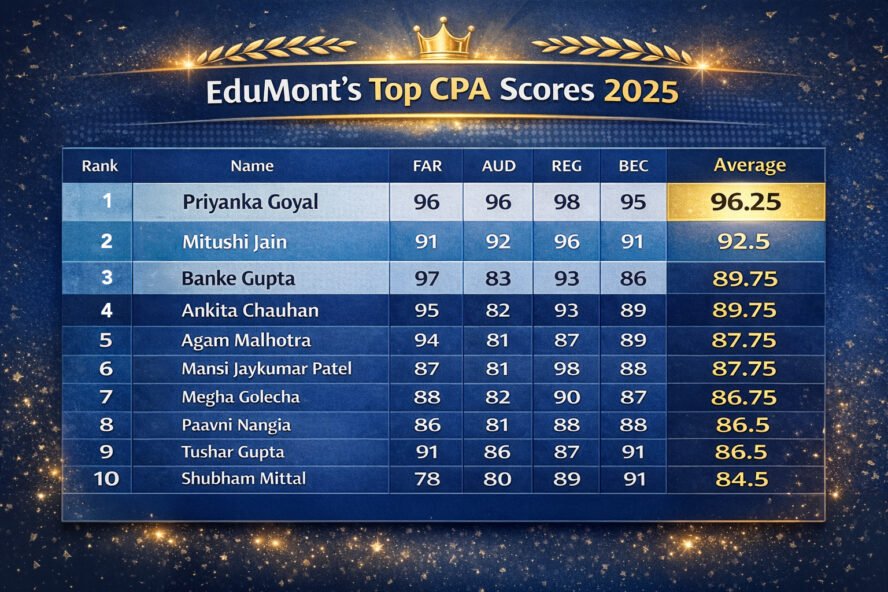
- Proven Legacy: Backed by over half a decade of consistent results and student success, EduMont has made a highly trusted name in the test-prep industry for US CPA in India.
Conclusion: Your Failure Is Not Your Final Direction
Failing CS is not the end of your career, it’s a moment of redirection. Choosing CPA after CS failure is not a fallback. What matters is choosing a path that aligns with your strengths, offers real growth, and opens global opportunities. The US CPA does exactly that. It is structured, faster, and built around practical finance skills that the industry actually demands today.
If you’ve been stuck in repeated attempts or feel your career is not moving forward, this is your chance to pivot with clarity. CPA is not a backup, it is a smarter, forward-looking decision for commerce students who want global exposure and strong career progression.
Still unsure where you stand? Get a clear answer based on your profile and take the first step with confidence.
Frequently Asked Questions
Q. Is CPA better than CS after failure?
CPA is a smarter choice if you want a finance, accounting, or global career. It suits commerce students more than law-heavy CS.
Q.Can CS Executive failed students do CPA?
Yes. Even if you failed CS, you can start CPA if you have a B.Com or equivalent
Q.Is CPA easier than CS?
CPA is more structured and practical, with MCQs and case-based questions. Many students find it easier than CS.
Q.What is CPA duration after CS failure?
It takes around 12 to 18 months on average, much shorter than CS
Q.Is CPA valid in India?
Yes. Indian companies, Big 4s, and MNCs value US CPA highly
Q.What jobs can CS students get after CPA?
Auditor, Financial Analyst, Tax Consultant, FP&A, Finance Manager, or global finance roles.