

US CPA registration from India follows a structured process, which a lot of applicants tend to make mistakes about. Such mistakes cost you wasted time, rejected applications, and even lost money, when you fail to apply correctly.
However, as long as you follow the correct process, the application process is relatively simple.
The complete CPA exam registration process from India has 8 steps:
- Before you apply: Confirm your eligibility (credit hours)
- Choose your US state board
- Get your Indian transcripts evaluated by an evaluating agency
- Apply to your state board and pay the registration fee
- Receive your Authorization to Test (ATT)
- Pay section fees to NASBA and receive NTS
- Schedule your exam at a Prometric centre in India
- Appear for the exam and track your score release
On average, the process of registering to sit for the CPA exam takes between 4 to 6 months. The longest of all processes is the transcript evaluation, which usually takes around 6 to 8 weeks to complete.
What Does the Registration Timeline Actually Look Like?
The CPA exam registration in India typically takes 4 to 6 months from when you decide to get the CPA to taking your first CPA exam. However, it all depends on how long it will take for your transcripts to be evaluated and when you schedule your exams after getting your NTS.
Below are the key steps involved in this process:
| Timeline | Phase | What to do | Time note |
| Week 1 | Eligibility & prep | Check eligibility with an expert, pick your State Board, request university transcripts. | Transcripts take ~2 weeks. |
| Weeks 2-8 | Credential evaluation | Submit documents to NIES, WES, or FACS. Most Indian candidates use NIES, since some state boards mandate it. Start studying while you wait. | ~6-8 weeks. The most critical step. |
| Weeks 8-12 | State Board application | Apply via the NASBA portal with your evaluation report. Pay the application fee. | A few weeks to process. |
| Weeks 12-14 | Receive ATT | Get your Authorization to Test. Verify your name and exam sections carefully. | ~2-4 weeks after applying. |
| Weeks 14-15 | Pay fees & get NTS | Pay section fees to NASBA and receive your Notice to Schedule. | NTS in 2–5 business days. |
| Weeks 15-16 | Schedule exam | Book your slot at a Prometric centre in India. | Book early, slots fill fast. |
| Months 4-6 | Take first exam | Sit for your first CPA exam section. | Scores in 7-10 days. |
Important note
Credential evaluation is the longest step in the process. Choosing the correct evaluation agency based on your state board is critical, as using the wrong one can lead to rejection and loss of fees.
STEP 1: Get Your Eligibility Confirmed Before Applying
Prior to beginning your US CPA registration process, it is important to check if you meet the required minimum number of credit hours. This is probably the biggest mistake that many candidates make that results in huge loss of time and resources.
Although the CPA credit hour requirements may differ from one US state board to another, the basic requirements are as follows:
- Minimum number of credit hours to be eligible to take the CPA exam: 120 US credit hours, including those for accounting
- Minimum number of credit hours to qualify for the CPA license: 150 US credit hours
How Do Indian Qualifications Convert to US Credit Hours?
Your Indian degree is evaluated and converted into US credit hours during the credential evaluation process. While the exact number varies, here is a practical estimate based on typical profiles:
| Qualification | Approx. US Credits | Eligible for Exam (120)? | Eligible for Licence (150)? |
| B.Com (3-year) | 90–105 | No | No |
| B.Com + M.Com | 120–140 | Yes | Usually yes |
| B.Com + CA (qualified) | 120–130 | Yes | Often yes |
| M.Com / MBA (Finance) | 120–150 | Yes | Yes |
| B.Com + CA Inter | 90–105 | Depends | No |
| 4-year degree (Engineering, etc.) + MBA | 150+ | Yes | Yes |
*These are indicative ranges. Your final eligibility depends on your credential evaluation report.
What This Means for Most Indian Candidates
- A 3-year B.Com alone is usually not enough to meet the 120 credit requirement
- Adding a postgraduate degree (M.Com or MBA) or completing CA can bridge the gap
- Candidates with CA qualification often meet the requirement, but this must still be verified through evaluation
If you fall short of 120 credits, you will need to complete additional coursework through a CPA bridge course or an equivalent academic programme.
The Importance of This Stage
Applying without checking your eligibility will result in:
- Being rejected by the state board
- Loss of application fees (non-refundable)
- A delay of many months
This stage tells you whether you qualify to move forward, which state to apply to, and whether you require any bridge course.
Important Point
Always verify your eligibility through a proper evaluation or a reliable eligibility check before proceeding to the next step.
STEP 2: How to Choose your US State Board of Accountancy
Selecting the appropriate state board is crucial at all stages of CPA registration. Although there are fifty-five jurisdictions in the US, the practical options available to Indians are very limited.
The state board that you choose decides whether you fit their criteria, whether you need to undergo evaluations and pay the relevant fees, and whether you will be allowed to register in the future.
The 3 factors that matter for Indian candidates
1. Requirement of SSN (Social Security Number)
Indian candidates do not usually possess the US Social Security Number.
- Some states require having an SSN to give the exam
- Other states require it just for licensure
- Still others don’t require it at all
If you apply to a state that requires an SSN at the wrong stage, your application may be rejected or you may not be able to get licensed later.
2. Credential evaluation agency (NIES, WES, FACS)
Not all state boards accept all evaluation agencies.
- Popular among Indian candidates states accept only NIES
- Other states require WES or FACS but not all of them
- Submission of an inappropriate report results in application denial
For this reason, many candidates choose NIES, as it is NASBA’s own evaluation service and is accepted across most relevant states.
3. Verification of experience (for licence)
Obtaining the licence requires 1 to 2 years’ work experience verification from a licensed CPA.
In the case of Indian candidates:
- Finding a US CPA supervisor can be difficult
- Some states offer flexibility (EVS or non-CPA supervisors)
- Others have stricter requirements
| State | SSN for Exam | SSN for Licence | Credits Required | Evaluation | CA Recognition | Experience Flexibility | Best For |
| Montana | No | Not mandatory (affidavit route) | 120 | NIES | Yes | EVS available | Most Indian candidates |
| Guam | No | No | 120 | NIES | Yes | Flexible | No SSN ever |
| Alaska | No | No | 120 | NIES | Verify | Moderate | Case-specific |
| Illinois | No | No | 120 | NIES | Yes | Non-CPA allowed | Indian supervisors |
| New York | No | Yes (for licence) | 120 | NIES (for exam) | Yes | Standard | Only if planning US move |
Alaska warning
Many older resources recommend Alaska for Indian candidates. However, recent changes in how CA credits are recognised have led to application rejections in some cases. Always verify eligibility through your evaluation report before applying.
Why Do Some States Not Work for Most Indians?
Some states cause needless trouble:
- Require SSN at the wrong stage
- Have restrictive or outdated credit recognition
- Do not accept commonly used evaluation agencies
Always verify current rules before applying, as requirements change over time.
Not sure which state fits your profile?
STEP 3: How to Get Your Transcripts Evaluated Through NIES, WES, or FACS
Credential evaluation is the stage at which your credentials earned in India are transformed into US credit hours. All applications are submitted through the NASBA registration process in India via the candidate portal.
It is the longest part of the entire registration procedure, usually taking about 6-8 weeks. This cannot be omitted or bypassed; it must be done at the right pace.
Which Evaluation Agencies Are Accepted?
There are three agencies that are usually chosen to evaluate CPA credentials:
- NIES (NASBA International Evaluation Services)
- WES (World Education Services)
- FACS (Foreign Academic Credential Service)
However, not all state boards accept all agencies. Some accept only NIES, which is why many candidates choose it to avoid compatibility issues.
How Does the Evaluation Process Work?
Evaluation body will:
- Obtain your transcripts directly from your university
- Translate you Credits into US credit hours
- Calculate your credit hours in accounting and total credits
- Issue a report to your chosen state board
This report becomes the basis for your eligibility.
What Documents Do You Need?
You will need:
- Official sealed transcripts from all universities attended
- Degree certificate
- Mark sheets (all semesters/years)
- Passport copy
Important: Transcripts must be sent directly by the university. Student-submitted or unsealed documents are rejected.
What Are the Fees and Timeline? (Typical Range)
| Service | Approx. Cost | Timeline |
| Standard evaluation | ~$200–$250 | 6–8 weeks |
| Expedited evaluation | ~$300–$350 | 3–4 weeks |
Costs vary slightly by agency and add-ons (such as additional state reports).
Common Mistakes Indian Candidates Make Here
- Wrong evaluation agency: Using WES/FACS for a state requiring NIES = automatic disqualification.
- Transcript issues: Only sealed, university-issued transcripts accepted. If you have degrees from multiple universities, all transcripts are required. Note: processing time varies across Indian universities.
- Delaying evaluation: Takes 1 to 2 months; a late start delays everything.
- Name discrepancy: Names must match exactly on transcripts, passport, and visa application.
- Single-name passport: Enter “NoLastName” in the surname field if your passport has only one name.
- Inactive application: Applications left idle too long may be closed without a refund.
Important note
Your evaluation report determines whether you are eligible to apply. Errors at this stage are difficult to fix later and often require restarting the process.
Start this step early and ensure all documents are accurate before submission.
STEP 4: How Do You Apply to Your State Board?
After your credentials evaluation is done and your report forwarded to the chosen state board, your next task will be submitting your application.
Here, you officially request permission to sit for the CPA exam.
How the Application Process Works
- Go to nasba.org → CPA Examination → Candidate Portal
- Select your chosen state board
- Create your NASBA candidate account
- Complete the application form with your academic and personal details
- Upload any required documents (varies by state – passport, degree certificate, etc.)
- Pay the state board application / registration fee
- NIES sends your evaluation report directly to the state board (you don’t need to submit it separately)
What Are the Application Fees? (2026 Estimates)
| State | Application Fee (2026 est.) |
| North Dakota | $100 |
| Washington | $96 |
| Alaska | $146 |
| Guam | $146 |
| Montana | $146 |
| Pennsylvania | $146 |
| Most states | $96 – $146 |
These application fees are non-refundable.
Common mistakes at this step
1. Applying before evaluation is complete
Without the correct evaluation report, you will face delays or rejection.
2. Selecting the wrong state
Based on outdated information or assumptions regarding credits’ eligibility, you risk a rejection after the payment.
3. Incorrect personal details
Incorrect spelling of your name in your application compared to the one in the passport can cause problems later when trying to schedule and take the test.
4. Missing required documentation
Some states require additional paperwork. Missing it means delaying your approval.
Important note
This step is straightforward if the earlier steps were done correctly. Most issues at this stage are not due to the application itself, but due to errors in eligibility confirmation or state selection.
Choosing the right state first helps avoid reapplication
[State selection guide]
STEP 5: How Do You Receive Your Authorization to Test (ATT)?
Once your application is approved, the state board issues your Authorization to Test (ATT).
This is the official confirmation that you are eligible to sit for the CPA exam.
What Does the ATT Include?
Your ATT includes:
- Your name (according to your application)
- Sections chosen for the exam
- Validity of ATT
You need this document to move forward with fee payment and scheduling.
How Long Is Your ATT Valid?
The ATT is valid for a limited period, typically 6 to 9 months, depending on the state board.
During this period, you will be required to:
- Pay for your exam sections
- Get your NTS
If your ATT expires before you complete these steps, you may need to reapply and pay application fees again.
What Should You Check Immediately After Receiving Your ATT?
As soon as you receive your ATT, verify the following:
1. Name accuracy
Your name must match your passport exactly. Even small differences can create issues later during exam scheduling or at the test centre.
2. Exam sections
Ensure the sections you applied for are correctly listed.
3. Expiry date
Note the expiry date and plan your next steps accordingly. Delays at this stage can affect your entire timeline.
Common Mistakes to Avoid
1. Ignoring name mismatches
Candidates often notice name differences too late. Corrections take time and can delay scheduling.
2. Missing the validity window
Waiting too long after receiving ATT can push you into reapplication and additional fees.
Important Note
You do not use the ATT to schedule your exam, but it is needed for the next phase. Consider this as an intermediary stage; in case there are any discrepancies, make corrections right away.
STEP 6: How Do You Pay NASBA Section Fees and Receive Your NTS?
With your ATT issued, you can now pay the NASBA exam section fees. After payment, NASBA issues your Notice to Schedule (NTS), which allows you to book your exam at a Prometric test centre.
You do not need to pay for all 4 sections at once. Many candidates pay for 1–2 sections at a time to manage both cost and preparation. A common approach is to start with FAR.
2026 NASBA Exam Fees: India-Specific Breakdown
| Fee component | Per section (USD) | Per section (INR ~) | Fee component |
| CPA exam section fee | $390 | ₹35,490 | CPA exam section fee |
| International testing fee | $510 | ₹46,410 | International testing fee |
| Total per section | $900 | ₹81,900 | Total per section |
2025 Surcharge Update: Critical
NASBA increased the international testing surcharge to $510 per section.
This now forms the bulk of the total expenditure for Indians. Taking all four sections together, the surcharge comes out to be around ₹1.85 lakh. Please ensure you verify the latest fee schedule prior to your budgeting.
What You Need to Know About Your NTS
- Validity: Usually six months (may vary from state to state)
- Number of Sections in NTS: Each transaction will result in a different NTS
- Needed to schedule your test: You cannot do so without having an NTS.
- No refunds: Paid amounts are not refundable at all
- Matching name: Your NTS name should exactly match your passport name
STEP 7: Schedule Your Exam At a Prometric Test Centre in India: Everything you need to know
Now that you have your NTS, you can proceed with scheduling your test. This process will be done using the Prometric website and usually lasts for less than 10 minutes.
Please note that availability depends on your location, and appointments in popular cities get filled up quickly. Scheduling your test immediately after obtaining your NTS is recommended.
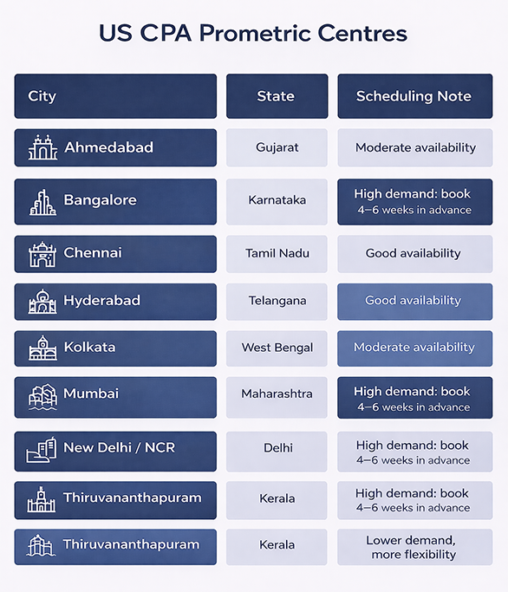
Which Cities in India Have Prometric Test Centres for the CPA Exam?
CPA exam centres in India are available in multiple cities, including:
How Do You Schedule Your Exam?
- Visit the Prometric CPA scheduling website
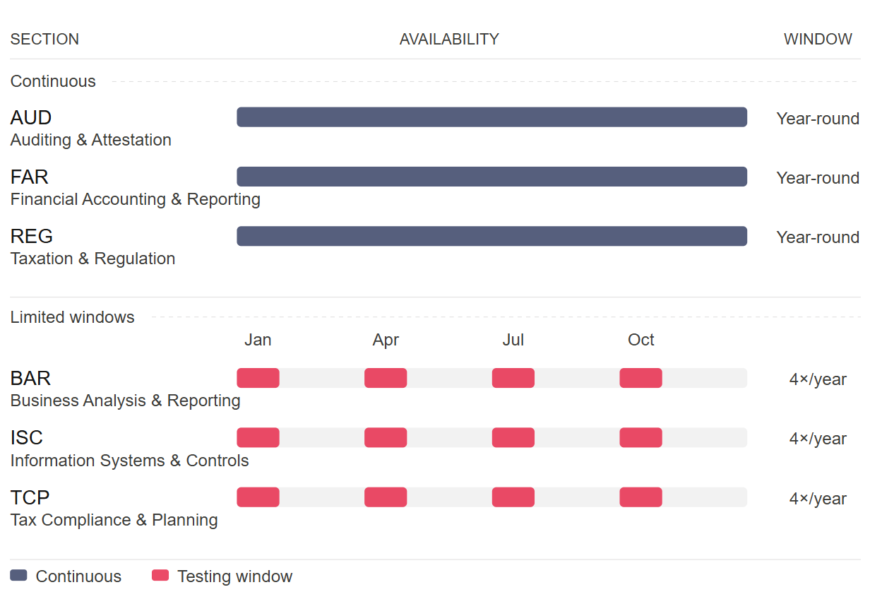
- Choose the exam part you wish to sit for (AUD, FAR, REG, or discipline)
- Type in your Notice to Schedule (NTS) number
- Select your country of choice: India
- Pick your test center, date, and time
Important Note
After you have cleared your first section of the CPA Exam, a 30-month time period starts.
You need to clear the other three sections during this time otherwise your first cleared section will expire and you will have to appear for it again.
STEP 8: What Happens on Exam Day and After?
Once your exam is scheduled, the remaining steps are straightforward. However, small errors on exam day can prevent you from taking the test, so it is important to follow the requirements carefully.
What Should You Bring on Exam Day?
- Primary ID: Passport (mandatory for international candidates)
- Secondary ID: Aadhaar card, PAN card or driving licence
- NTS copy: Printed or digital
Exam Day Guidelines
- Be there 30 minutes prior to your allotted time
- Late entry may not be allowed, and fees are not refunded
- Personal items such as phones, bags, watches and notes are not allowed inside the exam room
- Lockers are available at the testing center
When Are Scores Released?
CPA exam scores are released by NASBA on a rolling basis.
- Typical timeline: 7 to 10 days after the exam
- Passing score: 75 (on a scale of 0-99)
Exact release dates depend on the testing window.
Once you pass your first section, you have 30 months to pass the remaining three sections. If you do not complete all sections within this period, your earliest passing score expires.
COMPLETE COST SUMMARY: How Much Does CPA Registration from India Cost in 2026?
The table below consolidates all the major costs involved in the CPA registration process for Indian candidates. This uses Montana as a reference state, as it is the most commonly chosen.
The total cost of US CPA registration from India includes:
Category A: One-Time Fees
| Fee Type | USD | INR (~) | When to pay |
| Evaluation fee (NIES / WES / FACS) | $250 | ₹22,750 | Before application |
| State board registration fee | $140 | ₹12,740 | After evaluation |
| Total one-time fees | $365 | ₹33,215 | – |
Category B: Per Exam Fees
| Fee Type | USD | INR (~) | When to pay |
| CPA exam section / NTS fee | $390 | ₹35,490 | When booking each exam |
| International testing fee | $510 | ₹46,410 | Along with exam fee |
| Total per exam | $900 | ₹81,900 | – |
Total exam cost (all 4 sections)
| USD | INR (~) | |
| 4 exam sections | $3,600 | ₹3,27,600 |
Total Exam Cost (All 4 Sections)
| USD | INR (~) | |
| One-time + exam fees | $4,055 | ₹3,60,815 |
Important notes
- Exchange rate used: $1 = ₹91 (as of Jan 2026)
- Costs may vary slightly based on state board and exchange rate fluctuations
- All fees are non-refundable once paid
How EduMont Supports Your CPA Registration
The CPA registration process is straightforward once the sequence is clear, but most errors happen in eligibility checks, state selection, and documentation.
EduMont supports candidates at each stage to reduce these risks and ensure the process moves without delays.
1. Eligibility clarity
Before you begin, your profile is evaluated to determine whether you meet the credit requirements and what gaps, if any, need to be addressed.
This avoids unnecessary applications and helps you plan the right pathway from the start.
2. State board selection guidance
Choosing the correct state board is critical. Based on your qualifications, work plans, and SSN status, guidance is provided on which state aligns best with your profile.
This helps prevent rejections and avoids loss of application fees.
3. Credential evaluation support
From selecting the right evaluation agency to preparing and submitting documents, you are guided through the evaluation process.
This includes handling common issues such as multiple universities, document formats, and name consistency.
4. Application and documentation support
The state board application process is reviewed step by step to ensure accuracy in personal details, document submission, and fee payment.
This reduces the chances of delays or rejection due to errors.
5. Attempt planning and exam strategy
Once your NTS is issued, guidance is provided on when to schedule your exam and how to plan your attempts within the validity window.
The focus is on aligning preparation with timelines to avoid expiry of fees.
Student Insight
Most students that begin the process independently experience delays because of incorrect state selections or errors in evaluation. With structured guidance, these steps are completed correctly the first time, allowing them to focus on preparation instead of rework.
Important Note
The registration process cannot be cut short by any means. It requires a sequence of events and proper documentation. With the proper guidance, it is easy to go through the process.
If you want clarity before starting, begin with an eligibility check and a clear plan.
Conclusion
Registering for the US CPA exam from India is a structured process, but it requires careful execution at each step. In most cases, failure is not caused by complexity; rather, it results from wrong steps in the sequence, incorrect state selection, and wrong documentation.
Once you understand the process, the path becomes predictable. The key is to approach each stage with clarity, verify requirements before acting, and avoid rushing into applications without preparation.
FAQs
Q. How long does CPA exam registration take from India?
The full CPA exam registration process typically takes 4 to 6 months from decision to sitting your first exam. The longest step is credential evaluation (usually through NIES), which takes 6-8 weeks. Starting this early helps avoid delays while you prepare other documents and select your state board.
Q. Which US state is best for CPA registration from India?
Montana is the most commonly chosen state for Indian candidates in 2026. It does not require an SSN for the exam, accepts NIES evaluation, recognises Indian CA qualifications, and offers flexible experience verification. Guam is a suitable option if you do not plan to obtain an SSN at any stage.
Q. Do I need a Social Security Number to register for the CPA exam from India?
No, if you choose the right state. States such as Montana, Guam, Alaska, and Illinois do not require an SSN to sit for the exam. Some states may require an SSN later for licensure, so your long-term plans should guide your choice.
Q. Can I take the CPA exam in India without going to the US?
Yes. The CPA exam is conducted at Prometric test centres across India, including Ahmedabad, Bangalore, Chennai, Hyderabad, Kolkata, Mumbai, Delhi NCR, and Thiruvananthapuram. You can complete the entire exam process from India.
Q. What is NIES and why do I need it?
NASBA International Evaluation Services (NIES) converts your Indian academic records into US credit hours. State boards use this to determine if you meet the 120-credit requirement. Many states preferred by Indian candidates accept only NIES, which is why it is commonly used.
Q. How much does CPA registration from India cost in total?
The total registration cost is approximately ₹3.5–3.6 lakh for all four sections. This includes evaluation, state registration, exam fees, and international testing charges. Coaching and study material costs are additional.
Q. What is the NTS and how long is it valid?
NTS (Notice to Schedule) is issued after you pay exam section fees and is required to book your exam. It is typically valid for 6 months. If it expires before you schedule or attempt the exam, the fees are forfeited.
Q. Can I register for CPA after B.Com in India?
A 3-year B.Com usually provides 90–105 US credits, which is below the 120 required to sit for the exam. You can bridge this gap through additional qualifications such as M.Com, CA, or a bridge course. Final eligibility must be confirmed through credential evaluation.
Q. What happens if I fail a CPA exam section?
You can retake the section by paying the exam fee again and receiving a new NTS. There is no limit on attempts. However, once you pass your first section, a 30-month window begins to complete the remaining sections.
Q. Can I change my US state board after I’ve already applied?
Yes, but it involves additional time and cost. You will need to submit a new application and pay the state fee again. Your evaluation report can usually be forwarded to another state for an additional fee, depending on the evaluation agency.