

Accounting Qualifications After CA: CPA, CMA, ACCA & More
For most professionals, becoming a Chartered Accountant represents a high level of technical expertise, discipline and professional credibility. However, for many Chartered Accountants, this soon becomes a new question: what’s next?
As businesses become more global and finance roles more specialised, many CAs choose to build on this foundation with additional qualifications. Be it working with US GAAP, strategic finance, or global audits, additional qualifications are increasingly becoming a formal way of adding to the credibility of a CA.
The right course after CA is not about acquiring another certification. It is about ensuring that you are aligning your skill set with the direction in which the industry is moving and the direction in which you want to move.
In this blog, you get a comprehensive breakdown of the top accounting and finance qualifications after CA, including CPA, CMA, ACCA, CFA and EA, with clear comparisons across eligibility, duration, career scope and salary impact to support a well-informed career decision.
Why Pursue Further Qualifications after CA
While CA is a strong foundation in accounting, taxation and compliance, there are many reasons why one may want to add another qualification to their existing CA certification.
1. Global Exposure: CPA and ACCA designations are grounded in international frameworks such as US GAAP and IFRS, respectively, making it easier to work on global projects and roles.
2. Specialization: Each of these credentials serves as a stepping stone to a particular type of role:
- CPA: Global accounting, audit, tax & advisory, US GAAP-based financial reporting
- CMA: Strategic finance, financial planning and analysis (FP&A)
- CFA: Investment and analytical roles in finance
- ACCA: IFRS-based accounting and audit roles
- EA: US taxation and compliance
3. Career Advancement: At senior levels, expectations shift from execution to decision making. Additional qualifications help signal domain depth and readiness for leadership roles.
4. Role Alignment Matters: Not every CA needs an additional qualification. The decision should depend on the role you are targeting. A well-aligned qualification can support that transition. Without a clear intent, it adds limited value.
Top Accounting & Finance Qualifications After CA-Overview
| Qualification | Best Suited For | Typical Career Direction | Global Relevance |
| CPA (US) | Audit, US GAAP, Tax & Advisory, financial reporting | Big 4, GCCs, Consulting firms & MNCs in India/USA/CA/UAE/AUS/NZ | High (recognised in over 150+ countries) |
| CMA (US) | Cost management, FP&A, corporate finance | FP&A, controllership, leadership roles | High |
| EA (US) | US tax compliance and advisory (not a substitute for CPA) | Tax outsourcing firms, compliance, IRS representation | Moderate (US-focused) |
| ACCA (UK) | IFRS, accounting for MNCs with European operations | IFRS-based audit, advisory, compliance roles | High (IFRS-focused, primarily European/international) |
| CFA | Finance, investments, portfolio analysis | Equity research, asset management, investment banking | High (investment/finance globally) |
Book a free counselling session for deciding your next career move today!
Global Career Pathways after CA
1. CPA After CA
- The CPA (Certified Public Accountant) designation is one of the most comprehensive and globally recognised accounting qualifications a CA can pursue. It covers US GAAP, International Auditing & Attestation Standards, US federal taxation, business environment, and financial reporting – making it highly relevant for professionals targeting global accounting, audit, tax and advisory, and compliance roles.
- For CAs, CPA serves as a natural extension of existing knowledge. The designation does not require a shift in focus from the subjects of Finance & Accounting, making it an excellent choice for those seeking to build global accounting careers after CA.
- For most Chartered Accountants, the eligibility requirements can be fulfilled with ease through credential evaluation. With proper focus and discipline, all four sections can be completed within 12-18 months, making it one of the most time-efficient accounting designations after CA.
- Common roles for CPA professionals include US financial reporting, audits of US-listed companies, SOX reporting, internal audits, tax advisory, and risk advisory. CPA is in high demand across Big 4 organisations, GCCs (India), consulting firms, and MNCs operating in India/USA/CA/UAE/AUS/NZ.
2. CMA After CA
- The CMA (Certified Management Accountant) is another relevant qualification for Chartered Accountants targeting careers in corporate finance and strategic roles. It marks a deliberate shift from conventional accounting and compliance work to business finance and financial leadership.
- For Chartered Accountants, CMA represents a transition to more strategic and decision-oriented work. This is why many consider CMA after CA when targeting roles in financial planning & analysis (FP&A), budgeting & forecasting, performance management, transfer pricing, costing, and financial strategy within multinational organisations.
- A majority of CAs meet the eligibility requirements for CMA. With proper preparation and dedication, the course can typically be completed within 6 to 9 months, making it one of the more time-efficient designations for practising finance professionals.
- Key positions for CMA graduates include FP&A, corporate finance, budgeting, cost management, and business strategy roles. CMA professionals are valued across corporates and MNCs, supporting strong career growth after CA, especially in decision-making and leadership-oriented positions.
3. EA After CA
- The EA (Enrolled Agent) designation is a specialised qualification in the field of US taxation. It covers tax compliance, tax filing, and advisory services under the US tax system. It is important to understand the scope clearly: EA is a narrowly defined qualification focused exclusively on US taxation.
- CPA also covers US taxation as part of its broader curriculum. EA is the right choice specifically for CAs whose career focus is entirely on US tax outsourcing, compliance, and advisory services, rather than on broader accounting or audit responsibilities.
- All CAs meet the eligibility requirements for EA without additional academic barriers. With focused preparation, EA can be completed within 3 to 6 months, making it one of the quickest qualifications a CA can add to their profile.
4. ACCA After CA
- The ACCA (Association of Chartered Certified Accountants) qualification is another relevant option for CA professionals, particularly for those seeking to develop expertise in International Financial Reporting Standards (IFRS). It is a good option for working in MNCs operating in, or reporting under, European or IFRS-based frameworks.
- For Chartered Accountants, the ACCA designation provides exposure to International Financial Reporting Standards (IFRS), which is important for organisations that use IFRS-based reporting. It is sought by CAs targeting international audit, IFRS-based financial reporting, and roles in MNCs with European operations or global IFRS reporting requirements.
- CAs are eligible for multiple paper exemptions under the ACCA framework, which reduces the number of exams required. With this advantage, it is possible to complete the remaining exams within 3 to 4 years of focused preparation.
- Common roles include IFRS-based financial reporting, audit, compliance, and accounting functions within MNCs with international or European operations. ACCA qualified professionals find their strongest demand in organisations that operate under IFRS frameworks.
5. CFA After CA
- CFA (Chartered Financial Analyst) is a specialised finance qualification that CAs may pursue if they are seeking a shift to one of the field of finance which is investment analysis, and capital markets.
- The CFA programme requires clearing 3 levels, which typically takes 2-4 years depending on examination schedules and preparation time. It is one of the more demanding qualification pathways, particularly due to its depth in investments, valuation, and financial markets.
- Equity research, portfolio management, investment banking, and financial analysis are the primary career paths for CFA professionals. CFA holders are highly valued in investment firms, asset management companies, and financial institutions.
CPA vs CMA vs EA vs ACCA vs CFA-Detailed Comparison
| Factor | CPA | CMA | EA | ACCA | CFA |
| Primary Focus | Accounting, Audit, US GAAP, Tax & Advisory | Corporate Finance, FP&A | US Taxation (specialised) | IFRS, European/International Accounting | Finance, Investments, Portfolio Management |
| Best For | Global audit, reporting, tax advisory (Big 4, GCCs, MNCs) | Business finance & strategy (corporates, FP&A) | US tax compliance & advisory (outsourcing, IRS) | IFRS-based roles in MNCs with European operations | Investment & analytical roles (asset mgmt, equity research) |
| Duration | 12–18 months | 6–9 months | 3–6 months | 3-4 years | 2–4 years (3 levels) |
| Difficulty | High | Moderate | Moderate | Very High | Very High |
| Approx. Fees | ₹2.5–4L | ₹1.5–2.5L | ₹0.8–1.5L | ₹1.8–3L | ₹2.5–4.5L |
| Global Scope | High (US + 150 countries via MRA) | High (corporate worldwide) | Moderate (US-focused) | High (IFRS in 150+ countries) | Very High (investments globally) |
| Career Direction | Big 4/6 audit, SEC reporting, tax advisory, controllership | Corporate FP&A, treasury, strategy | US tax compliance, IRS representation, outsourcing | IFRS reporting, international audit, advisory | Portfolio mgmt, equity research, investment analysis |
Each qualification serves a different purpose. The right choice depends on whether your focus is accounting, corporate finance, finance/investments, or taxation, and the specific roles you want to move into.
Too confused to choose the right career?
Contact Us
Other Accounting & Finance Certifications After CA
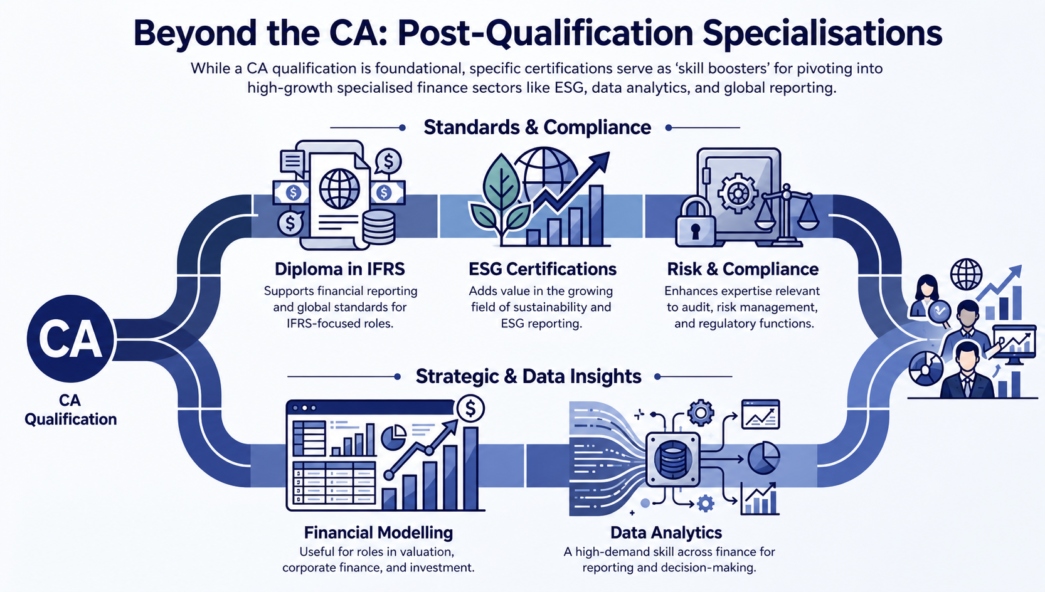
*While these certifications can be beneficial, they should only be pursued in alignment with your defined career goals.
Eligibility & Exemptions for CAs
One of the key advantages for Chartered Accountants is the eligibility and exemption benefits available across most global qualifications. This reduces both the time and effort required compared to starting from scratch.
- For CPA and CMA, CAs meet the eligibility requirements through credential evaluation, making the application process relatively straightforward.
- For ACCA, CAs are eligible for multiple paper exemptions, which significantly reduces the number of exams required and enables faster completion.
- For CFA, there are no subject-wise exemptions. However, CAs benefit from a strong foundation in accounting and finance that supports preparation for the CFA curriculum.
- For EA, there are no formal academic eligibility barriers or exemptions. The exam is accessible to all CAs, though it focuses specifically on the US tax system.
Overall, the CA qualification provides a clear advantage in terms of faster pathways and better alignment with advanced accounting and finance concepts, though the extent of these benefits varies by qualification.
Salary & Career Impact After CA + Qualification
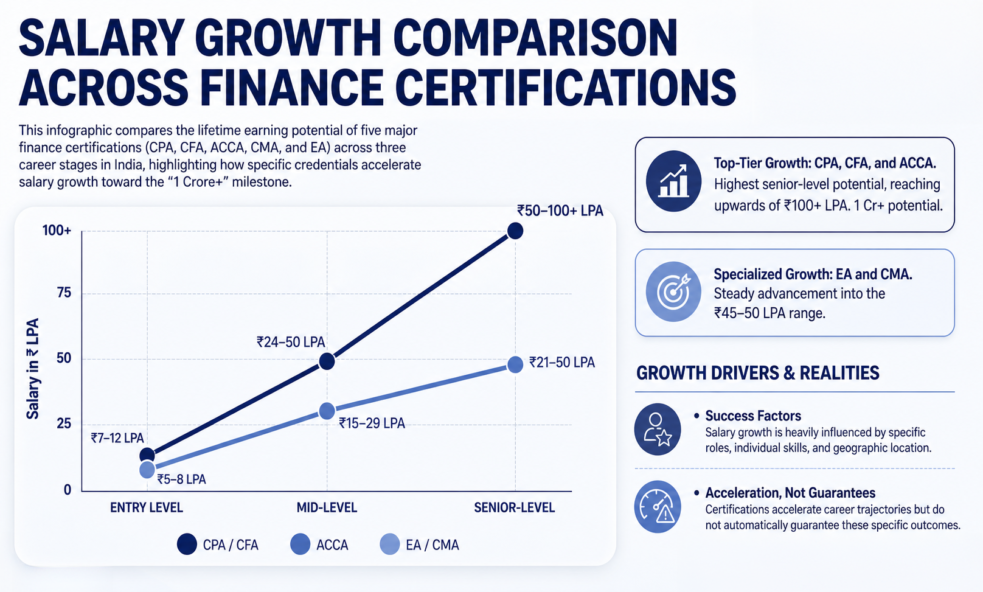
A CA qualification already provides a strong foundation for earning potential. However, CPA salary for CA professionals can see significant long-term growth with an additional global qualification, as it influences the nature of the role, international exposure, and overall career trajectory, rather than delivering an immediate salary jump alone.
What Actually Drives Salary Growth
Additional qualifications open doors to more specialised roles, but sustained salary growth is driven by:
- Role specialisation and domain depth
- Type of organisation (Big 4, MNC, consulting firm, investment firm)
- Experience and performance record
- Exposure to high-value or international assignments
A qualification creates the access point. Sustained salary growth requires ongoing skill development, strong delivery, and meaningful professional growth.
Salaries in India depend on the role, organisation type, and level of experience. The following table provides indicative salary ranges based on qualification and role type:
| Qualification | Typical Roles | Entry Level (₹ LPA) | Mid-Level (₹ LPA+) | Senior-Level (₹ LPA+) |
| CPA | US Audit, Financial Reporting, SOX, Tax and Advisory | 7–12+ | 24-50+ | 50-1+ Cr |
| CMA | FP&A, Corporate Finance, Strategy | 6-8+ | 15-21+ | 21-50+ |
| ACCA | IFRS Reporting, Audit, MNC roles | 7–10+ | 24-50+ | 50-1+ Cr |
| CFA | Equity Research, Investment Analysis | 7-12+ | 24-50+ | 50-1+ Cr |
| EA | US Tax, Compliance, Advisory | 5-7+ | 19-29+ | 29-45+ |
These figures are indicative and vary based on company type, city, and individual performance. At entry level, the qualification may not immediately change salary. The impact becomes more pronounced as professionals advance into specialised or managerial roles.
Expert Note: Which Qualification Is Best After CA?
According to our chief mentor, Rohan Chopra (CPA, CMA, TedX Speaker, Ex-EY professional), the right qualification after CA depends on the specific role you are targeting, not on which course appears more popular or prestigious.
- For professionals targeting global accounting, audit, and tax advisory roles, CPA is the most aligned qualification. It covers US GAAP, International Auditing Standards, and tax and advisory areas that are actively sought by Big 4 firms, GCCs in India, and MNCs across India/USA/UAE/AUS/NZ.
- For those looking to move into corporate finance and strategic decision-making roles, CMA is better suited. It focuses on financial planning, performance management, and business strategy rather than reporting and compliance.
- For CAs targeting IFRS-based accounting roles in MNCs with European operations or international IFRS reporting requirements, ACCA is a relevant option.
- For CAs seeking to transition into finance and investment-related roles, equity research, portfolio management, or investment analysis, CFA is the appropriate qualification. This represents a deliberate and clear shift away from core accounting into market-oriented finance.
- For roles focused exclusively on US taxation, particularly in outsourcing and compliance firms, EA offers a direct and specialised pathway. It is worth noting that CPA also covers US taxation and advisory. EA is specifically for those whose entire career focus is on US tax compliance.
The key mistake many professionals make is pursuing multiple qualifications without a clear direction. A strategically well-aligned qualification accelerates career growth. An unplanned one adds cost and effort without meaningful impact.
How EduMont Helps Your Journey to Become a CPA, CMA, and EA
Once a CA has decided to pursue an additional designation such as CPA, CMA, or EA, the next step is to understand the process of obtaining the qualification and preparing for the exams in an organised manner.
Global designations involve multiple steps before a professional becomes licensed. These include eligibility evaluation, exam registration, scheduling, and structured preparation. Without proper guidance, this process can become complicated and time-consuming.
- Unlimited Access to UWorld Resources: Students benefit from unrestricted access to UWorld’s printed study materials, eBooks, digital question banks, and unlimited mock exams, enabling efficient learning and practice until mastery is achieved.
- Live Chalk-and-Talk Classes: Interactive sessions allow for real-time doubt resolution, helping students grasp complex concepts effectively and clarifying any queries immediately.
- EduMont Learning Management System (LMS) Access: Candidates can access pre-annotated, highlighted study materials, class notes, and recorded lectures, with availability continuing until they successfully pass the exam.
- Certified Faculty-Led Training: Instruction is delivered by dually qualified & highly experienced professionals, lead by Mr. Rohan Chopra, CPA, CMA, TEDx speaker, as well as other expert CPA faculty including Mr. Paras Batra, CA, CPA; Mr. Shubham Shandilya CPA and Mr. Parth Zaveri, CPA, MBA; ensuring high-quality teaching and guidance.
- Safety Net System: EduMont tracks candidate progress continuously and offers intervention and personalized support. This ensures candidates attempt each CPA section only when fully prepared, maximizing the likelihood of success.
- Personalized One-on-One Game Plan Calls: One-on-one mentorship sessions to evaluate each student’s preparation, customize their exam strategy, and provide guidance designed to help candidates pass without needing retakes.
- Pass-in-One-Attempt Formula: The Safety Net System & one-on-one game plan calls underpin this promise, giving students confidence in their preparation and approach.
- End-to-End Support: EduMont assists students throughout the entire CPA journey, from eligibility checks and scheduling exams to career guidance and placement support, ensuring a smooth path from preparation to licensure.
- No-Cost EMI Option: Flexible payment options are provided to ensure that financial constraints never hinder learning, making world-class CPA preparation accessible to everyone.
- Half a decade of Legacy: Backed by over half a decade of proven excellence, EduMont has empowered CPA aspirants with exam-focused preparation, expert mentorship, and consistent results, making it a trusted name in US CPA training.
Conclusion
Selecting the right accounting or finance qualification after CA is not simply about acquiring another credential; it is about defining and committing to a clear career direction. Each qualification serves a distinct purpose: CPA for global accounting, audit, and tax advisory; CMA for corporate finance and strategy; ACCA for IFRS-based roles; CFA for finance and investment careers; and EA for US taxation.
The best qualification for you is the one that aligns with the specific roles you are targeting and the career direction you want to build over time.
It is also worth recognising that in a rapidly evolving finance and accounting landscape, staying current matters. Rather than remaining complacent, pursuing purposeful upskilling – whether through a structured certification or domain-specific learning consistently opens better opportunities and supports long-term career growth.
With the right clarity of thought and a structured preparation strategy, an additional qualification can meaningfully strengthen your profile and create access to more specialised, rewarding opportunities.
FAQs
1. Which is the best qualification after CA?
There is no single best option. The right qualification depends on your career direction. CPA and ACCA suit global accounting roles, CMA fits corporate finance, CFA aligns with investment roles, and EA is focused on US taxation.
2. Is CPA worth doing after CA?
CPA can be highly valuable for CAs targeting global accounting, audit, tax advisory, and US-based roles. It adds strong relevance in US GAAP, SOX compliance, and multinational environments.
3. Does CMA add value after CA?
Yes, CMA is useful for CAs looking to move into corporate finance, FP&A, and business decision-making roles. It shifts the focus from reporting & compliance work to strategy & decision making.
4. Which qualification gives the highest salary after CA?
Every qualification is equally rewarding, based on your interest and p0otential as for the salary, it depends more on your prior experience, role and the industry than the qualification itself.
5. Can a CA work abroad with CPA?
Yes, CPA improves global mobility, especially for roles in accounting, audit, advisory, tax advisory & planning, and compliance. Opportunities depend on experience, location, and work eligibility.
6. Is ACCA useful after CA?
ACCA is useful for CAs targeting IFRS-based roles and international accounting careers, particularly in MNCs with European operations or IFRS reporting requirements.
7. Is EA a good option after CA?
EA is a reasonably good option for CAs focused exclusively on US taxation. It is most relevant for roles in US tax compliance, advisory, and outsourcing firms handling US clients. Note that CPA also covers US tax; EA is for those with a specific, exclusive focus on US tax.
8. Should I do multiple courses after CA?
Pursuing multiple qualifications without a clear goal can lead to overlap without added value. However, they can work well for you if you plan and strategise your preparation smartly.