

Most CPA candidates focus on total credit requirements like 120 or 150 credits. But many applications get delayed or rejected for a different reason. They don’t meet the required number of accounting-specific credits.
This is one of the main sources of confusion. Total credits, accounting credits, and business credits are often treated as the same, but they are different, and each is evaluated separately by the US State Boards of Accountancy.
Accounting credits for CPA refer to the specific semester hours of accounting coursework, such as financial accounting, auditing, taxation, and cost accounting, that US state boards of accountancy require candidates to complete before sitting for the CPA exam or obtaining licensure. Most states mandate between 24 to 30 and more (state specific) accounting-specific credit hours. These are measured as accounting semester hours for CPA eligibility by state boards.
This guide answers one key question: how many accounting credits for CPA are actually required, what counts as accounting courses, state-by-state variations, and how Indian degree programs qualify.
KEY TAKEAWAYS
- Most US states require 24 to 30 accounting credits for CPA eligibility, separate from the total 120 or 150 credit requirement
- Accounting credits, business credits, and total credits are evaluated separately by state boards
- Core subjects like financial accounting, auditing, taxation, and cost accounting typically count toward accounting requirements
- Many states require upper-level accounting courses, not just introductory subjects
- A 3-year B.Com degree normally doesn’t fulfill accounting credit requirements alone
- Your transcript is individually evaluated subject-wise, not according to degree
- Lack of accounting credits is one of the biggest reasons for CPA eligibility denial
CPA Accounting Credit Requirements – The Standard Explained
Most US states require a specific number of accounting credits, separate from total education requirements, to qualify for the CPA exam or licensure. In most cases, this ranges between 24 and 30 semester hours in accounting-related subjects.
What Is the Typical Accounting Credit Requirement for CPA?
Most states require 24 credit hours in accounting for CPA. This is based on the National Association of State Boards of Accountancy (NASBA) guideline followed by a majority of jurisdictions.
There are also some states that have more rigorous requirements for the number of credits in accounting:
- States like Maryland require 30 accounting credits to be eligible for CPA
- New York will soon be tightening the credit requirements in accounting by 2027
It is crucial to note that these credits must necessarily be in accounting courses only. They cannot be in any other business-related subject, and simply having the required number of credits (120 or 150) does not mean you fulfill the accounting requirement.
What Is the Difference Between Accounting Credits and Total Credits?
This is one of the most common areas of confusion.
- Total credits (120 or 150) refer to your overall college education
- Accounting credits refer only to courses directly related to accounting
- Business credits include subjects like finance, economics, or even business law
The State board evaluates the credit requirements for each specific category independently.
For instance:
The student might have 150 credits in total
But only 18 accounting credits
So it makes them ineligible despite meeting total credit requirements
CPA Eligibility is not about the amount of work you’ve done; it’s about its content.
Do All States Require the Same Number of Accounting Credits?
No, Accounting credit requirements differ from state to state.
Even though some states adopt the 24-credit rule, other states impose requirements for:
- 30 or more accounting credits
- A certain number of upper-level (higher-level) courses
- Coverage of specific subjects like auditing or taxation
Some states are also becoming stricter by increasing:
- Minimum number of accounting credits
- Upper-level course requirements
It is because of this reason that selecting the right state is important.
One’s qualification depends not only on one’s education but also on his or her course curriculum with respect to a particular state’s requirements.
Which Accounting Courses Count Toward CPA Credits?
CPA accounting credits are based on specific accounting coursework for CPA exam eligibility, not degree titles. They are based on specific subjects that state boards recognize as accounting coursework. In most cases, only clearly defined accounting subjects count toward the 24-30 credit requirement.
What Are Core Accounting Courses Every State Requires?
Most states expect your accounting credits to come from a structured set of core subjects. These typically include:
- Financial Accounting (introductory level)
- Intermediate Accounting (I & II)
- Auditing
- Cost or Managerial Accounting
- Taxation (Individual or Corporate)
- Accounting Information Systems (AIS)
These are the core of the CPA course knowledge. Without them, even with sufficient credit hours, your application may be denied.
Do Auditing and Tax Courses Count as Accounting Credits?
Yes. Both auditing and taxation are treated as core accounting subjects.
In fact:
- Many states explicitly require auditing
- Taxation is often expected as part of the 24-credit structure
If you have taken these subjects and they appear on your transcript, they should be considered part of your accounting credits when evaluating your coursework.
Does Accounting Information Systems Count Toward CPA?
Yes, in most cases, Accounting Information Systems (AIS) counts as an accounting credit.
Those factors being:
- Class curriculum
- The institutional organization
- And evaluation from organizations such as World Education Services (WES) & NASBA International Evaluation Services (NIES)
Sometimes, due to their technical nature, AIS classes might actually be considered business classes. It is important because of this that you look at your class description in addition to the name.
Can Ethics Courses Count as Accounting Credits?
Usually, no.
Ethics courses are often:
- Counted under business credits, or
- Treated as a separate requirement in some states
They typically do not count toward the core accounting credit requirement, unless explicitly specified by a state board.
| Category | Common Subjects Included | Notes |
| Core Accounting | Financial Accounting, Intermediate Accounting, Advanced Accounting, Auditing, Taxation | Typically required by most state boards. |
| Accounting Electives / Supporting Courses | Cost/Managerial Accounting, Accounting Information Systems (AIS), Governmental Accounting, Forensic Accounting | Often accepted as accounting credits, but classification can vary by state board. |
| Business Credits | Business Law, Economics, Finance, Statistics, Management | Usually counted toward business credit requirements. |
Which States Require 24 Accounting Credits for CPA?
Most State Boards of Accounting observe the 24 credits rule, which is regarded as the benchmark to qualify for a CPA designation.
Some of the states are:
- California
- Virginia
- Illinois
- New Jersey
- Washington
However, many of these states still require:
- Upper division (level 300/400) classes
- Certain subjects, such as auditing and financial accounting
So while the credit requirement is generally 24, the quality and level of coursework matter just as much.
Which States Require 30 or More Accounting Credits?
Some states have stricter accounting requirements and expect deeper subject coverage.
Examples include:
- Maryland, which requires 30 credit hours in accounting
- New York, which requires a higher accounting concentration and is expected to tighten requirements further by 2027
These states are less flexible and typically require:
- More advanced classes in accounting
- More extensive subject matter is covered in accounting
If your academic background is limited to basic accounting subjects, these states may require additional coursework before eligibility.
Which States Have the Most Flexible Accounting Credit Rules?
Some states have greater flexibility regarding the design of accounting credit options.
They are, for example,
- California, which allows some flexibility in course mix and even permits excess accounting credits to count toward business requirements
- Alaska and Montana, which have greater flexibility in subject classification and advanced-level requirements
The states are favorable to international students because of their:
- Flexibility with respect to course structure
- Flexibility with regard to adjusting existing coursework
Accounting Credits vs Business Credits for CPA – What Counts Where
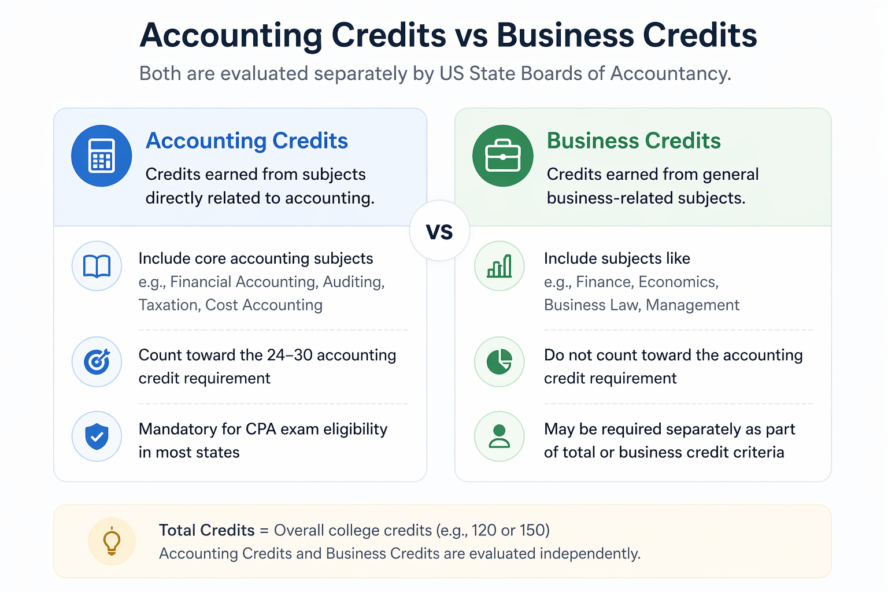
CPA eligibility requires both accounting credits and business credits, and they are evaluated separately. Most state boards expect candidates to meet minimum thresholds in each category, not just total education.
How Many Business Credits Are Required Alongside Accounting?
In addition to accounting credits, most states require 24 to 30 semester hours in business-related subjects.
These credits typically include areas like:
- Finance
- Economics
- Business law
- Management
- Statistics
Some states also specify that a portion of these must be upper-level (advanced-level accounting) courses.
The key point is simple:
- Meeting accounting requirements alone is not enough
- You must independently meet business credit requirements as well
Can Excess Accounting Credits Count Toward Business Requirements?
In some states, yes.
For instance:
In California, accounting credits in excess may be applied to meet business credit requirements.
Nonetheless, this is not applicable across all states. In most states,
- Overlap between credits is not allowed, or
- Distinct subject matter coverage must be provided for each credit type.
This is why assuming flexibility can lead to eligibility issues. You need to check how your target state treats credit overlap.
What Subjects Qualify as Business Credits for CPA?
The topics covered by business credits are diverse and span a wide variety of non-accounting disciplines.
Some typical examples of such courses are:
- Economics
- Finance
- Business Law
- Management
- Marketing
- Statistics
- Information Systems/MIS
While these courses are vital, they are not substitutes for accounting credits.
For instance,
A transcript containing several courses in finance and economics, but lacking in auditing or tax courses, won’t satisfy the accounting credits criteria.
How Indian Degrees Map to CPA Accounting Credit Requirements
Most Indian students don’t get rejected because of total credits. They get rejected because their accounting credits don’t meet state-level requirements. This section is where that gap becomes clear.
How Many Accounting Credits Does a B.Com Degree Provide?
A typical Indian BCom provides around 15 to 20 accounting credits after evaluation.
Realistically:
An average B.Com equates to 90-120 total American credits
Out of this, ~15 to 20 credits are in accounting subjects
What leads to the gap?
- B.Com spans from commerce, economics, laws, to theory subjects
- Accounting disciplines are of an introductory nature
- Certain subjects (for instance, business law/economics) don’t even fall under accounting disciplines
A B.Com alone usually falls short of the 24-30 accounting credit requirement
How Many Accounting Credits Does an M.Com or CA Add?
An M.Com or CA can increase your accounting credits, but not automatically guarantee eligibility.
M.Com:
Provides 6-12 accounting credit hours
Dependent on:
- University
- Selection of subjects
- Diligence in coursework
CA (Chartered Accountant – India):
Coursework can provide 6-12 accounting credit hours
Articleship does not count as academic credit
Any practical experience or training received would not be credited towards CPA accounting credits.
Final outcome with a B.Com and M.Com/CA):
The candidate
- May attain 20-30 accounting credits
- But may still fall short due to:
- Lack of upper-level coursework
- Missing specific subjects like auditing or taxation
What If Your Indian Degree Falls Short on Accounting Credits?
If your accounting credit hours fall short of the requirement, you must address specific gaps rather than simply adding credits.
Most common gaps:
- Auditing
- Taxation
- Advanced accounting
- Accounting information systems (AIS)
Approach that will help:
- Take targeted accounting courses only
- Choose upper-level courses where required
- Match coursework to your target state requirements
An approach that will not help:
- Adding random business subjects
- Increasing total credits without fixing the accounting gap
This is the number one cause for application denial.
How Do WES and NIES Evaluate Accounting Coursework?
WES and NIES analyze your transcript through the course-by-course approach and not by degree title.
The analysis involves:
- Content of the course
- credits for the course
- Level of study (introductory vs. advanced)
These courses are then categorized into:
- Credits in accounting
- Credits in business
- General credits
This results in:
- Students with identical B.Com degrees may earn different accounting credits
- The curriculum of the university and the subjects chosen influence the analysis
WES (World Education Services):
Widely used for general credential evaluation
NIES (NASBA International Evaluation Services):
Preferred for CPA-specific evaluations in many states
Both follow the same principle:
Only relevant accounting coursework is counted.
How to Earn Additional Accounting Credits for CPA
If your B.Com, B.Com (Hons), M.Com, or CA (India) does not meet CPA accounting credit requirements, you don’t need “more degrees.”
You need specific accounting subjects that are missing after the evaluation.
Can You Take Accounting Courses at a Community College?
Yes, community college courses can count toward CPA accounting credits in many states.
They are often the most cost-effective way to fill gaps.
However, there are restrictions:
- Community colleges typically have only beginning-level accounting courses.
- Most states require advanced or upper-level accounting courses.
- Beginner-level courses may not meet the requirements of 24-30 credits.
Use this method if:
- You lack knowledge in areas such as financial and cost accounting.
- Your state does not demand upper-level accounting courses.
Do not use this method if:
- Your evaluation indicates adequate credits in beginning-level courses.
- Your selected state demands advanced courses.
Do Online Accounting Courses Count for CPA Credits?
Yes, online courses are accepted, and for Indian students, this is often the most practical route.
However, there are certain requirements that must be fulfilled:
- It should come from an accredited institution (either US or international)
- Should have official transcripts
- Must be classified as accounting coursework
Effective strategies for Indian students:
Taking online classes from universities on:
- Auditing
- Taxation
- Advanced Accounting
- Accounting Information Systems
Non-acceptable options:
- YouTube-style learning
- Free certifications
- Skill-based programs without college credit
CTA: Access structured CPA study resources and credit planning checklists.
Is a Master’s in Accounting the Best Way to Fill the Gap?
A Master’s in Accounting (MAcc) is the most complete but not always necessary option for an indian student since thy will have to pursue it in distance.
What it addresses:
- Satisfies accounting requirements (24-30 hours)
- Satisfies the upper division course requirement
- Tends to satisfy the 150-credit rule
However, consider the following:
- It takes up a lot of time (1-2 years)
- It takes up a significant amount of money
- It is redundant if your problem is minor
Go for MAcc if:
You only have a 3-year Bachelor of Commerce (around 90 hours)
You are deficient in two categories:
- Overall credit hours
- Accounting credit hours
Most Indian candidates should opt for relevant targeted courses, not an entire degree.
Can CLEP Exams Satisfy Accounting Credit Requirements?
CLEP is not a viable option for Indian students.
Reasons:
The exams emphasize lower-level courses
They do not cover courses related to:
- Audit
- Taxation
- Higher accounting principles
Additionally:
- Most US State Boards will not approve CLEP accounting courses
- Even if approved, they do not satisfy upper division requirements
Conclusion:
While CLEP can contribute to general credits, it does not provide eligibility for an accounting course.
CTA:Compare the most efficient way to complete your remaining accounting credits.
Button: View Pricing (/pricing)
How EduMont Helps You Meet CPA Accounting Credit Requirements
Planning CPA eligibility is not complicated.
But without clarity, most students misjudge their accounting credits and delay their attempt.
At EduMont, the focus is simple:
No Retakes. Just Results.
Does EduMont Offer Courses Aligned to CPA Accounting Requirements?
Yes, EduMont provides 100% AICPA-aligned CPA study material, ensuring your preparation stays focused and relevant.
What this means:
- Your study content covers all CPA exam-relevant accounting areas
- You follow a structured preparation path, not scattered study
- You avoid wasting time on irrelevant or low-yield topics
Why Thousands Trust EduMont for Global Finance Careers
- Free Eligibility Check: Start with clarity by knowing your CPA eligibility instantly.
- Pass-in-One-Attempt Formula: Our Safety Net System, combined with personalized Game Plan Calls, delivers customized, structured prep so you’re fully prepared to pass each section on your first attempt.
- Unlimited UWorld Resources: Practice without limits with printed materials, eBooks, digital question banks, and unlimited mock exams for mastery.
- Live Chalk-and-Talk Classes: Interactive learning with real-time doubt clearing, helping you grasp complex concepts fast.
- EduMont LMS Access: All study materials, pre-annotated notes, and recorded lectures available until you succeed.
- Certified Faculty-Led Training: Led by Rohan Chopra, EduMont’s Academic Director and Chief Mentor; a CPA, CMA, ex-EY professional, and TEDx speaker with 5+ years of proven expertise.
- 100% Placement Assistance: We help our students level up with SAP FICO training, AI-powered insights for communication mastery, mock interviews, resume building, etc.
- No-Cost EMI option: Flexible payment plans ensure finances never block your learning.
- Half a Decade of Legacy: Over half a decade of growing proven results, mentorship, and exam-focused preparation.
Important:
EduMont supports your preparation and planning.
If additional accounting credits are required, they must be completed through recognized academic institutions.
How Can EduMont’s Mentors Help With Accounting Credit Planning?
This is where most students need clarity, and where EduMont adds real value.
Mentors start with your academic background:
- B.Com / B.Com (Hons)
- M.Com
- CA
- Non-commerce background
Based on this, you get an initial direction before formal evaluation:
- If you are from a commerce background, you may be able to start the CPA process directly (subject to evaluation)
- If you are from a non-commerce background, you will typically need to complete a bridge course before starting
What Happens After This
You are required to submit your transcripts to evaluation agencies such as:
- WES
- NIES
- FACS
Once your transcripts are evaluated:
- Mentors help you understand the evaluation report
- Explain your:
- Total credits
- Accounting credits
- Any deficiencies
- Highlight:
- Missing accounting subjects
- Upper-level requirements
- Eligibility gaps
How State Selection Works
The final state decision is not chosen arbitrarily.
- Your evaluation report determines which states you are eligible for
- Mentors guide you in understanding your options
- But the final eligibility depends on your evaluated transcripts
What This Approach Looks Like in Practice
- Personalized Game Plan Calls based on your profile
- A pass-in-one-attempt formula ensuring structured preparation
- Double-qualified mentor-led guidance
This ensures you are not just preparing for the exam, but also:
- Planning your 150 credits correctly
- Managing your timeline efficiently
- Avoiding unnecessary delays and costs
Conclusion
Accounting credits are not just a requirement; they are the most common reason CPA applications get delayed or rejected. The key is not how many total credits you have, but whether your coursework meets state-specific accounting criteria. Once you understand your position through proper evaluation, the path becomes straightforward. Focus on filling the right gaps, not adding unnecessary credits. With clear planning and the right guidance, you can move forward confidently and avoid costly delays in your CPA journey. These form part of the broader CPA subject requirements set by each state.
FAQs About Accounting Credits for CPA
How many accounting credits do you need for CPA?
Most US states require 24 semester hours of accounting credits, though some require 30 or more.
These typically include:
- Financial accounting
- Auditing
- Taxation
- Cost or managerial accounting
Always check your target state, as requirements vary.
What is the difference between accounting credits and business credits for CPA?
Accounting credits come from core accounting subjects like auditing and taxation.
Business credits come from supporting subjects, such as:
- Economics
- Finance
- Business law
- Management
They are counted separately, and one cannot fully replace the other.
Do all US states require the same number of accounting credits?
No, requirements vary by state.
- Many states follow the 24-credit standard
- Some require 30+ accounting credits
- Some specify upper-level coursework
Always align your credits with your target state’s rules before applying.
You can explore more breakdowns in our CPA requirement guides on the blog. (/blog)
Which specific accounting courses are required for CPA eligibility?
Most states expect a mix of:
- Financial accounting
- Intermediate/advanced accounting
- Auditing
- Taxation
- Cost or managerial accounting
- Accounting Information Systems (AIS)
Some states may require specific combinations or upper-level courses.
Can I use excess accounting credits to meet the business credit requirement?
In some states, yes. In others, no.
For example:
- States like California may allow this flexibility
- Others require separate accounting and business credits
You need to check state-specific rules before relying on this.
Does a 3-year B.Com from India provide enough accounting credits for CPA?
Usually, no.
A typical B.Com provides:
- ~15-20 accounting credits after evaluation
This often falls short of the 24-30 credit requirement, especially for:
- Advanced subjects
- Upper-level coursework
Most students need additional accounting courses.
Can I earn accounting credits online to meet CPA requirements?
Yes, if the courses:
- Are from a recognized university
- Provide an official transcript
- They are classified as accounting coursework
Online format is acceptable.
What matters is credit recognition, not delivery mode.
Do upper-level accounting courses count more than introductory courses?
Yes.
Many states require upper-level accounting credits.
Introductory courses:
- May count toward total credits
- But may not fully satisfy accounting requirements
This is a common gap for B.Com graduates.
Does EduMont help students plan their CPA accounting coursework?
Yes.
EduMont helps you understand your likely eligibility based on your background and gives initial direction.
Once your transcripts are evaluated (WES/NIES/FACS), mentors help you interpret the report, identify gaps, and plan your next steps based on actual eligibility.
You can start with EduMont’s free trial for initial clarity. (/free trial)
How do credential evaluation agencies count Indian accounting courses?
Agencies like WES and NIES use a course-by-course evaluation.
They assess:
- Subject content
- Credit hours
- Academic level
Each course is classified as:
- Accounting
- Business
- General
This is why two B.Com degrees can result in different accounting credit counts.