

Understanding CPA credits vs Indian credits is not optional if you’re planning to pursue the CPA designation from India. Most application delays and eligibility confusion come from one simple issue: Indian degrees are not measured the same way US CPA requirements are.
India follows a marks and percentage-based system.
The US CPA system works on semester credit hours.
These two systems do not align directly, and assuming they do is where most candidates go wrong.
Before you look at eligibility, exams, or timelines, you need to understand how your degree actually converts.
Key Takeaways
- Indian degrees are evaluated into US semester credits through agencies like WES and NIES.
- A 3-year B.Com typically converts to around 90–100 US credits, not 120. This is why a 3-year degree often falls short of CPA eligibility requirements.
- CPA eligibility is based on credit hours, not marks or percentages
- Most Indian students face a credit gap, especially for the 150-credit licensure requirement
- Adding degrees (M.Com, CA, MBA) does not guarantee eligibility unless credits are evaluated correctly
- The evaluation process is course-by-course, not degree-based
- State selection plays a major role in how your credits are accepted
CPA Credits vs Indian Credits – Why They Don’t Match Directly
The US and Indian education systems are built on completely different measurement models. One tracks learning through credits earned per course, the other through years completed and marks scored. Because of this, there is no fixed formula to convert one into the other.
Understanding this difference is what prevents incorrect assumptions about the CPA eligibility.
How Does the US Credit System Work?
The US education system measures academic progress using semester credit hours.
The credit hours depend upon the following factors:
- Teaching hours
- Academic level (introductory vs advanced)
- Depth of the course
The average credit hours of a 4-year degree program in the USA are 120, with 3-4 credit hours per course.
Regarding the CPA designation:
- 120 credit hours: Eligible to take the examination
- 150 credit hours: Eligible for licensure
(State-specific information can differ)
However, what is important is not only the number of credits but also:
- Accounting credits
- Business credits
This is a structured, standardized system. Every subject is counted individually.
How Does the Indian Education System Differ?
Credit-based grading is not utilized in the Indian system either.
Rather, it operates on:
- Program length (3-year B.Com, 2-year M.Com, and so forth)
- Lists of subjects covered
- Percentages/grades obtained
There is no uniform, visible credit structure attached to each subject. Even when internal credits exist, they are not aligned with US semester-hour standards.
Two issues arise here:
- Two students having the same degree may cover two distinct sets of subjects
- The system does not indicate how much weight each subject carries in credit terms
As a result, the degree alone does not tell the full story.
Why Can’t You Simply Convert Indian Marks to US Credits?
This is because a CPA qualification does not depend on marks.Having higher marks in B.Com will not add to your credits. Having lower marks will not deduct from it. Marks do not make any difference in the conversion process. There is no direct method to convert Indian marks to US credits for CPA eligibility.
What really counts is:
- Subjects taken by you
- Hours spent on them
- If they constitute accounting or business credits
That is why evaluation bodies consider course-by-course conversion rather than a marks-based conversion.
Two applicants with:
- Same B.Com degree
- Similar marks
may end up with varied US credits.
The bottom line is clear:
There is no shortcut conversion.
Credits depend on your academic structure, not marks.
How Indian Degrees Convert to CPA Credits – Degree-by-Degree Breakdown
There is no standardized conversion formula where one unit of Indian education earns you a fixed number of CPA credits.
Every evaluation is done course-by-course, but over time, clear patterns have emerged. Indian degrees generally land in a certain credit range when assessed by bodies such as WES, FACS and NIES.
This exercise does not seek to provide precise figures but to outline the possible ranges and gaps to enable you to understand your position.
Indian Degree to CPA Credit Conversion (Typical Range)
| Degree | Approx Credits | Key Reality |
| B.Com | 90–120 | Usually needs additional credits |
| B.Com + M.Com | 120–140 | Often eligible for exam |
| B.Com + CA | 120–150 | Highly state-dependent |
| BBA | 90–110 | Needs accounting credits |
| BBA + MBA | 120–150 | Strong eligibility |
| B.Tech | 120–130 | Lacks accounting subjects |
*Your exact credit count depends on subject distribution and evaluation.
How Many CPA Credits Does a 3-Year B.Com Equal?
When evaluating B.Com credits for CPA, a 3-year degree typically converts to 90–100 US credits. This credit gap is one of the most common challenges Indian students face when planning CPA eligibility.
It results in an instant deficiency:
- You are usually short of the 120-credit requirement to sit for the CPA exam
- You are significantly short of the 150-credit licensure requirement
That is why Indian students cannot depend solely on their B.Com degree.
The problem is not in the degree. The problem is in its length (3 years instead of four) and insufficient credit weight for each discipline.
How Many CPA Credits Does an M.Com Add?
In terms of M.Com credits for CPA, this degree usually adds 30–40 additional credits.
M.Com + B.Com:
Total reaches 120–140 credits
It enables you to:
- Take the CPA exam (in several states)
- Close the gap to licensure considerably
But it doesn’t necessarily ensure 150 credit hours. Candidates can only know when their coursework is officially evaluated.
How Many CPA Credits Does a CA Qualification Provide?
CA certification in conjunction with B.Com results in earning you around 130-150 credits. When assessing CA credits for CPA, the qualification can significantly increase your total credit count.
However, this is the common mistake made by the candidates:
They think that just because of their CA certification, they have 150 credits automatically.
This is not always the case because:
- A CA without a graduation does not meet the minimum requirement.
- A CA inter can sometimes not give you enough credits
But, in most cases, CA can help you get closer to your desired number of credits.
How Do BBA and MBA Degrees Convert for CPA?
A 3-year BBA typically converts to 90–95 credits.
With an MBA, the total usually reaches 130–160 credits.
This is enough for:
- Total credit requirements (120/150)
- Business credit requirements
But not enough for:
- Accounting credits
BBA and MBA programs are business-focused, so most candidates fall short of the 24-30 accounting credits required by CPA state boards.
Do not assume you’re eligible just because your total credits are high.
You need to check:
- How many pure accounting subjects do you have
- Whether they meet state-specific accounting requirements
You may have enough total credits and still be ineligible due to missing accounting subjects.
The CPA Credit Evaluation Process for Indian Students
Before you can apply for the CPA exam, your Indian education must be translated into the US credit system.
This is done through a credential evaluation, where your transcripts are assessed course-by-course and converted into US-equivalent semester credits. This report is what CPA state boards use to determine your eligibility.
What Is Credential Evaluation and Why Is It Required?
Credential evaluation refers to the conversion of your Indian credits into equivalent semester credits for US colleges.
Agencies evaluate:
- Course content
- Hours of study
- Level of course (beginner or advanced)
The courses are categorized as follows:
- Credits towards core accounting
- Credits towards business subjects
- General credits
This is necessary since CPA eligibility depends on:
- Total credits (120 or 150)
- Credits in specific subjects (accounting and business)
Indian degrees do not provide this structure directly, so evaluation is mandatory.
Should You Use WES or NIES or FACS for Indian Transcripts?
The three commonly used evaluation agencies are:
- World Education Services
- NASBA International Evaluation Services
- Foreign Academic Credential Service
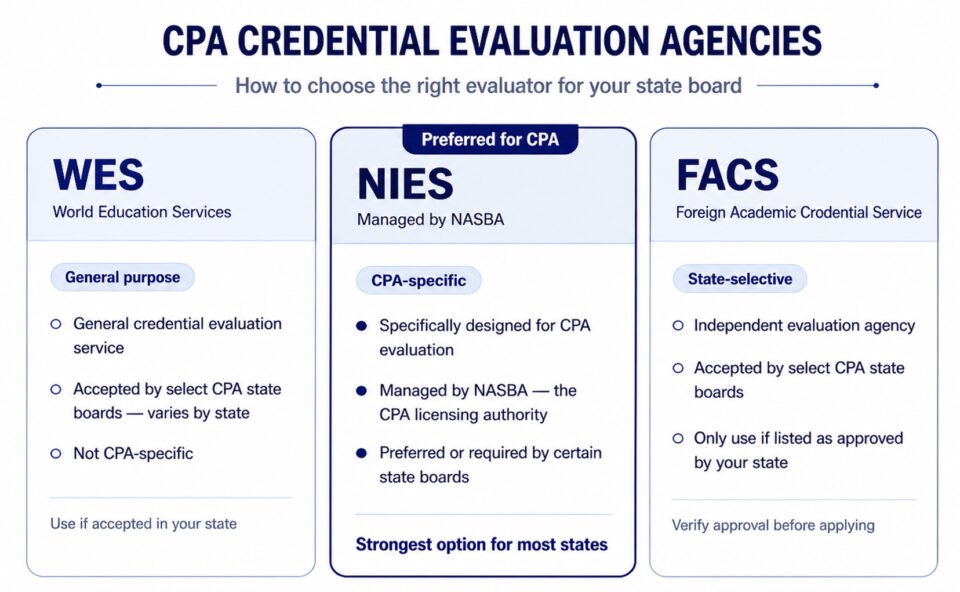
Some states only accept NIES, while others provide a list of approved agencies that may include WES or FACS.
How Long Does the Evaluation Take and What Does It Cost?
Typical timelines and costs:
WES
- Fees: Approx. $205
- Processing Time: Approx. 7-10 weeks
NIES
- Fees: $205-$300
- Processing Time: Approx. 6-12 weeks
FACS
- Fees: Dependent on the kind of report and state regulations
- Processing Time: Usually within the same timeframe (dependent on the application and paperwork)
Processing time depends on:
- Accuracy of document submission
- Speed of university replies
- Need for further verification
Most delays are caused by incomplete or incorrectly submitted transcripts, not the agency itself.
What Are Common Pitfalls in the Evaluation Process?
Most issues are avoidable and come from incorrect assumptions.
Typical errors include:
- Assuming degree = fixed credits
Evaluation is done per course, not per degree program
- Selecting an unauthorized evaluation agency
- Filing incomplete academic documents/ unofficial transcripts.
- Neglecting course classification
- Credits might be sufficient for total, but not for accounting courses
The right strategy is straightforward:
- Apply for the authorized evaluation agency
- File complete academic information
- Review your examination report before planning next steps
This prevents mistakes, time loss, and additional expenses.
Understanding the Credit Gap – Where Indian Students Fall Short
Following the evaluation of your academic qualifications, the output will make it clear that you still don’t fulfill the full requirement.
The shortfall between what you possess and the requirements of the CPA is referred to as the credit deficit. For Indian students applying for the program, this deficit is normally foreseeable.
What Is the Typical Credit Gap for Indian Graduates?
The majority of Indian degrees lack the total number of credits required for the US CPA in India.
Examples of cases:
B.Com (3-year degree)
~90 to 100 credits
Shortage of: 20-30 credits for 120 credits and 50-60 credits for 150 credits
B.Com plus M.Com
~120 to 140 credits
Shortage of: 10-30 credits for 150 credits
B.Com plus CA
~130 to 150 credits
Shortage of: 0-20 credits for 150 credits
Reason for the above shortage
Indian bachelor’s degrees are 3 years, US bachelor’s degrees are 4 years (120 credits). That one-year difference creates the initial gap.
Which Specific Credits Are Usually Missing?
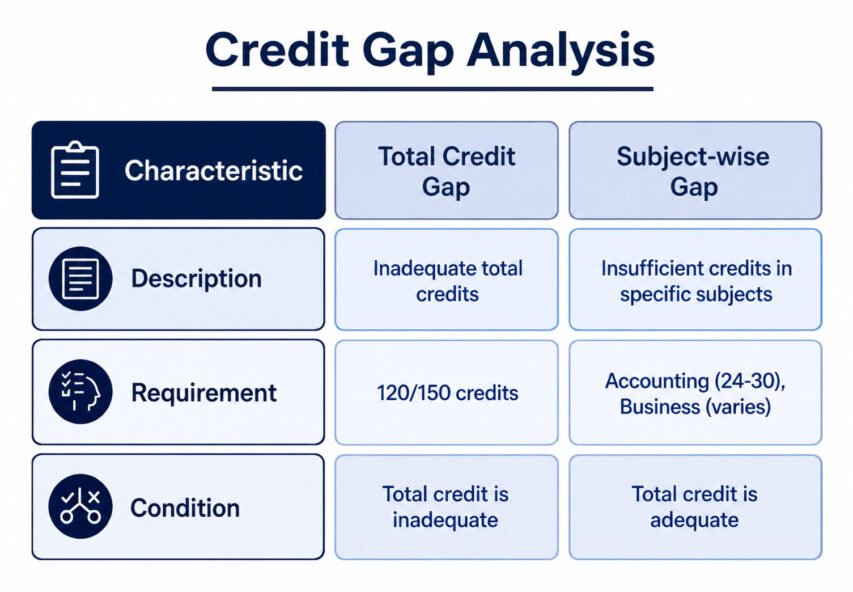
There are two kinds of gaps:
1. Total Credit Gap
Inadequate total number of credits to achieve 120/150
2. Subject-wise Gap
If total credit is adequate, but there could be insufficient:
- Credits in Accounting (usually 24–30 are necessary)
- Credits in Business (varies from state to state)
Some common subjects that may be lacking include:
- Advanced Accounting
- Auditing
- Taxation
- Financial Accounting
This is especially common for:
- 3 yr B.Com-only candidates (total + accounting gap)
- BBA+MBA candidates (primarily accounting gap)
Does the Gap Differ Between Exam Eligibility and Licensure?
Yes. It’s here that most applicants make mistakes.
CPA Exam Eligibility
- Usually needs 120 credits altogether
- Certain states permit taking the test at this point
CPA Licensure
- Needs 150 credits altogether
- In addition to mandatory accounting and business credits
Which implies that:
- You may begin the CPA tests without having 150 credits
- However, you cannot earn your license until all criteria are fulfilled
You should divide your approach into two steps:
- Achieving 120 credits to start the tests
- Working out how to complete 150 credits for the license
Treating both as the same requirement leads to poor planning and delays.
How to Bridge the Credit Gap Between Indian and CPA Requirements
Your evaluation is done, but the process doesn’t end here. The next stage is taking action.Bridge courses are standalone, credit-bearing courses designed to help internationally trained candidates meet the specific academic requirements set by U.S. state boards for CPA exam eligibility.
It’s pointless to enroll in arbitrary courses or obtain an entirely new degree. You need to fill the exact gap shown in your report, whether that’s total credits, accounting credits, or both.
Can Bridge Courses Fill the Gap Quickly?
Yes, provided that it is done properly.
Bridge courses are the best method for:
- Filling up any accounting/business credit deficiencies
- Covering up minor to moderate credit shortages
They are most effective when:
- Your gap is clearly defined
- You choose credit-bearing courses from accredited institutions
They will fail you if:
- You take unrelated subjects
- The course does not appear on an official transcript
Bridge courses are the most effective ways to fill minor requirements. They are cheap, easy to complete courses that don’t hamper your preparation. But they only work if they complement your evaluation report.
Do Online US University Courses Count?
Indeed, under two conditions:
- The class should be from an accredited institution.
- The university must provide official academic credits and transcripts.
It does not matter in what format you took the class:
- Online
- Hybrid
- or traditional classroom classes.
What will not count for credits:
- free courses;
- platform learning without transcripts.
CPA boards evaluate credits, not how the course was delivered.
Is Pursuing a US Master’s Degree Worth It for the Credits?
It all comes down to where you’re at.
An American master’s degree (such as MAcc/MBA):
- Could help you achieve or surpass the credit requirement of 150
- Provides an organized curriculum
However, it is:
- Very time-consuming
- expensive
For most Indians, a full master’s degree is not necessary if the credit gap is minor to moderate.
It is worth the investment for situations where:
- The credit gap is huge
- Or you need some international experience and/or a career change
Can the New 120-Credit Pathway Help Indian Candidates?
Certainly, this is true when taking the test.
Several state boards permit a student to:
- Take the test with only 120 credits
This works perfectly for Indian students who:
- Possess roughly 120 credits after assessment
- Want to start exams without waiting to reach 150
However, this does not nullify the last requirement:
- You’ll need 150 credits for your licensure
Approach:
- Use the 120-credit system to take the tests
- Earn additional credits either concurrently or after tests
Best US States for Indian Candidates Based on Credit Conversion
State selection directly affects how your Indian credits are evaluated and accepted.
There is no single “best” state. The right choice depends on:
- Your total evaluated credits
- Accounting and business credit breakdown
- Documentation constraints (SSN, residency)
Choosing the wrong state is one of the most common reasons candidates face delays.
Which States Accept Lower Credit Thresholds for International Candidates?
Certain US State Boards of Accounting permit sitting for the examination with 120 credits instead of 150.
Such states are usually more preferred by Indian aspirants since:
- The combination of B.Com + M.Com (120-140 credits) is enough
- You get an opportunity to write the CPA examination earlier
Examples of such states are:
- New York (eligible to write CPA examination with 120 credits)
- Illinois
- Washington
- Alaska
Noteworthy facts:
It concerns only eligibility for the exam
Licensure requires 150 credits
Also, many of these states require evaluation through NASBA International Evaluation Services.
If your evaluation shows ~120 credits, target a state that allows early exam entry instead of waiting to reach 150.
Which States Do Not Require SSN or Residency?
Some CPA states do not require:
- A Social Security Number (SSN)
- US residency
making them convenient for foreign applicants from India to apply directly.
Examples are:
- Alaska
- Washington
- NY State (for exam eligibility)
- Montana
But remember that:
- Requirements vary from examination to licensure
- Some states might even add more documentation after the fact
Notably:
Requirements for states keep changing, along with their policy on evaluation agencies (WES/NIES/FACS).
Always confirm your:
- Credit requirement
- Acceptance of the evaluation agency
- SSN/Citizenship requirements
before choosing a CPA state.
How EduMont Helps Indian Students Navigate CPA Credit Conversion
Planning CPA eligibility is not complicated.
But without clarity, most candidates misjudge their credits, choose the wrong state, or delay their attempt.
At EduMont, the focus is simple:
clarity before action.
Does EduMont Offer CPA Credit Planning Support?
Yes. EduMont supports both credit planning and exam preparation, but the approach is structured.
You get:
- Guidance on interpreting your evaluation report (WES / NIES / FACS)
- Clear identification of:
- Total credits
- Accounting credits
- Business credits
- Directions on how to fill your required credit gaps
Along with this, preparation support includes:
- 100% AICPA-aligned study material
- Unlimited UWorld access for practice and test simulation
- EduMont’s LMS-based structured learning
- Pre-annotated notes to simplify concepts
- Mock tests aligned with CPA exam patterns
How Can EduMont Mentors Help With State Selection?
This is where most candidates make mistakes.
Mentors start with your academic background:
- B.Com / B.Com (Hons)
- M.Com
- CA
- Non-commerce background
Based on this, you get initial direction before evaluation:
- Commerce background – may proceed directly (subject to evaluation)
- Non-commerce background – typically requires bridge coursework
After Evaluation:
You submit transcripts to:
- World Education Services
- NASBA International Evaluation Services
- Foreign Academic Credential Service
Once evaluated, mentors help you:
- Understand your report
- Break down:
- Total credits
- Accounting credits
- Credit Gaps
- Identify:
- Missing accounting subjects
- Upper-level requirements
- Eligibility gaps
What This Approach Looks Like in Practice
- Personalized Game Plan Calls based on your profile
- A pass-in-one-attempt formula built on structured preparation
- Mentor-led guidance by CPA/CMA-qualified faculty
This ensures you are not just preparing for the exam, but also:
- Planning your 150 credits correctly
- Managing your timeline efficiently
- Avoiding unnecessary delays and costs
Conclusion
CPA eligibility for Indian students is not about your degree title. It is about how your education is evaluated in terms of credits.
A 3-year degree, additional qualifications like M.Com or CA, and your subject mix all influence your final credit position. There is no direct conversion, and assumptions often lead to delays.
The right approach is simple:
get your evaluation done, understand your credit gap, and plan accordingly.
With clear guidance and structured preparation, the process becomes straightforward. Focus on filling the right gaps, not adding unnecessary qualifications. That is how you move forward efficiently without losing time.
FAQs About CPA Credits vs Indian Credits
How many US CPA credits does a 3-year Indian B.Com equal?
A 3-year B.Com typically converts to 90–100 US credits after evaluation.
This usually falls short of both:
- 120 credits (exam eligibility)
- 150 credits (licensure requirement)
Is a CA qualification equivalent to 150 CPA credits?
No. A CA qualification does not automatically equal 150 credits.
When combined with B.Com, it typically results in 130–150 credits, depending on evaluation.
Final credit count depends on how your coursework is assessed.
What is the difference between WES and NIES evaluation for CPA?
- WES
- General evaluation agency
- Accepted by some CPA states
- NIES
- CPA-specific evaluation body
- Required by many CPA states
Key difference:
NIES is designed specifically for CPA eligibility, while WES is a general evaluator.
Which states accept NIES only and not WES?
Several CPA states require evaluation through NASBA International Evaluation Services and do not accept WES.
Examples include:
- Illinois
- Maryland
Requirements can change, so always verify with the specific state board before applying.
How long does it take to get Indian transcripts evaluated for CPA?
Typical timelines:
- WES: ~7-10 weeks
- NIES: ~6-12 weeks
Delays usually occur due to:
- Incomplete documents
- University verification timelines
Can I sit for the CPA exam if my Indian degree gives me only 90 credits?
Not directly.
Most CPA states require 120 credits for exam eligibility.
If your evaluation shows ~90 credits, you will need to add credits before applying.
What is the cheapest way to fill the credit gap from India?
The most cost-effective approach is:
- Taking credit-bearing courses from accredited institutions
- Focusing only on required subjects (accounting/business)
Avoid:
- Full degrees unless necessary
- Non-credit or unrecognized courses
Does EduMont help with CPA credit evaluation and planning?
EduMont helps with:
- Credit planning and guidance
- Understanding your evaluation report
- Recommending suitable CPA states based on your profile
Do Indian marks and percentage scores affect CPA credit conversion?
No.
CPA credit conversion is based on:
- Coursework
- Subject content
- Instruction hours
Marks or percentage scores do not determine your credit count.
Can an M.Com combined with B.Com meet the 150-credit CPA requirement?
Sometimes, but not always.
B.Com + M.Com typically results in 120–140 credits.
In some cases, it may reach 150, but many candidates still have a gap.
Final eligibility depends on:
- Evaluation outcome
- Subject-wise credit distribution