

Becoming a CPA will not just unlock opportunities; it promises you a career that many can only dream about in terms of high salaries and stability. However, like anything that is worth getting, passing the CPA exam also needs effort.
While researching CPA exam statistics, everyone has come across at least one figure, a pass rate somewhere around 50%. Yet, there is more to the picture than meets the eye.
Every section of the CPA test has its peculiarities when it comes to difficulty level and pass rates. What distinguishes a student that will pass the test with flying colors from others who are unaware of their existence is an understanding of these nuances.
By breaking down 2026 CPA exam pass rates by section and interpreting the meaning behind them, this article will allow you to optimize your studying and prepare yourself for the best possible performance on all four tests.
Key Takeaways
- Overall CPA exam pass rate remains stable at 50–55%
- However, there are large disparities in pass rates for different CPA exam sections
- Pass rates can range anywhere from 41% (BAR) to 79% (TCP)
- Lowest pass rates correspond to FAR and BAR because of syllabus size and technical content
- Highest rates apply to the more straightforward CPA exam sections, i.e., TCP and ISC
- Pass rate data can be helpful for preparing, but does not determine your success rate
CPA Exam Pass Rate – Latest Numbers at a Glance
Before getting into section-wise data, it helps to understand what the overall CPA exam pass rate actually represents, and why looking beyond the average gives a clearer picture of the exam.
What Is the Overall CPA Exam Pass Rate in 2026?
In 2026, the overall CPA exam pass rate remains roughly at the same level as before, varying within the range of 50-55%.
At first glance, this figure might suggest that around 50% of candidates manage to pass each section of the exam. But it would not provide an accurate image of the situation as such.
The CPA exam is not a single test. It is made up of multiple sections with very different levels of difficulty, syllabus depth, and skill requirements. This is why the CPA pass rate by section varies widely, and looking only at the overall percentage does not give you a complete picture of the CPA exam difficulty.
This is what a proper interpretation of the numbers looks like:
- The exam is designed to be rigorous, but not unpredictable
- Outcomes depend heavily on preparation quality and strategy
- Section-wise variation is where the real insight lies
How Has the CPA Pass Rate Changed After CPA Evolution?
With the introduction of the CPA Evolution model, the structure of the exam changed but the pass rates remain rather stable. However, there are certain changes associated with the structure and nature of each section.
| Change | Impact on Pass Rates |
| Core vs Discipline split | More variation across sections |
| Narrower discipline scope | Higher pass percentages |
| Skill-based testing | Strategy matters more |
It is crucial to remember these facts when choosing a section to attempt first.
CPA Pass Rate by Section – Core and Discipline Breakdown
Looking at the CPA pass rate by section gives a far more accurate picture of the exam than the overall average. Each section tests a different skill set, which is why pass percentages vary significantly. Here’s a table representing the official AICPA figures and how they have evolved-
| Section | 2025 Cumulative | Q1 2026 | Trend | Difficulty Tier |
| AUD | 48.21% | 47.80% | Stable | Medium |
| FAR | 42.12% | 43.46% | Slight increase | Hard |
| REG | 63.12% | 66.65% | Improving | Easy–Moderate |
| BAR | 41.94% | 41.30% | Stable | Hardest |
| ISC | 67.79% | 66.79% | Stable | Easy |
| TCP | 77.65% | 79.28% | Improving | Easiest |
Source: https://accounting.uworld.com/cpa-review/cpa-exam/pass-rates/
What Is the FAR Pass Rate?
The CPA pass rate for FAR in Q1 of 2026 is 43.46% and it is one of the lowest pass rates amongst all the sections.
FAR Section (Financial Accounting and Reporting) is competitive mainly due to its:
- extensive syllabus
- layered concepts
- heavy emphasis on accuracy and retention
The section covers basic accounting principles extensively, that’s why it serves as the foundation of other sections.
What Is the AUD Pass Rate?
The pass rate for AUD (Auditing & Attestation) for Q1 of 2026 is 47.80%, putting it at mid-level.
AUD is less about calculations and more about:
- knowledge of the auditing process
- logical application of ideas
- scenario analysis
Many candidates find AUD manageable after building a strong foundation in accounting, which is why its pass rate is higher than FAR but still below 50%.
What Is the REG Pass Rate?
The pass rate for REG (Regulation) in Q1 of 2026 is 66.65%, which is one of the better-performing core subjects.
REG includes:
- Taxation
- corporate laws
- compliance
The relatively high pass rate for REG can be attributed to:
- more structured content
- predictable question patterns
- clearer conceptual boundaries compared to FAR
Discipline Sections
Each of the sections of the CPA exam is different from one another, and even the pass rates prove the same. Each of these sections requires a specific set of skills, covers a specific range of topics, and has different levels of difficulty depending on where you are in your preparation process. But before we look at those numbers, it is important to keep in mind what those pass rates imply.
What Is the TCP Pass Rate?
TCP (Tax Compliance and Planning) Q1 of 2026 pass rate stands at 79.28%, which is the highest amongst all sections.
TCP is a discipline section with:
- focused scope
- application-based questions
- strong alignment with taxation concepts
The high pass rate does not mean it is easy. It reflects the narrower syllabus and targeted preparation required.
What Is the ISC Pass Rate?
The pass rate in Q1 of 2026 for the ISC section is 66.79%.
ISC cover:
- Information systems and data management
- Internal controls over information systems and business processes
- Security, confidentiality, and privacy of information
Candidates who are comfortable with conceptual understanding and logical frameworks tend to perform well here, which explains the relatively strong pass percentage.
What Is the BAR Pass Rate?
BAR (Business Analysis and Reporting) has a pass percentage of 41.30% in Q1 of 2026. This is the lowest pass rate compared to other sections.
It is difficult for candidates to score well in BAR because it involves:
- complex accounting
- Interpretation
- application
Unlike FAR, which is broad, BAR is more niche and conceptually dense. Its low pass rate reflects this technical depth rather than syllabus size.
Hardest CPA Exam Section – What the Data Shows
Pass rates give a useful indication of difficulty, but they need to be interpreted correctly. A lower CPA exam pass rate usually reflects the nature of the section, its scope, depth, and the type of preparation it demands.
Why Is FAR Considered the Hardest Core Section?
FAR consistently has one of the lowest pass rates and is widely regarded as the most demanding core section.
There are several reasons for that:
1. Syllabus volume
FAR covers a broad range of accounting topics, from basic principles to complex reporting standards. Its vastness alone makes the learning process difficult.
2. Layered concepts
Topics in FAR are interconnected. Missing one concept often affects understanding of others, which increases the overall difficulty.
3. Precision and accuracy
Unlike theory-heavy sections, FAR requires exact application. Small errors can lead to incorrect answers, especially in task-based simulations.
Contrary to popular belief, the reason for the low pass percentage for this particular section does not involve unpredictability.
Why Does BAR Have the Lowest Discipline Pass Rate?
BAR has the lowest pass rate among all sections, at 41.30% in Q1 of 2026.
Unlike FAR, which is broad, BAR is challenging for a different reason- it is technically dense and analytical.
Key reasons include:
1. Advanced application
BAR builds on core accounting knowledge and requires candidates to apply it in more complex, analytical scenarios.
2. Conceptual depth
The section focuses on interpretation and problem-solving rather than straightforward recall.
3. Niche coverage
As BAR is more specialized, many candidates are less familiar with its content compared to core sections.
This is why BAR often feels harder even though its syllabus is not as extensive as FAR.
Which Section Should You Attempt First?
Pass rates indicate how tough the section is, they do not determine when to take the section.
Despite being one of the hardest sections in terms of its pass rate on the CPA Exam, FAR is often the optimal first section.
Here’s why:
1. It lays the foundation
FAR principles extend into other sections, such as AUD and BAR. Knowing these principles well will make the rest of the exam easier.
2. It poses the greatest cognitive demand
FAR demands rigorous study efforts from candidates. Trying it out at the beginning of the process will help you face it when you are mentally strongest.
3. It gives you better use of the 30-month window
The CPA exam allows a 30-month window to complete all sections once you pass your first paper. Starting with FAR ensures that this window is used more effectively.
4. It gives you a push
Clearing the FAR section gives you more direction while working on the rest.
To pass the CPA exam, it does not matter whether you begin with the easiest section. It is essential to find out which sequence will ensure passing all four sections most efficiently.
Therefore, taking FAR at the beginning of the process is practically viable.
CPA Exam First-Time Pass Rate vs Repeat Attempts
The overall CPA exam pass rate tells you how candidates perform in a single section. But what most students actually want to know is different: how many people clear all four sections in one go, and how many require multiple attempts.
This is where preparation approach matters more than sectional difficulty.
What Percentage of Candidates Pass All Sections on the First Try?
A relatively small percentage of candidates clear all four sections on their first attempt.
Although specific figures differ depending on sources, statistics reveal that the majority of those taking the CPA exam do not pass the entire test in just one sitting without taking the exam repeatedly. However, there is no unpredictability involved in this test since most candidates:
- underestimate the depth of certain sections
- start without a clear sequence
- rely on inconsistent study patterns
The pass rate of the CPA exam sections can range from 50% to 55%, but completing all four sections in succession is what takes more effort for most people.
How Do Repeat Attempt Pass Rates Compare?
Those who take the same sections over again usually score better than before, but this is not without its downsides.
Each reattempt results in a repetition of the exam fee and is costly enough even if only one section is repeated. Apart from the financial impact of having to pay twice for the same exam, there is also the cost of wasted time, disrupted learning flow, and potential demotivation.
At the same time, being familiar with the exam format and structure helps candidates perform better. Prior experience also provides insight into what parts of the preparation were lacking.
However, it is critical to understand that for most people, repeating an exam is not about lacking knowledge or skills; it is about poor preparation for the test. People who try to pass an exam instead of preparing to pass it will be the ones who need to pay the extra fees for another attempt.
CPA exam order for Indian Candidates
Recommended CPA Exam Order for Indian Candidates
| Background | First Section | Why | Next Section | Why |
| BCom | FAR | Builds core base early | AUD | Direct overlap |
| MCom | FAR | Strong conceptual alignment | AUD | Reinforces concepts |
| CA | FAR | High familiarity | BAR | Advanced extension |
| MBA (Finance) | FAR | Strengthens fundamentals | AUD | Practical linkage |
For many students in India, the key concern is not just the overall CPA exam pass rate, but how Indian candidates perform compared to global averages. The short answer is: there is no major gap in capability, but there is often a gap in preparation approach.
How Do Indian CPA Candidates Perform Compared to the Global Average?
The Indian candidates tend to do well, in accordance with international standards, with the passing rates for each section of the examination being normally between 45% and 55%.
This aligns closely with the overall CPA exam pass percentage, which means the exam is not inherently more difficult for Indian students.
Where differences arise is in:
- familiarity with US-based concepts (especially taxation and regulations)
- understanding of exam format and expectations
- access to structured preparation and guidance
Once these gaps are addressed, performance tends to match global benchmarks.
How CPA Exam Scoring Works – What a 75 Really Means
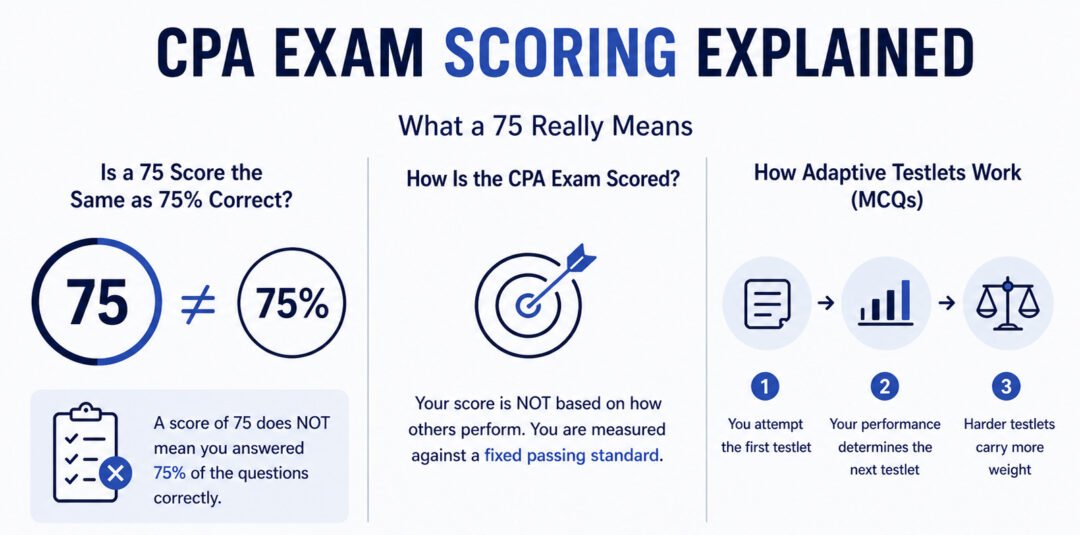
Is a 75 Score the Same as 75% Correct?
No. A grade of 75 in the CPA examination does not mean that one answered 75% of all questions correctly.
This is because CPA exams use a scaled score, which implies:
- Your grade depends on both accuracy and the level of difficulty of the questions.
- Different questions hold varying importance levels.
- Tests are assessed on testlets and not just the number of correct answers.
In essence, it implies that:
- One may pass the test without getting precisely 75% of all answers right.
- One might score lower than 75 despite having a high raw accuracy rate.
The score represents whether you have demonstrated minimum competency, not a simple percentage.
How Are MCQs and TBSs Weighted in Scoring?
| Component | Weightage | What It Tests | Common Mistake |
| MCQs (Multiple Choice Questions) | 50% | Concept clarity, speed, accuracy | Over-practiced, gives false confidence |
| TBSs (Task-Based Simulations) | 50% | Application, problem-solving, handling pressure | Under-practiced, causes score drop |
Balanced preparation matters. Strong MCQ performance alone is not enough if TBS practice is weak.
Are CPA Exam Scores Curved?
No. The CPA exam is not graded on a curve.
Your exam grade is not relative to other students in your cohort. Rather, your grade:
- is relative to a pre-set benchmark
- depends on whether or not you reach the required benchmark
What this means:
- your grade is independent of another person’s performance
- you pass solely on the basis of your preparation
Although the exam itself is not graded on a curve, it makes use of an adaptive testlet approach when it comes to multiple choice questions (MCQs).
How it works:
- There are testlets within the exam (series of questions)
- Your performance in the testlet will determine the difficulty of the subsequent testlet
- Your high performance will result in a harder testlet
- Weak performance will lead to a moderate testlet
However, what’s important to remember is that:
- Higher difficulty testlets will have a higher weight when it comes to grading
- Doing well in hard testlets will help boost your scaled score
Often, people misconceive this as a percentile system. This means that they think it’s based on relative performance. However, you are not actually being ranked among others.
Does Coaching Impact CPA Pass Rates for Indian Students?
Yes, but not in the way it is typically discussed.
Coaching does not change the difficulty of the exam. What coaching does do is alter:
- clarity of concepts
- structure of preparation
- timing of attempts
The structured process enables candidates to:
- divide the syllabus into smaller components
- ensure that the preparation conforms to the examination requirements
- take the exams only after being thoroughly prepared
This becomes especially crucial for Indian candidates who find themselves having to juggle:
- work or college commitments
- unfamiliar exam patterns
- limited clarity at the starting stage
EduMont ensures that the candidate reduces their uncertainty from the very start by making sure the candidate has:
- eligibility clarity
- structured study plans
- and continuous performance tracking
It is important to understand that coaching does not mean adding extra hours of studying, rather it means optimizing the existing hours.
As in almost all cases, a better CPA exam pass rate is a result of better preparation, not extra hours of studying.
How to Improve Your CPA Exam Pass Rate
Understanding the CPA exam pass rate is useful. Improving your own outcome depends on how you prepare.
Across sections, one pattern is consistent: candidates who follow a structured, exam-aligned approach perform better than those who rely only on effort or long study hours.
How Many Study Hours Do Top Scorers Put In?
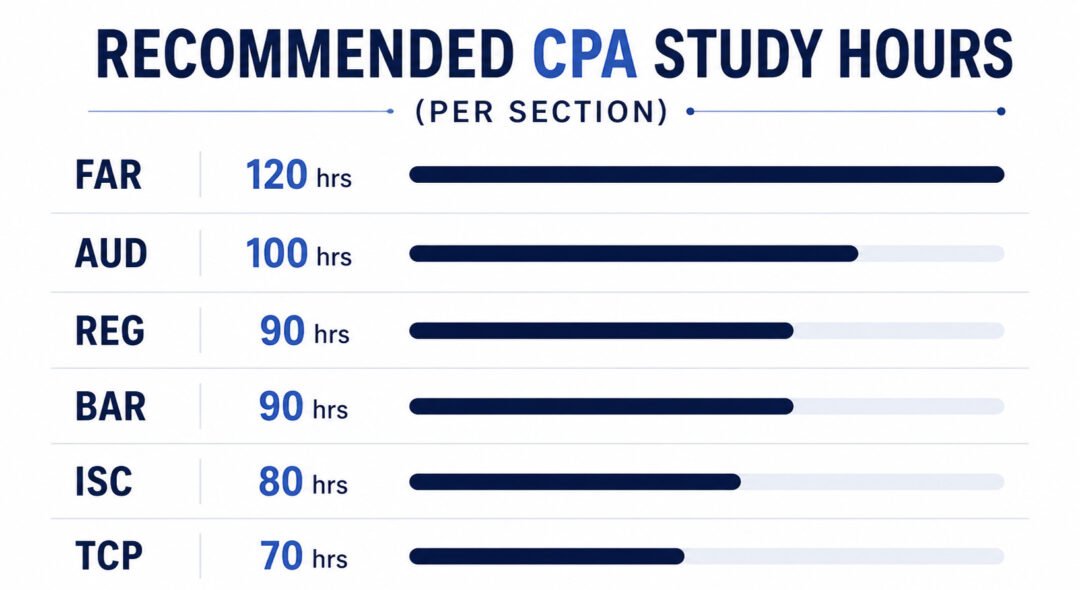
Hours aren’t everything, though.
Two students could put in an equal amount of hours and yet come up with different grades. This can generally be attributed to:
- the time at which they begin practicing
- the ability to reinforce their weaker spots
- active vs passive studying
What Study Strategies Correlate With Higher Pass Rates?
There are certain trends that have been noticed in candidates who have passed a section for the first time:
1. Exposure to exam-level questions early
The successful candidates practice solving MCQs and TBSs even before completing the syllabus. This enables them to know how the concept is examined.
2. Concentration on comprehension over rote
For sections such as FAR and AUD, application is mandatory. Rote memorization is not enough and fails under exam pressure.
3. Revisions done regularly
Without revision, retention becomes difficult, and it becomes more challenging for sections having more topics such as FAR.
4. Assessment of performance before attempting the exam
It is crucial to assess whether one can pass the test rather than knowing when to complete studying all topics. Candidates who evaluate themselves through mock tests and practice tests are more likely to make good choices.
5. Section sequencing in a proper manner
By beginning with core sections such as FAR, the candidates find it easier to perform well in other sections as well.
How Does Edumont Help Improve Your CPA Pass Rate?
Ensuring CPA exam success should not be about putting more material into the exam. This should be about clarity of mind and effective decision-making during the entire preparation period.
At EduMont, the focus is on a first-attempt oriented preparation system:
Starting with clarity: Guidance on eligibility and credit evaluation so that you begin your This approach is built through a combination of structure, practice, and continuous guidance:
- Pass-in-One-Attempt approach
Preparation is designed around attempt readiness, not speed. Through structured planning and personalized game plans, students focus on building enough depth before attempting a section. - Unlimited practice and exam exposure
Students get access to UWorld question banks, mock exams, and multiple practice formats. This ensures consistent exposure to exam-level difficulty, which is critical for improving the CPA exam pass percentage. - Live, concept-first teaching
Classes follow a chalk-and-talk approach with real-time doubt solving. The focus is on clarity and application, especially for sections like FAR and AUD where understanding matters more than memorization. - Centralized learning system (LMS)
All lectures, notes, and study resources are organized in one place and remain accessible until the exam is cleared. This supports revision and reduces dependency on scattered material. - Mentorship-led preparation
Guidance is led by experienced faculty, with a focus on helping students make better decisions- from section sequencing to attempt timing. - End-to-end support beyond academics
From interview preparation to skill development (such as SAP FICO and communication training), the system is designed to support students not just in clearing exams, but in transitioning into relevant roles. - Flexible access and continuity
Options like flexible payment plans and continued access ensure that preparation is not interrupted due to external constraints.
As in many cases, increasing CPA scores is less about putting in extra hours, and more about clarity and proper approach.
Conclusion
The CPA exam pass rate is not just a statistic. It is a reflection of how candidates approach the exam. Section-wise variation shows that difficulty is not uniform, and neither should your preparation be. Most failures come from poor sequencing, weak strategy, or incomplete practice, not lack of ability.
Reattempts are expensive, both in exam fees and in the time and momentum lost between attempts. The candidates who avoid them are not necessarily the smartest in the room. They are the ones who prepared with a clear plan and didn’t leave their first attempt to chance.
That is exactly what EduMont is built for. With a track record of high first-attempt pass rates, EduMont gives you the structure and direction to walk into each section ready to pass it, not just take it. If you use pass rate data correctly, you can make smarter decisions about where to start, how to prepare, and when to attempt.
The goal is not just clearing one section. It is finishing all four without setbacks, extra costs, or lost time. With EduMont, that goal becomes a plan.
FAQs About CPA Exam Pass Rate
What is the overall CPA exam pass rate in 2026?
The overall CPA exam pass rate 2026 remains in the range of around 50–55%. However, this average varies significantly by section, which is why section-wise analysis gives a more accurate understanding of the exam.
Which CPA exam section has the highest pass rate?
Among all sections, TCP (Tax Compliance and Planning) has the highest pass rate, at around 79% in Q1 2026. This is mainly because it has a more focused syllabus and application-based questions.
Which CPA exam section has the lowest pass rate?
BAR (Business Analysis and Reporting) has the lowest pass rate, at around 41%, followed closely by FAR. Both sections are considered more demanding due to technical depth and conceptual complexity.
What percentage of candidates pass the CPA exam on the first attempt?
Only a minority of candidates clear all four sections on the first attempt. Most require more than one try across sections, typically due to preparation gaps or poor section sequencing rather than lack of ability. EduMont’s first-attempt plan addresses this directly, combining structured section sequencing, expert-led instruction, personalized weak area targeting, mock exams, and progress checkpoints so you go into each section ready to pass it the first time.
Is the CPA exam getting harder or easier?
The CPA exam has remained relatively stable in difficulty over time. Pass rates have not shown extreme fluctuations, which indicates that the exam is consistent. What has changed is the structure under CPA Evolution, not the overall level of difficulty.
Does a 75 score on the CPA exam mean 75% correct answers?
No. A score of 75 is not the same as 75% correct. The CPA exam uses a scaled scoring system where question difficulty and performance across testlets are taken into account.
How do Indian CPA candidates perform compared to the global average?
Indian candidates generally perform in line with global averages, with pass rates typically between 45% and 55% per section. Differences usually arise from preparation approach and familiarity with exam format, not capability.
Should I pick my discipline section based on pass rates?
Not entirely. While pass rates provide useful context, your discipline choice should also depend on your background and strengths. A higher pass rate does not automatically make a section easier for every candidate.
How many study hours are recommended to pass the CPA exam?
Most candidates require 300-400 total study hours across all sections. However, the effectiveness of those hours matters more than the number. Structured preparation and consistent practice have a greater impact on outcomes.
Does Edumont offer CPA exam preparation that improves pass rates?
EduMont provides a structured CPA preparation system focused on attempt readiness, concept clarity, and consistent practice. The goal is to help students pass each section in the first attempt by reducing confusion and aligning preparation with exam expectations.
You can read about the exam schedule for 2026.