


For a long time, the CPA credential was seen as something relevant only if you planned to work in the United States. That perception has changed.
In 2026, CPA career opportunities in India are expanding steadily across audit firms, consulting companies, Global Capacity Centres (GCCs), listed corporates, fintech firms and multinational organisations operating in India. As companies handle cross-border reporting, US GAAP compliance, SOX controls and international taxation from Indian offices, they need professionals who understand global work standards, especially in US GAAP (Generally Accepted Accounting Principles accepted in USA), IRC (Internal Revenue Code) & SAS (Statements of Auditing Standards).
Because of this shift, the CPA career in India is now closely linked to roles in financial reporting, audit, tax compliance, and financial analysis. Most multinational organisations are building large finance teams in India to support international operations, creating a growing number of CPA jobs in India for professionals with the right technical skills.
For example:
- Preparing US GAAP financial statements for US-listed companies from India
- Supporting Big 4 audit teams on global client engagements
- Handling international tax filings and transfer pricing documentation
- Performing FP&A and budgeting for overseas business units
- Managing SOX compliance and internal controls testing
- Working in GCCs and shared service centres for reporting, consolidation, and analysis
The US CPA, a designation awarded by the AICPA in coordination with NASBA, is respected because it builds strong technical knowledge in accounting and reporting, auditing, and taxation. In India, it signals that a professional can work on international accounting assignments with structure and precision.
You will learn about CPA career opportunities in India, including job roles, industries, salary ranges, scope, and long-term growth path. This page will serve as an authoritative & comprehensive document to rely on, when discussing CPA salaries in India.
How CPA Shapes Career Opportunities in India?
The CPA exam tests your knowledge in:
- Financial accounting and reporting
- Audit and attestation
- Taxation
- Business laws and regulations
CPA is known for its strong focus on US GAAP and International Auditing & Attestation standards which are widely used in multinational organisations around the world.
Now the important question is
How does this translate into CPA jobs in India?
A growing amount of global accounting work is now handled from India. Many companies manage finance, reporting and compliance functions through their India based teams.
This work often includes:
- US financial reporting
- Audit of US-listed companies
- US taxation assignments
- SOX compliance
- Internal Auditing
- Financial Advisory
- Internal controls and risk management
These roles require professionals who understand US accounting rules clearly. That is where CPA becomes relevant.
In simple terms, CPA prepares professionals for structured accounting, auditing, taxation, advisory and compliance roles that are already present in India. It does not limit you to one country. Instead , it gives you skills that Indian offices of global companies actively use.
CPA Career opportunities in India
CPA career opportunities in India have increased steadily over the last few years. This growth is driven by clear business trends.
First, Global Capability Centers (GCCs) have been established in India by numerous multinational corporations. For their international operations, these centers manage accounting, reporting, audit support, tax compliance, and internal controls. Companies favour experts who are familiar with US GAAP and structured reporting systems because a large portion of this work adheres to US accounting standards. This has greatly increased the scope of CPAs in India.
Second, outsourcing of accounting and compliance work to India has grown. US-based firms and listed companies often manage reporting, reconciliations, SOX documentation, and audit preparation from India offices. Companies prefer professionals who already understand US GAAP and regulatory frameworks.
Third, compliance requirements are increasing. Whether it is audit documentation, risk reporting, or internal control testing, companies need structured and technically sound professionals. CPA training directly supports these roles.
Together, these factors explain why the CPA career in India is becoming increasingly relevant for professionals interested in accounting, reporting, and compliance roles within multinational finance environments.
Corporate Roles vs Consulting Roles
In India, CPAs generally work in two broad environments: corporate finance teams or consulting and professional services firms. Both paths offer different types of experience and responsibilities.
Corporate Roles
Corporate roles exist within companies that manage their own finance, reporting, and compliance functions. These roles focus on supporting the financial operations of the business.
- Financial reporting
- FP&A
- Internal audit
- Risk and compliance
- Controller support functions
These positions are found in businesses like MNCs, listed corporations, fintech companies, and BFSI organisations. Corporate positions frequently offer steady advancement and greater participation in business decision-making for professionals considering a long-term CPA career in India.
Consulting/Firm Roles
Consulting roles usually exist in professional services firms that provide accounting, audit, and advisory services to clients.
Common consulting roles include:
- Audit of US clients
- US tax assignments
- Financial Accounting Advisory
- SOX compliance & advisory
- SOC engagements
- Transaction advisory
- Financial advisory
CPA opportunities in Big 4/6 in India often fall under this category. These jobs offer experience across different industries and complex client engagements, especially in the early years of service.
India as an Accounting Hub
India is increasingly becoming a delivery center for global accounting and compliance work. Instead of relocating, many professionals build strong careers in India itself while working on international assignments.
This is why CPA career opportunities in India are expanding, to cater to a structural demand.
CPA Job Roles in India
After completing CPA, the most important question is:
What roles can I actually get in India?
Among the numerous job opportunities for CPAs in India, two industries stand out: large consulting firms and MNCs.
These firms are involved in complex financial reporting, cross-border compliance, and international audit practices. As such, these firms tend to seek individuals who are already conversant with international accounting standards.
Why Big 4 Firms Prefer CPA Professionals
Large professional service firms like Deloitte, PwC, EY, and KPMG work with multinational clients, including US-listed firms.
The CPA qualification is not for any specific job title. Instead, it equips the qualified individual for structured roles such as accounting, audit, taxation, compliance, and financial analysis. Such roles already exist in various consulting firms, MNCs, GCCs, and large Indian corporates.
The most common job roles for CPAs in India are listed below:
1. US Accountant
This is one of the most common entry-level accounting jobs after CPA.
What the role involves:
- Preparing financial statements under US GAAP
- Handling month-end and year-end closing
- Performing reconciliations
- Working with US clients or internal teams.
This role builds strong reporting fundamentals.
2. Audit Associate (US Audit)
Common in consulting and professional services firms.
What the role involves:
- Assisting in audit of US entities
- Testing internal controls
- Reviewing financial statements
- Preparing audit working papers
This role requires attention to detail and documentation discipline.
3. US Tax Consultant
A technical role focused on tax compliance.
What the role involves:
- Preparing US corporate or individual tax returns
- Supporting tax compliance processes
- Handling documentation and filings
Strong understanding of tax concepts is important in this role.
4. Financial Analyst
This role focuses more on analysis and reporting.
What the role involves:
- Financial reporting and analysis
- Budget tracking and variance analysis
- Performance tracking
- Preparing management reports
It suits professionals who enjoy working with numbers and financial data.
5. FP&A Analyst (Financial Planning & Analysis)
This role supports business decision-making.
What the role involves:
- Budgeting and forecasting
- Variance analysis
- Financial modelling
- Supporting business strategy
These roles often require 1–2 years of experience in finance or reporting.
Cleared the exam? Find out what to do after passing the CPA exam — from choosing your first role to building a long-term finance career in India
6. Risk & Compliance Analyst
This role focuses on governance and internal control systems.
What the role involves:
- Testing internal controls
- Preparing SOX documentation
- Conducting compliance reviews
- Identifying control gaps
This role is structured and process driven.
7. Accounting Advisory
This is a more advanced role usually taken up after gaining some experience.
What the role involves:
- Implementing accounting standards
- Managing complex reporting transitions
- Supporting regulatory compliance
These roles are common in consulting firms.
8. Finance Manager (With experience)
With 5-8 years of experience, many professionals move into managerial roles such as:
- Finance Manager
- Reporting Manager
- Controller roles
At this stage, growth depends more on leadership ability and experience than on qualifications alone.
Typical CPA growth Paths:
| Role | Main Focus | Entry Level? | Growth Direction |
| US Accountant | Reporting & reconciliations | Yes | Senior Accountant → Manager |
| Audit Associate | Audit & controls | Yes | Audit Senior → Manager |
| US Tax Consultant | Tax compliance | Yes | Tax Senior → Manager |
| Financial Analyst | Reporting & analysis | Yes | Senior Analyst → FP&A Lead |
| Risk & Compliance Analyst | Internal controls | Yes | Compliance Lead → Risk Manager |
| Accounting Advisory | Technical accounting | With experience | Senior Advisory → Director |
Progression typically hits mid-level (Senior roles) in 2-5 years, managers in 5-8 years.
Industries Hiring CPAs in India
| Industry Area | Main Roles (Key Areas) | Hiring Trend | Suitable For |
| Big 4 / Big 6 & Financial Services | Audit, Tax, SOX, Advisory, Risk, Consulting, Financial Reporting, FP&A | Strong | Freshers & Experienced |
| Outsourcing & GCCs | Reporting, Controls, Audit, Tax, Advisory, Risk, Consulting, Financial Reporting, FP&A | Growing | Structured career seekers |
| Global Corporates & NYSE-Listed MNCs | FP&A, Accounting & Reporting, Management Accounting, Risk, Cost, Compliance, Controllership, CFO’s Office, Corporate Finance | Stable | Corporate-focused professionals |
| IT/ITES | US Accounting, Reporting | Entry-level heavy | Freshers |
| BFSI | Risk & Compliance | Moderate | Control-focused candidates |
| Fintech | Reporting & Controls, Data Analytics, Digital Audit, RPA, RegTech | Growing | Analytical professionals |
| Investment & Treasury | Investment, Risk, Treasury, Financial Planning, Portfolio Advisory/Management | Moderate | Finance specialists |
| International Tax & Cross-Border | International Tax, Transfer Pricing, Global Mobility | Stable | Tax experts |
| Startups & Venture Capital | FP&A, Strategic Finance, Controllership, Venture Capital, Fund Analyst | Growing | Entrepreneurial professionals |
| Emerging Technologies | Blockchain Audit, Agentic AI, Predictive Analytics, DeFi, Digital Currency | Emerging | Tech-savvy innovators |
CPA Career Opportunities in Big 4 & MNCs
Among the many employers hiring CPAs in India, two environments stand out: large consulting firms and multinational companies.
These organisations deal with complex financial reporting, cross-border compliance and international audit work. Because of this, they often look for professionals who are already familiar with global accounting standards.
Why Big 4 Firms Prefer CPA Professionals
Large professional services firms such as Deloitte, PwC, EY, and KPMG work with multinational clients, including US-listed companies.
Many of these engagements require knowledge of
- US GAAP financial reporting
- Audit documentation standards
- SOX internal control frameworks
- US tax compliance requirements
Since CPA training covers these areas in detail, firms often prefer CPA-qualified candidates for roles in audit, tax, risk, and advisory teams.
For many professionals, working in these firms provides strong early-career exposure to structured audit processes, client work, and regulatory compliance.
Why MNCs hire CPAs
Multinational companies with operations in India manage a large part of their finance and reporting functions from Indian offices.
These teams handle-
- Consolidated financial reporting
- Budgeting and financial planning
- Internal audit and risk management
- Regulatory compliance and controls
CPA-qualified professionals are valued because they bring structured accounting knowledge and familiarity with international reporting standards.
CPA Salary in India
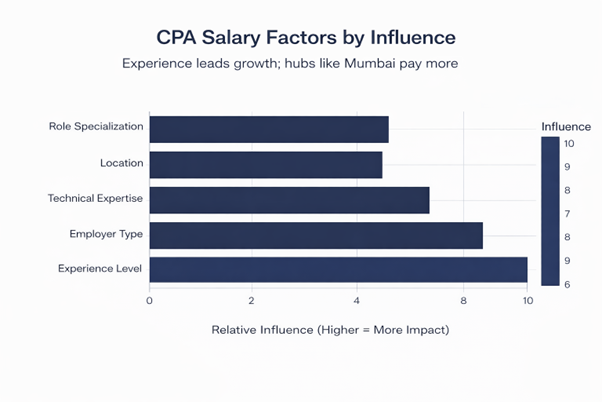
CPA salaries in India are largely influenced by experience, job role, and the organization you are working with. Like other finance professionals, salaries are not static and grow with experience from execution-level jobs to more senior roles.
In the early stages of their careers, CPAs tend to work in roles such as US accounting, audit support, tax compliance, and financial analysis. As professionals gain more experience and assume more responsibility, they move into senior analyst roles and other advisory and finance management positions.
Factors that influence CPA salary
CPA Salary in India – Estimated Range
| Experience Level | Typical Roles | Estimated Salary Range (INR) |
| Fresher (0–2 years) | US Accountant, Audit Associate, Tax Associate | ₹7 – ₹24 LPA |
| Mid-Level (3–6 years) | Senior Analyst, Senior Auditor, FP&A Analyst | ₹25 – ₹50 LPA |
| Senior Level (7–10+ years) | Finance Manager, Controller, Compliance Lead | ₹50 LPA – ₹1 Cr+ |
These figures are indicative and may vary based on the organisation, industry, and individual performance. Over time, professionals who build strong technical expertise and leadership skills can move into senior finance roles such as Finance Manager, Financial Controller, or Head of Finance.
Also know why big 4s pay more for US CPAs in our expert researched guide on CPA salary in big 4 in India
CPA vs CA – opportunities
| Parameter | CA (India) | CPA (US) |
| Duration | Undefined; typically 4- 6+ years depending on attempts | Time-bound;12-18 months with structured planning |
| Exam Structure | Subjective, descriptive exams | 100% computer-based, MCQ + simulations |
| Attempts per Year | Limited attempts per level | Multiple testing windows throughout the year |
| Passing Criteria | Group-wise clearing with aggregate rules | Section-wise; 75 percentile per section |
| Fees | Lower upfront cost but extended over years | Higher upfront cost, predictable total |
| Global Mobility | Primarily India-focused | High global recognition (US, GCC, Big 4, MNCs) |
| Career Flexibility | Strong for Indian public practice & compliance | Strong for corporate, consulting & global roles |
| Work-Life Balance | Demanding, especially in practice & peak seasons | Relatively predictable in corporate roles |
| Risk Profile | High due to dependency on limited attempts | Lower due to flexibility and retake options |
Skills Required to Maximize CPA Career Opportunities
Completing the CPA credential builds strong technical knowledge. However, long term career growth depends on the practical skills you develop alongside. Employers look for professionals who can go beyond theory to apply accounting concepts in real business situations.
The following skills are commonly expected in CPA roles in India
Strong Knowledge of Accounting Standards
Many CPA roles involve financial reporting and compliance work. Because of this, professionals are expected to understand accounting standards clearly.
Two frameworks are especially important:
- US GAAP- widely used for financial reporting and audit work related to US companies
- IFRS- used by many multinational companies for global reporting
Understanding these standards helps professionals prepare financial statements, review reports, and support audit assignments.
Audit and Compliance Understanding
Many finance roles involve internal controls, audit documentation, and regulatory compliance. An understanding of audit procedures, risk assessment and control testing is important for professionals working in consulting firms or corporate finance teams.
Taxation Basics
Even when working outside pure tax roles, professionals often need a basic understanding of taxation principles. Knowledge of compliance processes, documentation requirements and reporting helps in many accounting and finance positions.
ERP and Accounting Systems
Large companies use ERP systems to manage financial data. Familiarity with tools such as SAP, Oracle or other accounting platforms helps professionals handle large volumes of financial information efficiently.
Communication and Documentation Skills
Accounting work requires clear communication and accurate documentation. Professionals often work with global teams, auditors and management. Being able to explain financial information clearly is an important part of the job.
Building these skills alongside the CPA credential helps professionals expand their career opportunities and move into senior finance roles over time.
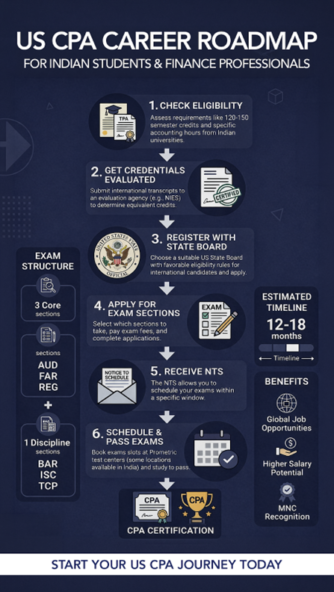
Career Roadmap After CPA in India
Future Career Opportunities for CPAs in India
If you’re considering a CPA career in India, the timing is favorable. The way global companies handle their finance and accounting work has changed significantly and India has landed right in the middle of that shift.
Global Companies Are Setting Up in India
Over the past decade, many large multinationals have moved parts of their finance operations to India through dedicated centers, commonly known as Global Capability Centers (GCCs). These teams take care of financial reporting, audits, compliance and internal controls, among other things.
As these centres grow, companies need people who genuinely understand global accounting standards and can work within complex reporting systems. That kind of expertise doesn’t come easy, which is why qualified CPAs are in demand.
More Outsourcing Means More Opportunities
A significant portion of accounting work for international companies is now handled from India. We’re talking about tax preparation, audit documentation, financial reporting, compliance reviews and more.
As a result, consulting firms, outsourcing companies, and multinational organisations continue to hire finance professionals locally. For many professionals pursuing US CPA career opportunities, this means they can work on international accounting assignments without relocating abroad.
Compliance Requirements Continue to Grow
Anyone working in finance will tell you that regulations have only gotten harder to keep up with. Companies today face more detailed reporting requirements, stricter internal control expectations and closer scrutiny from regulators.
This has made professionals with audit and compliance knowledge genuinely hard to replace. That demand is not slowing down.
India Has Become a Real Accounting Hub
India has quietly built one of the largest finance and accounting talent bases in the world. Global organizations have recognized this, and many now manage core accounting and reporting functions right from their Indian offices.
For professionals building a CPA global career in India, this means international accounting work is increasingly accessible without moving overseas.
As finance functions grow more complex and technology takes on a bigger role, professionals who bring both technical depth and hands-on experience will continue to find strong career prospects ahead.
How EduMont Helps You Build a Strong CPA Career
Clearing the CPA exam is an important milestone. But building a successful CPA career requires more than just passing the exam. It requires the right preparation system, guidance on when to attempt the exam, and a clear understanding of how the qualification fits into long-term CPA career opportunities in India.
At EduMont Classes, the preparation process is designed to address these areas early so students approach the exam with clarity and discipline.
Clarity Before Preparation
Many students start CPA preparation without understanding state board eligibility, credit requirements or attempt timelines. Preparation begins with evaluating these factors so students know exactly where they stand before starting the exam journey.
Structured Study System
CPA preparation requires consistency. Instead of relying on last-minute preparation, students follow a structured study approach that includes.
- Section-wise study plans
- Regular practice tests
- Progress tracking
The focus is on attempting exams only when preparation is complete.
Focus on Core Accounting Concepts
Passing the exam is important, but strong conceptual understanding is equally necessary for professional roles later.
Preparation therefore emphasises clear understanding of
- Accounting and financial reporting
- Audit procedures
- Compliance frameworks
This helps students apply their knowledge in real work environments later in their careers.
Understanding the Career Path
Students are also guided on what accounting jobs after CPA actually involve. This includes discussions around:
- Common job roles after CPA
- Skills employers expect
- How professionals move from entry-level roles to finance leadership positions
This helps students connect exam preparation with long term career development.
Mentorship and guidance
A key part of preparation is having experienced guidance throughout the process. Mentorship helps students stay disciplined, avoid common mistakes, and approach the CPA exam with a clear attempt strategy.
The goal is not only to help students clear the exam, but also to prepare them for the professional expectations that come with building a long-term career in accounting and finance.
Conclusion
The CPA designation has gradually moved from being seen as a US-specific credential to becoming highly relevant within India’s global finance ecosystem.
As multinational companies expand their finance operations in India, the demand for professionals who understand US GAAP, audit frameworks, internal controls, and international compliance systems continues to grow. This has created a wide range of CPA career opportunities across consulting firms, global capability centres, multinational corporations, and financial services organisations.
However, long-term career growth depends on how professionals apply their knowledge in real work environments. Experience in financial reporting, audit documentation, compliance processes, and financial analysis gradually opens the door to more strategic roles such as finance management, controllership, and advisory leadership.
For professionals interested in working on international accounting assignments while building a career in India, CPA offers a structured and globally relevant pathway.
Ready to evaluate your CPA career path?
Check Your CPA Eligibility
FAQs
1. Is CPA useful in India?
Yes. CPA is increasingly relevant in India because many multinational companies manage US financial reporting, audit support, taxation, advisory, and compliance work from Indian offices. Professionals with US GAAP knowledge are therefore in demand.
2. What jobs can you get after CPA in India?
Common CPA roles include US financial reporting, Audit of US-listed companies, US taxation assignments, SOX compliance, Internal auditing, Financial advisory, Internal controls and risk management. These roles are typically found in consulting firms, MNCs, and GCCs.
3. What is the starting salary for CPA in India?
Entry-level CPA salaries in India generally range from ₹7 LPA to ₹24 LPA, depending on the company, job role, and prior experience. Compensation increases as professionals move into senior finance roles.
4. Do Big 4 firms hire CPAs in India?
Yes. Big 4 firms such as Deloitte, PwC, EY, and KPMG regularly hire CPA-qualified professionals for roles in audit, accounting advisory, risk, SOX compliance, and US tax services.
5. Can CPA professionals work in India without going abroad?
Yes. Many CPAs build successful careers in India while working on international accounting and reporting assignments through multinational companies and global capability centres.
6. How long does it take to complete CPA?
Most candidates complete the CPA exam within 12–18 months with a structured preparation plan. The exam consists of four sections that can be attempted separately.
7. Is CPA better than CA for multinational companies?
CPA is often preferred for roles involving US GAAP reporting, international accounting, and global finance teams, while CA is stronger for Indian taxation, statutory audit, and domestic compliance.
8. What skills help CPAs grow faster in their careers?
In addition to CPA knowledge, skills such as financial analysis, audit understanding, ERP systems (SAP/Oracle), and clear communication help professionals progress into senior finance roles.