

If you’ve been researching the US CPA, you’ve probably come across the “150 credit hours” requirement and felt stuck. Is your BCom qualification sufficient? Or will you have to spend years studying all over again? These are precisely the questions that most Indian students face. And the problem isn’t the requirement itself. It’s the lack of clear, structured guidance around it.
The 150 credit hours CPA requirement refers to the total semester hours of college-level education that most US states mandate for CPA licensure. This exceeds the standard 120-credit bachelor’s degree by 30 additional hours, which candidates can earn through graduate programs, extra coursework, or alternative pathways.
This blog will give you a clear idea of:
-
The meaning of the 150-credit rule
-
Evaluation of the Indian degree
-
All the practical ways to complete the extra credits
-
Which option makes the most sense based on your time and budget
150 Credits CPA – What Is the 150-Hour Rule and Why Does It Exist?
A credit-hour rule of 150 credits suggests that, in order to obtain a CPA license in most American states, one has to complete more courses than would be required by a normal bachelor’s degree program. Instead of stopping at 120 credits, you need an additional 30 credits before you can apply for licensure. These credits are measured as accounting semester hours, which is the standard academic unit used by US state boards.
The 150 credit hour rule is often perceived by many students as something difficult. However, this rule serves the purpose of gaining in-depth knowledge in accounting and business.
What Exactly Are the 150 Credit Hours for CPA?
The 150 credits mean the number of higher education credits offered within the United States, measured in semester credits.
The usual distribution of credits may look like the following:
-
Bachelor’s degree: 90-120 credits
-
One additional requirement: 30-60 credits
These extra credits do not have to come from a single source. They could be gained through:
-
Master’s degree (e.g., M.Com, MBA, PGDM Accounting & Finance)
-
Additional courses for a bachelor’s degree
-
Other educational sources, such as online institutions and community colleges
The main thing here is that those credits should be acknowledged by the US State Boards of Accounting and evaluation agencies.
Why Did AICPA Introduce the 150-Hour Requirement?
The AICPA 150 credit-hour requirement was put into place by the American Institute of Certified Public Accountants back in 1988 as a means of elevating the standards of the profession.
The reasoning is quite clear:
Jobs in accounting are getting more complicated. The fields of financial reporting, auditing, taxation, and regulation require better comprehension than simply having a college-level knowledge.
With the added year of schooling, the purpose of the requirement would be to:
-
Boost analytical abilities
-
Educate for complexity
-
Enhance professional credibility worldwide
Eventually, it became the norm for most American states.
Is the 150-Hour Rule Going Away in 2026?
The 150-credit requirement is not being removed, but the pathway to becoming a CPA is becoming more flexible.
As of 2026, some US states have devised an alternative method by which individuals will only need 120 credits in lieu of the previous number of 150 credits.
But there are certain other criteria that need to be fulfilled.
The following requirements need to be fulfilled in order to become a CPA through the new route:
-
Bachelor’s degree with specified accounting courses
-
CPA exam passed
-
Professional experience of two years instead of one
In short, the requirement has not been done away with. There has been a modification in it.
120 vs 150 credits in CPA:
-
150 credits and 1 year of experience (traditional path)
-
120 credits and 2 years of experience (alternative path)
This will provide more freedom to Indian students in the sense that, depending on personal preferences, one may opt for one of the above paths.
How to Get 150 Credit Hours for CPA – All Pathways Explained
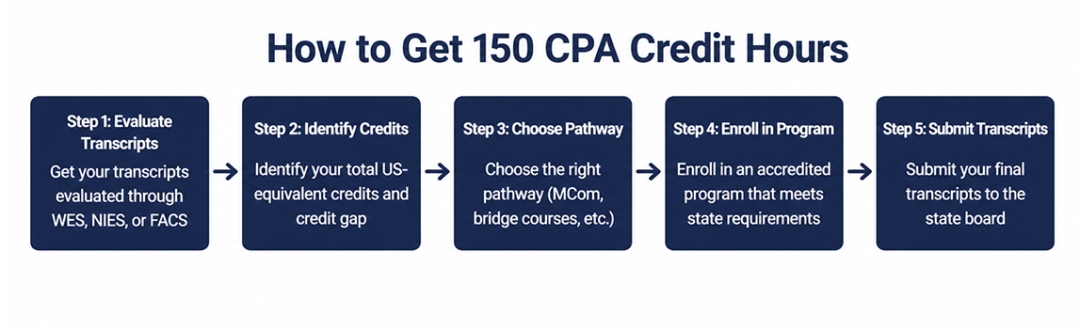 There are multiple ways to complete the required 150 CPA credits. The right path depends on your current education, budget, and timeline. This shortfall is commonly referred to as the CPA credit gap.
The main CPA coursework options include a bachelor’s plus master’s CPA route, MAcc for CPA programs, community college CPA credits, and additional courses to complete the extra 30 credits CPA requirement.
Can You Get 150 Credits With a Bachelor’s Degree Plus Extra Courses?
Yes. If you have a bachelor’s degree, then this is probably the quickest path to achieve your goal.
All you need to do is take additional coursework and earn credits via:
-
Extra undergraduate courses
-
Certificate programs
-
Approved academic extensions
This works well if you want a cost-effective and flexible option without committing to another full degree.
Is a Master’s Degree the Best Way to Reach 150 Hours?
The Master’s degree (M.Com or MBA for eg.) is the most systematic way of attaining 150 credits.
It will give you:
-
All mandatory credits in one program
-
Subject expertise
-
Strong academic credentials
But at the same time, it is the costliest and the longest route and hence is only justified if you have a high regard for the degree as well.
Can You Use Community College Credits for CPA?
Absolutely, in many situations.
At community colleges, you can gain further credits at affordable rates. These are typically accepted if:
-
It is an accredited college.
-
It satisfies the state board criteria for credits.
It is among the most cost-effective means of attaining the extra 30 credits, particularly for effective planners.
Do Online Courses Count Toward CPA Credit Hours?
Yes, as long as they are from an accredited institution.
An online course is definitely a good choice if you are searching for a more flexible way. What is important here is not the format but the following factors:
-
Accredited status of the institution
-
The credits are accepted by evaluation agencies and state boards
With a careful selection, this is definitely a flexible and targeted way to bridge your credit gap.
How to Get 150 Credits for CPA as an Indian Graduate

If you’re coming from an Indian education background, the process starts with one thing: understanding how your degrees translate into US credits. Once that’s clear, the rest becomes a planning exercise.
How Many US Credits Does a 3-Year B.Com Equal?
B.Com degrees in India are generally considered to be worth 90 to 100 semester credit hours in the US. A B.Com honours, however, can fulfill your 120 credit requirement in most cases.
If you have a 3 year B.Com:
-
You are falling short of the 120-hour minimum requirement in many states
-
Also far off the mark from the minimum 150 hours for licensure
The exact number depends on your university and evaluation agency, but most students should expect a clear credit gap after BCom alone.
Want to know your exact credit hours? Avail a free eligibility check with EduMont today.
How Many Credits Does an M.Com or CA Add?
Both M.Com and CA can affect your credit standing greatly, but the results will depend upon what combination you hold and how that combination is evaluated.
-
M.Com (after BCom): Generally, this combination is evaluated to be equivalent to about 150 US credits and thus fulfills the education criteria required for CPA certification.
-
CA:
CA final + B.Com: Generally evaluates to be around 150 credits and qualifies candidates for licensure in most states.
CA Intermediate + B.Com: Helps in reaching 120 credits and allows you to attempt CPA exams, but might still make a deficit for licensure.
Never rely on your qualifications alone. Always remember to:
-
Evaluate your credentials
-
Check state-specific requirements
-
Verify the eligibility for both the examination and certification separately
How Do You Bridge the Credit Gap From India?
As soon as your credits have been reviewed, the following step is easy, as you should simply plug the gap effectively.
The main approaches for most Indian applicants to plug the gap include:
-
Additional coursework (targeted subjects)
-
Accredited online courses
-
Credits from community colleges
-
A Master’s Degree program (if they want a structured route)
Remember, the aim is to accumulate 150 credits, but it should be done according to your timeline, budget, and future career goals.
Which Credential Evaluation Agency Should You Use?
First and foremost, your transcripts need to undergo evaluation from an accredited agency recognized by your desired US State Board of Accountancy.
The most frequently utilized agencies among CPA hopefuls include:
-
World Education Services
-
Foreign Academic Credentials Service
-
NASBA International Evaluation Services
Every state board has its own agencies that it recognizes, which means this decision cannot be a random one.
This decision needs to be made taking into account your chosen state board, not the ease or swiftness of the process.
Ways to Get 150 Credits for CPA – Cost and Time Comparison
Not all pathways to 150 credits are equal. The right choice depends on how much you’re willing to spend, how quickly you want to move, and whether you value an additional degree. For many students, this additional year of education is often called the fifth-year CPA requirement.
M.Com vs MAcc vs MBA vs Bridge Courses – Which Path Is Cheapest?
|
Pathway |
Approx Cost |
Time |
Credits Earned |
CPA Relevance |
Best For |
|
MAcc (US) |
$20K–$60K |
1–2 years |
Full 150 |
Very High |
Students targeting US exposure |
|
MBA |
₹5L–₹25L+ |
1–2 years |
Varies |
Low–Medium |
Career switchers |
|
M.Com (India) |
₹20K–₹1.5L |
2 years |
Can reach 150 |
Medium |
Budget-focused students |
|
Bridge Courses |
₹50K–₹2L |
6–12 months |
Targeted credits |
High |
Students with small gaps |
|
Community College |
$150–$400/credit |
6–12 months |
Flexible |
High |
Cost-efficient planners |
|
Online Programs |
₹30K–₹2L |
6–12 months |
Flexible |
Medium–High |
Working professionals |
Can Work Experience Replace the Extra 30 Credits? (2026 Update)
In terms of the schedule for Indian students, it will vary based on the approach taken towards obtaining the desired degrees or credits.
|
Pathway |
Duration |
Notes |
|
M.Com (India) |
2 years |
Suitable for direct post-BCom candidates |
|
MAcc (Abroad) |
1-2 years |
Depends on university requirements |
|
MBA |
1-2 years |
May not align fully with CPA credit requirements |
|
Bridge Courses / Additional Credits |
6-12 months |
Can be shorter if only specific credits are needed |
|
Community College (US / Online) |
6-12 months |
Duration varies based on course load and schedule |
Implications for planning:
-
In case you have B.Com + M.Com or CA qualifications, it is possible that no additional time is required following an assessment.
-
Should you have a credit deficiency, taking specialized courses would likely be the quickest option as opposed to pursuing a full degree.
For most Indian candidates, the realistic timeline to reach 150 credits depends on your starting point and chosen pathway.
150 Credit Hours CPA – State-by-State Quick Reference
The 150-credit rule is not applied uniformly anymore. What matters is where you apply. Some states are strict, some are flexible, and some now allow you to start earlier but still require 150 hours for licensure.
Which States Still Require 150 Credits With No Alternative?
Some states continue to follow a strict 150-credit model, where you typically need to complete all educational requirements before applying for the CPA exam.
Some common ones (as of now) are:
-
California
-
New York
-
Illinois
-
Massachusetts
Characteristics of such jurisdictions are:
-
More traditional
-
More resistant to other routes
-
Heavy in documentation
Implications on your end:
-
You’ll have to finish your 150 credits first
-
There’s no early test-taking benefit for you
-
It is necessary that you plan your credit requirements early on
For Indians, it usually translates into:
-
The B.Com alone won’t cut it
-
You’ll have to pursue further education, e.g., an M.Com, before attempting to take the test
Which States Now Offer the 120-Credit Pathway?
A growing number of states now allow candidates to sit for the CPA exam at around 120 credits, while still requiring 150 credits later for licensure.
Examples include:
-
Alaska
-
Georgia
-
Virginia
-
Washington
It is becoming increasingly popular, but keep in mind that:
-
It is constantly developing
-
Timeframes vary among states
-
Specific conditions differ
What this changes:
-
You can start the CPA exam earlier
-
You don’t have to delay your attempt just to complete credits
-
You can complete the remaining credits alongside or after exams
Note: This is not a relaxation of the requirement. It’s only a shift in timing.
Which States Are Best for Indian CPA Candidates?
There are no “best states” that you could simply choose beforehand.
Examples of such include:
-
Alaska
-
Montana
-
Guam
But even here, suitability depends on multiple factors.
Criteria for determining which is the most appropriate state include:
-
Your credit evaluation result (WES/NIES/FACS)
-
Acceptance of your 3-year degree as an equivalent
-
Total credits awarded
-
Need for documentation (SSN, proof of residency, and so on)
This is why two students with the same degree can still end up choosing different states.
How EduMont Helps You Plan Your 150 CPA Credit Hours
Where students struggle is in planning their 150 credits, which may not necessarily be complicated.
At EduMont, the focus is simple: clarity before action.
What backs this approach?
-
Pass-in-One-Attempt Formula through structured preparation
-
Personalized Game Plan Calls based on your profile
-
Unlimited UWorld resources for practice and testing
-
Mentor-led guidance, not generic advice
This means preparing for an exam and organizing your credits, time and pass attempts correctly.
Does EduMont Offer CPA-Aligned Courses?
EduMont offers 100% AICPA-aligned CPA study material, ensuring that:
-
Your study materials cover everything in the exam.
-
Your preparation process is focused.
-
Your preparation process follows an efficient path and is not hampered by extraneous details.
In addition to these, you also have:
-
Unlimited UWorld access for structured preparation
-
LMS-based learning process guiding you through your guidance and training
-
Pre-annotated notes that simplify complex topics
-
Mock tests aligned with actual CPA exam patterns
How Can EduMont’s Mentors Help With Credit Planning?
That’s where the real value lies. EduMont’s approach is:
-
Start with your academic background (B.Com, CA, M.Com, etc.)
-
Guide you toward getting a proper transcript evaluation
-
Help you understand your actual credit gap
Based on that, mentors help you:
-
Decide whether you should:
-
Start with the CPA exam (if eligible), or
-
Complete credits first
-
-
Choose between:
-
M.Com
-
Bridge courses
-
Additional certifications
-
More importantly, they help you avoid common mistakes:
-
Choosing the wrong state
-
Overpaying for unnecessary degrees
-
Delaying your CPA attempt due to poor planning
Conclusion
In addition to being an eligibility criterion, the 150-hour requirement is a planning step that will impact your timeframe, budget, and entire CPA experience.
Most setbacks do not result from the exam per se. Instead, they are caused by a lack of clarity about credit planning, choosing the wrong state, and not having an initial evaluation before proceeding.
If approached correctly, there is no reason why it shouldn’t be easy for you:
-
Understand your current credits
-
Choose the right state based on your profile
-
Bridge the gap in a structured way
There is no single “best” route. What works depends on your background and evaluation outcome.
Focus on clarity first. Once all aspects align, becoming a CPA won’t be such a daunting task anymore.
FAQs About 150 Credit Hours for CPA
What is the 150 credit hour requirement for CPA?
The 150 credit hour requirement refers to the total college-level education needed for CPA licensure in the US. The standard bachelor’s degree program provides for about 90 credits, meaning another 30 hours for the exam and 60 credit hours for licensure.
How do I get from 120 to 150 credit hours for CPA?
You can complete the extra 30 credits through M.Com, MBA or other additional courses.
For many Indian students, a PGDM in Accounting is a practical option as it adds relevant credits at a lower cost.
The right choice depends on your evaluation, budget, and timeline.
Can I sit for the CPA exam with only 120 credit hours?
Yes, in certain states.
You can take the CPA exam with about 120 credits.
That said, this applies only for the exam but not the license. Typically, you will have to meet the following requirements:
-
150 credits in total
-
Relevant work experience
The ABE criteria (Accounting, Business, Economics) could help if you come from an overseas institution. This means that although you do not have 120 credits, you can begin taking the exam since you fulfill the minimum number of subjects.
But this does not change the end requirement.
You can begin before 120 credits
You will still need 150 credits to become a CPA.
Does a 3-year Indian B.Com degree meet the 150-hour CPA requirement?
No, a 3-year B.Com alone usually evaluates to around 90-100 US credits. This means you will still need additional credits to reach the 150 credit requirement. Most students bridge this gap through M.Com, CA, or additional coursework. The exact number depends on your transcript evaluation.
What is the cheapest way to earn the extra 30 CPA credits?
The most cost-effective option is usually additional coursework or community college credits rather than a full master’s degree. Online accredited programs can also be a flexible and affordable route. However, cost should not be the only factor. The credits must meet state requirements and align with your CPA plan.
Are states removing the 150-credit-hour CPA requirement in 2026?
No, the 150-credit requirement is not being fully removed, but the model is evolving. While many states now allow exam entry at 120 credits, some are introducing alternative pathways where candidates can obtain licensure with 120 credits plus additional work experience (typically 2 years). These options are state-specific and still developing, so requirements can vary.
Can I use CLEP exams or online courses for CPA credit hours?
In many cases, yes. Some states accept CLEP exams and accredited online courses toward CPA credits. However, acceptance depends on the state board and the type of course. You should always confirm eligibility before enrolling to avoid wasting time or money.
Does EduMont help students plan their CPA credit pathway?
Yes, EduMont helps students understand their credit position and plan the next steps. This includes guiding you through transcript evaluation, identifying your credit gap, and choosing the right pathway. The focus is on clarity and structured decision-making, not generic advice.
How long does it take to earn 150 credit hours for CPA from India?
It typically takes 1-2 years to bridge the credit gap, depending on the route you choose. A master’s degree may take longer but offers structured learning, while additional coursework can be faster. Your timeline depends on your starting credits and how efficiently you plan the process.
Is a Master’s in Accounting (MAcc) the best way to get 150 credits?
Not necessarily, especially for Indian students. A MAcc is well-aligned with CPA requirements, but it is expensive and often not the most practical route. For many Indian candidates, a PGDM in Finance & Accounting or similar programs can be a more cost-effective and relevant way to earn additional credits. The right choice depends on your credit gap, budget, and long-term plan.