


While selecting between ACCA and CPA, most candidates get stuck in the very first question, ACCA or CPA, which is better?
That is not something to be confused with. The difference does not lie in ease or recognition. It lies in your desired work location and profile.
ACCA is a UK-based accounting qualification built on IFRS, structured across 13 papers, and accepted across multiple countries. CPA is a US-based designation focused on US GAAP and tax, completed through 4 exam sections, and widely valued in US-facing roles and multinational companies.
Both are global. But they lead to different career directions.
This blog compares ACCA and CPA on the basis of Eligibility criteria, Exam structure, Difficulty level, Salary, Cost, and Career Opportunities, so you can choose the right accounting certification in India based on your goals.
Key Takeaways
- ACCA & CPA are both international accreditations but suited for different types of accounting systems
- ACCA is built on IFRS, while CPA is built on US GAAP and US taxation
- CPA is shorter but more intense per section; ACCA is longer but more spread out
- Choose based on your career trajectory not ease of studying
ACCA vs CPA – Quick Comparison at a Glance
ACCA is a UK-based accounting qualification built on IFRS, while CPA is based on US GAAP, making this an ACCA IFRS vs CPA GAAP comparison at its core.
What Is ACCA?
The ACCA is an accountancy designation in the UK, which has its core basis in IFRS (International Financial Reporting Standards). It has a total of 13 papers, organized at various levels, and aims to develop expertise in accounting, auditing, taxation, and performance management.
The typical candidates for ACCA are:
- Those who desire early entry post 12th
- Prefer a structured, level-based progression
- Seeking positions within accounting, auditing, and finance streams
It emphasizes principles-based accounting and hence can be applied to different jurisdictions.
What Is CPA?
The US CPA (Certified Public Accountant) is the highest standard in accounting and finance in the United States, granted by state boards and governed by the AICPA. It is a globally recognized designation for professionals qualified in auditing, taxation, and financial reporting, allowing for roles in public accounting, finance, and corporate leadership.
Generally, CPA is sought by those individuals who:
- Seek careers within US accounting systems
- Seek employment in US MNCs, Big 4 companies, or global capability centers
- Prefer a shorter route to being designated
What Is the Core Difference Between ACCA and CPA?
This ACCA vs US CPA comparison highlights the key differences in structure, standards, and career alignment.
| Parameter | ACCA | CPA |
| Governing Body | UK-based ACCA | US-based AICPA |
| Accounting Standard | IFRS | US GAAP |
| Structure | 13 papers (levels) | 4 exam sections |
| Duration | 3–4 years | 12-18 months |
| Eligibility | After 12th (10+2) | Bachelor’s + 120–150 credits |
| Pass Benchmark | 50% per paper | 75 (scaled score) |
| Exam Approach | Spread out, progressive | Short, intensive |
| Cost (India) | ₹2–4 lakh | ₹3–5 lakh |
| Career Alignment | Accounting, audit, finance roles | US accounting, audit, compliance |
ACCA vs CPA Eligibility – Who Can Apply?
ACCA vs CPA eligibility is one of the first real filters in this decision.
Not everyone can start both at the same stage, and this directly affects your timeline.
What Are the Eligibility Requirements for ACCA?
ACCA provides one of the most flexible routes to entry in accounting.
You can join ACCA:
- After 12th/10+2
- After graduating (BCom, BBA, etc.)
- Or even when you’re already working as a professional
There are no hard credit constraints here. Instead, ACCA follows the level system, whereby you move from basic to advanced papers.
In case of having a relevant qualification, you might be eligible for paper exemptions, thereby lowering your number of exam papers for you, but that exemption comes at a cost.
The implications:
- Early birds get more time
- Degree holders benefit from exemptions
- No entry barrier in terms of education
What Are the Eligibility Requirements for CPA?
CPA uses a more formal academic eligibility framework.
For pursuing CPA, you normally have to:
- Possess a bachelor’s degree
- Have 120-150 academic credit hours (commonly referred to as the CPA 150 credit requirement)
- Submit an analysis of your academic records
That implies that:
- Indian students usually qualify only after completing their graduation
- Some students might require extra credits through bridge courses
CPA eligibility is strict, yes. But most Indian candidates with a commerce background qualify . It is requirement-driven, not level-based.
Can You Start ACCA After 12th but Not CPA?
Yes. This is one of the most obvious distinctions between both.
- ACCA studies commence right after completing the 12th.
- However, in order to commence the CPA course, you need to first graduate from university.
Thus arises an extremely different timeline for both programs:
- ACCA gives you the option to commence early and qualify while completing your degree
- Whereas, with CPA, you commence later in life but the program itself is shorter
However, the early start with ACCA does not automatically mean you finish faster. Since the qualification itself typically takes 3-4 years, the overall timeline often aligns closely with your graduation period.
ACCA vs CPA Exam Structure – Papers, Sections, and Timeline
This ACCA vs CPA exam structure comparison shows how each qualification is designed and how that impacts your preparation.
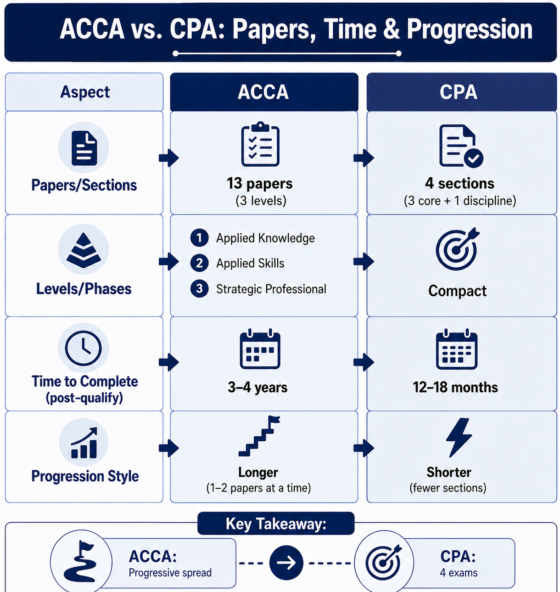
In simple terms, the ACCA vs CPA exam structure determines whether your preparation is spread out over time or concentrated into fewer, high-intensity exams.
How Many Papers Does ACCA Have?
The ACCA has 13 papers and can be categorized into three different levels:
- Applied Knowledge
- Applied Skills
- Strategic Professional
Step by step, you will acquire knowledge incrementally.
Implications of this design include:
- The structure is progressive and spread out
- You typically take one or two papers at a time
- Preparation is more about consistency over a longer period
How Many Sections Does CPA Have?
CPA Exam consists of 4 exam sections:
- 3 Core papers
- 1 Discipline section (depending on the specialization you choose)
All 4 sections need to be completed within a given time period.
This implies that:
- The structure is compact
- Each section covers a large volume of content
- Preparation is more about intensity and focus in shorter cycles
How Long Does Each Qualification Take to Complete?
ACCA: Usually 3-4 years
CPA: Usually 18-30 months (after qualification)
However, just the period does not paint the whole picture.
ACCA divides the burden into more subjects over a longer time frame
CPA concentrates the burden into fewer sections.
In conclusion, the actual disparity lies here:
ACCA → longer, steady progression
CPA → shorter, high-intensity progression
ACCA vs CPA Difficulty – Which Is Harder to Pass?
This is where most comparisons go wrong.
Students try to reduce it to one answer: which is harder?
ACCA vs CPA difficulty cannot be judged by a single metric. It depends on how the exam is structured and how you prepare.
What Are the Pass Rates for ACCA vs CPA?
Both qualifications have similar pass benchmarks at a high level, but they work differently.
ACCA
- Passing mark: 50%
- Passing rates: average of 45 to 55%, varying by paper
CPA
- Passing mark: 75 (scaled score)
- Passing rates: average of 45 to 55%, varying by section
In summary, they appear alike.
However, the passing rates do not measure:
- volume per exam
- exam format
- preparation pressure
Is CPA More Intense Per Section Than ACCA?
CPA
- Each section covers a large yet systematic syllabus
- Each exam consists of MCQs and task-based simulations
- Needs thorough preparation before taking the test
Which Qualification Has a Tougher Overall Journey?
The difficulty comes in different forms.
CPA becomes difficult when:
- You find it challenging to undertake intensive study routines
- You don’t have a clear study plan
- You attempt exams without being adequately prepared
ACCA becomes difficult when:
- You lose consistency when studying over an extended period
- You continually postpone writing your papers
- You perceive ACCA as flexible and procrastinate
Ultimately,
- CPA is difficult on a section-by-section basis
- ACCA might be more difficult on the overall journey
ACCA vs CPA Salary – Earning Potential in India and Abroad
Salaries are a major factor that influences decisions, but this is usually where people start comparing incorrectly.
ACCA or CPA does not give a guarantee of any kind of salary package.
All they do is place you in a position where you can earn.
What Is the Average ACCA Salary in India?
The average salary for ACCA holders in India is generally from various accounting and auditing positions.
- Starting salary range: ₹6-12 LPA
- Mid-level salary (3-6 years): ₹12-25 LPA
Some common designations include:
- Financial analyst
- Auditor associate
- Management accountant
However, your income will depend a lot on:
- Experience
- Specialization
- Company (Big 4 vs mid-sized vs industry)
What Is the Average CPA Salary in India?
CPAs are typically assigned US-aligned roles in India.
Entry level: ₹8 – 15 LPA
Mid-level salary (3-6 years): ₹12-25 LPA
Examples of job positions held include:
- US accounting and bookkeeping
- Audit and assurance
- US taxation and compliance
- Financial reporting under US GAAP
- Risk advisory and internal controls
- SOX compliance and regulatory reporting
The higher starting range is largely driven by demand from US MNCs and global capability centers.
How Do ACCA and CPA Salaries Compare Globally?
Both designations are used internationally, however, salaries would vary depending on the market demand and regulation conformity.
ACCA professionals are practiced in numerous countries, particularly in the IFRS framework
CPA professionals conform with the US accounting system, which is popularly practiced globally
In practice:
Mobility across the globe applies for both
Salaries, however, differ according to location and organization, rather than the credential itself
Which Qualification Offers Faster Salary Growth?
There is no automatic salary increase in either route. The process involves:
- role progression
- skill depth
- complexity exposure
Nonetheless, there are indications that:
CPA
- Faster initial jump due to specialized demand
- Strong early growth in US-facing roles
ACCA
- Steady, long-term growth across broader roles
- Progression depends more on experience and role shifts
ACCA vs CPA Scope – Career Opportunities and Global Recognition
Scope is not about where a qualification is “accepted.”
It’s about where your skills are directly applicable and in demand.
Both ACCA and CPA are used globally. The difference is how they align with different accounting systems, employers, and roles.
Where Is ACCA Recognized Globally?
ACCA is based on IFRS standards, which are prevalent in many countries.
This makes ACCA relevant in:
- United Kingdom & Europe
- Middle East (UAE, Qatar, Saudi Arabia)
- Asia & Africa
Common areas of application are:
- Financial accounting and IFRS reporting
- Audit and assurance (external and internal)
- Management accounting and cost control
- Corporate finance and business analysis
- Taxation (depending on region and local regulations)
- Financial planning and analysis (FP&A)
- Treasury and cash flow management
- Risk management and internal audit
- Consulting and advisory roles
ACCA works well in environments where:
- IFRS is the reporting base
Where Is CPA Recognized Globally?
CPA is compatible with US GAAP and US regulations.
CPA has a lot to offer in:
- United States, Europe, Middle East, Australia, Asia (especially India)
- US-based multinational corporations
- India’s global capabilities centers (GCCs)
Opportunities available include:
- US accounting and financial reporting
- Audit and assurance for US-listed and multinational entities
- US taxation (individual, corporate, international tax)
- Compliance and regulatory reporting (SEC filings, disclosures)
- SOX (Sarbanes-Oxley) internal controls and testing
- Internal audit and risk advisory
- Financial planning and analysis (FP&A) for US entities
- Advisory and consulting (process improvement, controls, reporting)
- Shared services and controllership roles in MNCs
These roles exist wherever companies:
- follow US GAAP
- report to US stakeholders
- or operate under US regulatory frameworks
Which Is Better for Big 4 Careers?
Both ACCA and CPA are accepted at Big 4 firms; this isn’t what sets them apart.
The difference is in what kind of projects you get assigned.
ACCA aligns more naturally with IFRS-based audit, financial reporting, and advisory work
CPA aligns more directly with US audit engagements, US reporting, and compliance-driven roles
Big 4 firms in India serve both IFRS and USA clients.
Thus, practically speaking,
It affects who your clients will be, depending on your qualifications.
Your exposure will depend on whether your reporting system expertise is IFRS or USA.
Which Is Better for US MNC Roles in India?
For US-facing roles in India, CPA has a clearer alignment.
- Strong demand in GCCs and US MNC finance teams
- Direct relevance to US GAAP, SEC reporting, and tax systems
ACCA can still be relevant, but:
- It may require additional adaptation to US systems
- Roles may be broader, not always US-specific
ACCA vs CPA Cost – Total Investment Comparison
Cost is not just about how much you pay.
It’s about how much you spend, how long you take, and how quickly you recover that investment.
ACCA vs CPA Cost (India)
| Component | ACCA | CPA |
| Registration / Application | ₹8,000–₹12,000 | ~₹33,000 |
| Annual Subscription | ₹30,000–₹50,000 (3–4 years) | Not applicable |
| Exam Fees | ₹1,65,000–₹2,45,000 (13 papers) | ₹3,27,600 (4 sections) |
| Ethics / Additional Modules | ₹9,500–₹11,000 | Included in exam structure |
| Total Cost | ₹2.2–3.2 lakh | ~₹3.6 lakh |
What Is the Total Cost of ACCA From India?
The cost structure of ACCA is quite elaborate yet dispersed across multiple components.
Based on official fee ranges:
- ACCA Registration Fees: ₹8,000 to ₹12,000
- Subscription Fees (for 3-4 years): ₹30,000 to ₹50,000
- Examination Fees for All 13 Papers: ₹1,65,000 to ₹2,45,000
- Ethics Module EPSM Fees: ₹9,500
Total estimated cost: ₹2.2–3.2 lakh (excluding coaching cost)
Important:
- Costs are distributed over time
- Longer duration increases subscription cost
- Exemptions reduce total exam cost slightly
What Is the Total Cost of CPA From India?
CPA is a more expensive process up front.
Based on official data:
One-time costs:
- Evaluation + registration: ₹33,000
Exam costs (4 sections):
- Per exam: ₹81,900
- Total exams: ₹3,27,600
Total CPA cost: ~₹3.6 lakh (excluding coaching cost)
Important:
- Higher upfront commitment
- Costs are concentrated within a shorter timeline
- Retakes can increase total significantly
Which Offers Better ROI for Indian Students?
While the figures show that ACCA is more affordable, cost does not determine the ROI.
ACCA allows you to invest in a timeframe of 3-4 years, making the course manageable financially. However, the longer duration means your earning jump is delayed, and your ROI builds gradually over time.
CPA, in contrast, requires a higher initial investment. But because it can be completed faster and aligns closely with US MNC roles, many candidates experience faster salary growth, reducing the recovery period.
So instead of comparing cost alone, it makes more sense to look at:
ACCA- slightly lower investment, longer recovery cycle
CPA- higher investment, quicker recovery potential
In both cases, ROI ultimately comes down to one factor: how fast you finish the licensure and move into the right role.
ACCA vs CPA for Indian Students – The Decision Framework
| If You Want… | Choose | Why |
| Start after 12th | ACCA | You can begin early without waiting for graduation |
| Work in IFRS-based roles | ACCA | Built around IFRS and financial reporting frameworks |
| Flexibility across roles and regions | ACCA | Broader applicability across accounting and finance |
| A step-by-step exam structure | ACCA | Spread across levels with gradual progression |
| Work in US MNCs or GCCs | CPA | Direct alignment with US GAAP and reporting |
| Higher starting salary potential in India | CPA | Strong demand in US-facing roles |
| Faster completion timeline | CPA | Can be completed in 18–30 months |
| Specialized roles (US tax, SOX, audit, compliance) | CPA | Designed for US regulatory environments |
Choose ACCA If…
- You want to begin right after 12th
- You prefer a steady, long-term progression
- You’re aiming for roles in IFRS based financial reporting, audit, or corporate finance
- You want flexibility across industries and locations
Choose CPA If…
- You already meet the eligibility criteria (graduate with required credits)
- You’re aiming for roles in US MNCs or global capability centers
- You prefer a shorter, more intensive path
- You’re targeting accounting, audit, taxation, or compliance roles in India
Can You Pursue Both ACCA and CPA?
Yes, but for most students, it isn’t necessary.
Both cover similar core accounting concepts, but they are built for different systems. Doing both only makes sense if:
- Your role requires cross-border reporting exposure
- You plan to work across both IFRS and US GAAP environments
For most people, the better approach is to:
- Choose one based on your career direction
- Complete it efficiently
- Build experience in that specific domain
How Does Edumont Help You Choose and Prepare?
The EduMont approach is not about offering multiple options. It focuses on helping you make the right choice once and prepare with clarity from the very beginning.
With over half a decade of experience, we specialize in CPA preparation built around a pass-in-one-attempt formula.
If CPA aligns with your career direction, the system supports you end-to-end, with a clear structure, consistent practice, and better decision-making at every stage of preparation.
Preparation is built on the following principles:
- First-attempt mindset
The focus is on being fully prepared before attempting, rather than rushing. Students follow a structured plan that ensures depth of understanding. - Unlimited practice and exam exposure
Access until you pass, to UWorld question banks, mock exams, and varied practice formats ensures continuous exposure to exam-level difficulty. - Live, Concept-based teaching
Classes follow a chalk-and-talk approach with real-time doubt solving. The focus is on clarity and application, especially for sections like FAR and AUD where understanding matters more than memorization. - Centralized learning system (LMS)
All lectures, notes, and resources are organized in one place, enabling structured revision without relying on scattered materials. - Mentorship-driven preparation
Ongoing guidance covers everything from section sequencing to exam timing, helping students make informed decisions at every stage. - End-to-end support
Support goes beyond exams, including interview preparation and development of role-relevant skills.
The objective is straightforward:
reduce confusion, improve decision-making, and ensure each attempt is made with clarity and proper preparation.
Conclusion
ACCA and CPA do not compete against each other. They operate in separate frameworks and serve. There is no issue of safety or popularity in deciding between an ACCA or CPA. The choice simply lies in identifying the accounting system in which you are willing to progress your career in the long run.
While the ACCA is known to provide breadth, versatility, and headstart in career, CPA offers a lot of depth and speed, along with direct exposure to the world’s largest accounting market.
One of these is bound to suit you better depending upon your qualifications, potential employers, and desired career goals.
What causes most students trouble is not their inability to cope with the curriculum but their lack of proper focus and direction in the course preparation process.
Choose your qualification wisely and then prepare yourself to pass in one attempt.
FAQs About ACCA vs CPA
Which is better for Indian students, ACCA or CPA?
There’s no universal answer, but for many Indian students, CPA is often the more practical choice.
It offers a shorter timeline and stronger alignment with US MNC and global capability center roles.
ACCA is better suited if you want to start after 12th or prefer a longer, structured progression.
The right choice depends on your career direction and eligibility.
Can I start ACCA after 12th but not CPA?
Yes.
ACCA can be started after 12th (10+2).
CPA requires a bachelor’s degree and specific credit requirements, so you can only start after graduation.
Which pays more in India, ACCA or CPA?
On average, CPA roles in India tend to offer higher starting salaries, especially in US MNCs and global capability centers.
However, salary depends on:
- role
- company
- experience
Both qualifications can lead to strong earnings over time.
Is CPA harder than ACCA?
Not exactly.
- CPA is more intense per section
- ACCA is longer and requires sustained consistency
Difficulty depends on how well your preparation matches the exam structure.
Is ACCA recognized in the United States?
ACCA is recognized by employers globally, including in the US.
However, it does not grant the same regulatory standing as CPA for signing or licensing in the US.
Can an ACCA holder become a CPA?
Yes, but you must meet CPA eligibility requirements:
- required academic credits
- state board criteria
There is no automatic conversion. You may need additional coursework.
Which is better for Big 4 jobs, ACCA or CPA?
Both are accepted.
ACCA aligns with IFRS-based audit and reporting roles, while CPA aligns with US audit and compliance engagements.
Your work depends more on client type and team allocation than the qualification alone.
How long does it take to complete ACCA vs CPA?
- ACCA: typically 3-4 years
- CPA: typically 12-18 months (after eligibility)
ACCA is spread out, while CPA is more compact and intensive
Can I pursue both ACCA and CPA together?
It is possible, but not necessary for most students.
Both qualifications overlap in core concepts but are designed for different systems.
In most cases, it is better to complete one properly and build experience before considering the other.
Does Edumont offer coaching for both ACCA and CPA?
As of now, EduMont focuses on CPA preparation.
The system is designed around:
- clear eligibility guidance
- structured preparation
- first-attempt readiness