


Most students don’t struggle to find jobs after B.Com.
It’s about choosing the right job.
While finance, accounting, banking, and auditing appear to be valid finance career options for commerce graduates, each of them requires distinct skills, certifications, and timings. Due to a lack of insight, many graduates end up in low-growth entry-level finance jobs that don’t lead anywhere.
The truth is simple:
Getting a B.Com is the first step on the ladder; it doesn’t dictate where you end up on it.
To build a strong path in B.Com finance jobs, you need:
- Clear roles
- Job-ready skills
- Certification at the right point in time
In this guide, you’ll discover:
- Best financial jobs for B.Com graduates
- Salaries to expect from B.Com jobs in India
- Required skills for each type of role
- Career path post-B.Com
Finance Jobs for B.Com Graduates
All jobs in finance may not provide equal growth opportunities for graduates of B.Com.
There are some jobs that focus more on execution rather than decision-making, whereas there are other positions that will lead you towards analysis and planning with high salaries.
| Job Role | What You Actually Do | Best For |
| Accountant | Maintain books, prepare financial statements, and handle GST filings | Strong accounting basics, Tally/ERP users |
| Financial Analyst | Analyse financial data, create reports, and support business decisions | Analytical thinkers aiming for growth roles |
| Audit Assistant | Assist in audits, verify records, and ensure compliance with Ind AS | Detail-oriented, process-driven individuals |
| Tax Associate | Handle income tax, GST, and TDS filings & compliance | Those interested in taxation and laws |
| Banking Executive | Manage operations, customers, and relationships within banks | Banking and finance aspirants |
| Credit Analyst | Evaluate loan applications, assess risk & creditworthiness | Strong analytical and decision-making mindset |
| Accounts Executive | Manage daily bookkeeping, invoicing, and bank reconciliations | Entry-level candidates starting in accounting |
| AP/AR Analyst | Handle payables/receivables, vendor reconciliation, collections | Process-driven and detail-focused individuals |
| Investment Banking Analyst (Intern/Entry) | Research, financial modeling, build pitch decks | High-growth, competitive career seekers |
| Finance Executive | Support budgeting, forecasting, and financial reporting | Those exploring core finance roles |
| Payroll Executive | Manage salaries, deductions, and statutory compliance (PF, ESIC) | Compliance-focused, structured thinkers |
| Operations/Back Office Executive | Handle documentation, KYC, and operational processes | Freshers entering the finance domain |
Salary After B.Com
Salaries in finance jobs for B.Com graduates vary based on:
- Skills (especially Excel, analysis, tools)
- Certifications (CMA, CPA, CFA, etc.)
- Type of company (startup vs MNC vs Big 4)
A B.Com degree alone typically leads to entry-level salaries. Growth depends on how quickly you upskill.
| Job Role | Fresher Salary (₹ LPA) | 3-5 Years Experience (₹ LPA) |
| Accountant | 2-4.5 | 5-9 |
| Financial Analyst | 3.5-7 | 7-14 |
| Audit Assistant | 2.5-4.5 | 5-10 |
| Tax Associate | 3-5 | 7-12 |
| Banking Executive | 2.5-4.5 | 5-10 |
| Credit Analyst | 4-8 | 8-18 |
| Accounts Executive | 2-3.5 | 4-7 |
| AP/AR Analyst | 2.5-4.5 | 5-9 |
| Investment Banking (Entry-level) | 6-12 | 12-25+ |
| Finance Executive | 3-5.5 | 6-11 |
*These salary ranges are based on industry averages across platforms like Naukri and LinkedIn.
What Really Affects Your Pay
Proficiency level – Proficiency in Excel and finance results in better pay
Certification – A vital element to progress beyond ₹6-8 LPA
Role choice – Analytical jobs are advancing more quickly than regular jobs
Experience – Relevance is far more important than experience alone
Note:
Two B.Com passouts can earn vastly different salaries just 2-3 years apart, depending on these factors.
Skills Required for Finance Jobs
A B.Com degree gives you theoretical knowledge.
Finance jobs require applied skills.
If you don’t build these, you’ll remain limited to basic entry-level finance jobs with slow growth.
Core Skills
These are compulsory in almost all finance positions in B.Com:
- Accounting Fundamentals
Journal entries, ledger, financial statements knowledge - MS Excel
Formulas, pivot tables, basic data analysis - Tally/ERP Software
Used in most accounting and finance roles - Tax Fundamentals (GST and Income Tax)
Significant in compliance and accounting positions - Communication Skills
Explain figures is a requirement for the job - Financial Analysis & Interpretation
Reading between the numbers, not just preparing them
- Attention to Detail
Critical for audits, compliance, and avoiding costly errors
- Process & Compliance Awareness
Understanding how real businesses operate beyond textbooks
Role-Based Skills
These skills directly map to roles in finance, banking, and consulting.
- Financial Analysis: Interpreting financial statements, ratios, and business performance for decision-making roles like Financial Analyst and Credit Analyst
- Financial Modeling: Building valuation models, forecasting revenue, and scenario analysis for investment and corporate finance roles
- MIS & Reporting: Preparing dashboards, monthly reports, and KPI tracking for Corporate Finance and operations teams
- Banking & Credit Fundamentals: Understanding loans, risk assessment, and credit evaluation for banking and lending roles
- Excel & Data Handling (Recommended Add-on): Using spreadsheets for analysis, reporting automation, and financial modeling
Skill Booster
For advanced roles in finance, accounting, and analytics:
- Advanced Excel Skills: Lookup functions, Pivot Tables, dashboards, and data automation
- Financial Statement Analysis: Deep interpretation of P&L, Balance Sheet, and Cash Flow for business insights
- Data Visualization Tools: Power BI or similar tools for creating interactive dashboards and reports
- ERP & Industry Tools: Exposure to systems like SAP or Tally used in accounting, reporting, and operations
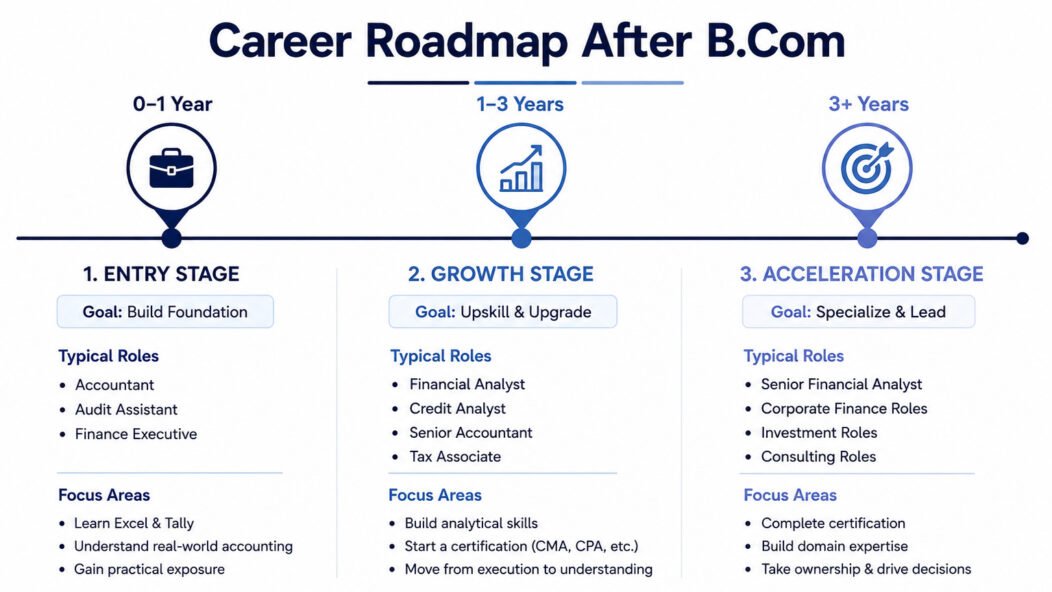
Career Roadmap for B.Com Graduates
A finance career path after completing a B.Com usually progresses in stages. The initial position is less important than how soon you can advance.
Certifications After BCom
B.Com can be used as your stepping stone.
Your certifications will decide how far you can progress in finance-related positions for B.Com graduates.
Most students, without certification, remain in slow-growing positions; however, with a proper certification, you make it big by entering into analytical and decision-making corporate finance positions.
But remember, the trick lies not in opting for any certification, but rather choosing one based on your future career position.
Certification Comparison
| Certification | Best For | Duration | Difficulty | Career Impact |
| CMA | Corporate finance, management roles | 6-12 months | Moderate | Strong growth in companies |
| CPA (designation) | Accounting, audit, global roles | 12-18 months | Moderate-High | International opportunities |
| ACCA | Audit, IFRS, global accounting | 2-3 years | High | Strong global recognition |
| CFA | Investment banking, equity research | 2-3 years | High | High-end finance roles |
| CA | Audit, taxation (India) | 5-6 years | High | Traditional path |
| MBA Finance | Management + finance roles | 2 years | Moderate | Broad career shift |
Short-Term Skill Certifications
These don’t replace core certifications but improve your job readiness:
- Excel & Financial Modelling
- GST Certification
- Tally + ERP
- Data Analytics / Power BI
- MIS Reporting
- SAP FICO
How to Choose the Right Certification
Use this simple mapping:
- Accounting / Audit – US CPA, ACCA, CA
- Corporate Finance – US CMA
- Investment / Markets – CFA
- Management Roles – US CMA
Common Mistakes Students Make
- Choosing based on trends, not career goals
- Starting multiple certifications and finishing none
- Delaying certification until “after getting a job”
- Ignoring skill-based learning alongside certification
Government Jobs After B.Com
A popular option for B.com graduates seeking a secure job with a scope of growth in their careers is government jobs. The process of securing a government job generally involves clearing a competitive exam.
Some of the popular government exams for B.com graduates are banking exams such as IBPS PO, IBPS Clerk, SSC CGL, which offers various administrative posts, RBI Assistant and insurance related exams.
However, the competition in government exams is quite tough and the process of preparation takes a good amount of time.Unlike private sector roles, the focus here is on exam performance rather than practical skills or experience.
For students who prefer stability over faster growth and are comfortable with structured exam preparation, government jobs can be a suitable path.
Top Industries Hiring B.Com Graduates
Different industries offer different types of finance jobs for B.Com graduates.
Your growth depends not just on the role, but also on the industry you enter.
Banking & Financial Services
Where: Banks, NBFCs, lending platforms
Common Roles:
- Banking Officer
- Loan Officer
- Credit Analyst
- Relationship Manager
What to expect:
Structured roles, steady growth, strong exposure to financial products
Accounting & Audit Firms
Where: CA firms, audit firms, consulting firms
Common Roles:
- Audit Assistant
- Tax Associate
- Junior Accountant
What to expect:
Strong foundation in accounting, taxation, and compliance
Big 4 & Accounting Firms
Where: Deloitte, EY, KPMG, PwC
Common Roles:
- Audit Associate
- Tax Analyst
- Advisory roles
What to expect:
High learning curve, strong brand value, demanding work environment
Corporate Finance
Where: MNCs, large corporates, manufacturing firms
Common Roles:
- Financial Analyst
- Finance Executive
- Accounts Executive
What to expect:
Budgeting, reporting, and internal finance operations
Startups & Fintech Companies
Where: Payment companies, fintech platforms, startups
Common Roles:
- Finance Analyst
- Operations Executive
- MIS Executive
What to expect:
Fast-paced work, broader exposure, less structured roles
Investment & Capital Markets
Where: Brokerage firms, investment firms
Common Roles:
- Research Analyst
- Trading Assistant
- Investment Analyst
What to expect:
High-growth roles, requires strong analytical skills
How EduMont Helps You Start Your Finance Career After B.Com
By now, you must have an idea about the roles, skills and career prospects after completing B.Com. The next step is execution. This is where most students fail, not because they are not putting in the effort, but because they are lacking proper guidance.
If you are planning to build a career in accounting and finance with certifications like CPA, CMA or EA, what you need to focus on is more important than what you study.
What Sets EduMont Apart
- Unlimited Access to UWorld Resources: Students benefit from unrestricted access to UWorld’s printed study materials, eBooks, digital question banks, and unlimited mock exams, enabling efficient learning and practice until mastery is achieved.
- Live Chalk-and-Talk Classes: Interactive sessions allow for real-time doubt resolution, helping students grasp complex concepts effectively and clarifying any queries immediately.
- EduMont Learning Management System (LMS) Access: Candidates can access pre-annotated, highlighted study materials, class notes, and recorded lectures, with availability continuing until they successfully pass the exam.
- Certified Faculty-Led Training: Instruction is delivered by dually qualified & highly experienced professionals, lead by Mr. Rohan Chopra, CPA, CMA, TEDx speaker, as well as other expert CPA faculty including Mr. Paras Batra, CA, CPA; Mr. Shubham Shandilya CPA and Mr. Parth Zaveri, CPA, MBA; ensuring high-quality teaching and guidance.
- Safety Net System: EduMont tracks candidate progress continuously and offers intervention and personalized support. This ensures candidates attempt each CPA section only when fully prepared, maximizing the likelihood of success.
- Personalized One-on-One Game Plan Calls: One-on-one mentorship sessions to evaluate each student’s preparation, customize their exam strategy, and provide guidance designed to help candidates pass without needing retakes.
- Pass-in-One-Attempt Guarantee: The Safety Net System & one-on-one game plan calls underpin this promise, giving students confidence in their preparation and approach.
- End-to-End Support: EduMont assists students throughout the entire CPA journey, from eligibility checks and scheduling exams to career guidance and placement support, ensuring a smooth path from preparation to licensure.
- No-Cost EMI Option: Flexible payment options are provided to ensure that financial constraints never hinder learning, making world-class CPA preparation accessible to everyone.
- Half a decade of Legacy: Backed by over half a decade of proven excellence, EduMont has empowered CPA aspirants with exam-focused preparation, expert mentorship, and consistent results, making it a trusted name in US CPA training.
Final Note
Many B.Com students struggle with:
- Choosing the right certification
- Planning eligibility and credits
- Deciding when to start
Guided planning avoids delays and unnecessary costs.
Conclusion
Being a B.Com graduate provides many choices for career paths in finance for commerce students, but having many choices does not mean having a specific direction.
If you:
- Choose a role early
- Build practical skills
- Add the right certification
You can move from basic entry-level finance jobs to strong, long-term careers in finance.
Otherwise, you will continue in mediocre finance jobs along with other B.Com graduates.
There is no such thing as a right starting point.
The only thing that matters is your next step!
FAQs
1. What are the best finance jobs for a B.Com graduate?
Common finance jobs for B.Com graduates include Accountant, Financial Analyst, Tax Associate, Audit Assistant, and Credit Analyst. The “best” role depends on your skills and long-term career goal.
2. What is the highest-paying finance job for a B.Com graduate?
Investment banking and financial analyst roles offer the highest long-term salaries. However, these require strong analytical skills and often additional certifications.
3. Can a B.Com graduate become a financial analyst?
Yes. But you need skills like Excel, financial analysis, and reporting. Many students also add certifications to improve their chances.
4. Is it enough for a B.Com graduate to have a degree in order to secure a good finance job?
For entry-level roles, yes. For long-term growth in B.Com finance jobs, skills and certifications become essential.
5. What skills are needed for finance jobs?
Core skills include:
- Accounting basics
- Excel
- Financial analysis
- Tally/ERP
- Communication
- SAP FICO
These are required for most entry-level finance jobs.
6. What are the best certifications for a B.Com graduate in order to secure a finance job?
CMA, CPA (designation), ACCA, and CFA are among the most relevant certifications. The right choice depends on whether you want to go into accounting, corporate finance, or investment roles.
7. What are the highest-paying certifications after B.Com?
CFA (investment roles), CPA (global accounting roles), and CMA (corporate finance) are known for strong salary growth over time.
8. Are there government jobs available after B.Com?
Yes, there are various options such as banking exams (IBPS PO/Clerk), SSC CGL, RBI Assistant and insurance jobs like LIC AAO. However, separate exam preparations are required for these roles.
9. What are the best finance jobs for freshers with no experience?
Accounts executive, audit assistants, back offices and junior analyst roles are common for freshers. These roles are more about practical experience.
10. How can I get a finance job after B.Com?
Choose a clear role
Build relevant skills (Excel, accounting)
Gain internship experience
Apply strategically
Add a certification
11. What are the industries where B.Com students can find finance jobs?
Banks, NBFCs, Big 4 firms, corporates, startups and fintech companies regularly hire B.Com graduates for entry-level finance roles.
12. How long does it take to grow in a finance career after B.Com?
With consistent skill development and the right role, you can move from entry-level to mid-level positions within 2-4 years.