


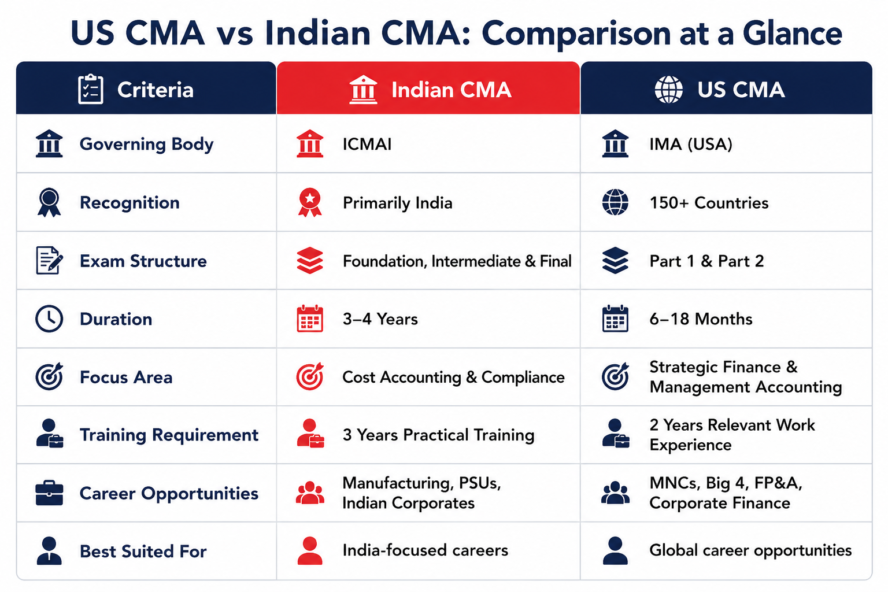
US CMA vs Indian CMA: Two prominent professional designations, US CMA (Certified Management Accountant) and Indian CMA (Cost and Management Accountant), equip professionals with essential financial, analytical, and decision-making skills.
While both can lead to rewarding career opportunities, they differ in exam structure, global recognition, career scope, industry demand, and salary potential. Understanding these differences is important for students and professionals evaluating which qualification aligns best with their long-term career goals.
This article provides a comprehensive comparison of the US CMA vs Indian CMA, covering eligibility, course duration, fees, syllabus, career opportunities, and earning potential to help you make an informed decision.
US CMA vs Indian CMA: Comparison at a Glance
What Are the Eligibility Requirements for US CMA and Indian CMA?
|
Eligibility Requirement |
US CMA |
Indian CMA |
|
Educational Qualification |
Bachelor’s degree in any discipline |
Foundation route after Class 12 or direct entry to Intermediate with a recognized degree |
|
Professional Membership |
IMA membership required |
ICMAI registration required |
|
Work Experience |
2 years of relevant experience in management accounting or financial management (within 7 years of passing the exam) |
3 years of mandatory practical training |
|
Entry Structure |
Direct entry to a two-part examination |
Three-level structure: Foundation, Intermediate, and Final |
- Require membership in the Institute of Management Accountants (IMA).
- A bachelor’s degree in any discipline.
- Two years of professional experience in management accounting or financial management (must be completed within 7 years after passing the exam).
Indian CMA Eligibility
- Three-tier progression: Foundation, Intermediate, and Final Exam.
- Direct entry into Intermediate if one holds a recognized degree.
- 3 years of mandatory practical training.
Get Free CPA Eligibility Check
How Long Does It Take to Complete US CMA and Indian CMA?
| Duration Factor | US CMA | Indian CMA |
| Typical Completion Time | 6–18 months | 3–4 years |
| Exam Structure | Two-part examination | Foundation, Intermediate, and Final levels |
| Training Requirement | 2 years of relevant work experience | 3 years of mandatory practical training |
| Exam Completion Window | Maximum 3 years to pass both parts | Varies based on progression through all levels |
US CMA Duration
- Can be completed in 6-9 months with focus, typically within 12-18 months.
- A maximum of 3 years to pass both parts.
Indian CMA Duration
- 6 to12 months per exam level + 3 years of mandatory training.
- Typically, 3 to 4 years to complete all levels and requirements.
What Is the Cost of US CMA Compared to Indian CMA?
The cost of pursuing US CMA and Indian CMA varies significantly based on registration fees, exam fees, membership requirements, and training or coaching expenses. While US CMA generally involves a higher upfront investment, it can be completed in a shorter timeframe. Indian CMA has lower examination fees but typically requires a longer commitment due to its multi-level structure and mandatory training requirements.
US CMA vs Indian CMA Fee Comparison
| Cost Component | US CMA | Indian CMA |
| Governing Body | IMA (USA) | ICMAI |
| Membership Requirement | Mandatory | Included through registration |
| Exam Structure | 2 Parts | Foundation, Intermediate & Final |
| Estimated Total Cost | ₹81,780 – ₹1,33,296 | Starts from ₹75,000 |
| Typical Completion Time | 6–18 months | 3–4 years |
*Based on current IMA fees and EduMont bundle discounts. Costs may vary depending on exchange rates, coaching, study materials, and registration category.
CMA Course Fees: US CMA vs Indian CMA
US CMA Exam Fees (in USD)
| Fee Category | Students |
Professionals |
| IMA Membership | $160 | $295 |
| Entrance Fees | $225 | $300 |
| Exam Fees | $814 | $1090 |
| Total | $1,088 | $1,685 |
US CMA Fees For Indian Students
| Fee Category | Students | Professionals |
| IMA Membership | ₹4,495 | ₹26,845 |
| Entrance Fees | ₹20,475 | ₹27,300 |
| Exam Fees | ₹74,074 | ₹99,190 |
| Total | ₹99,008 | ₹1,53,335 |
Including coaching, study materials, and membership costs, the total typically ranges from $929.25 – $1,394.80 or ₹79,547 – ₹1,19,041 at EduMont Classes.
Indian CMA Cost
- Foundation: ₹6,000
- Intermediate: ₹23,100
- Final: ₹25,000
- Total cost typically starts from ₹75,000, including registration fees, exam fees, study materials, and training. Actual costs may vary depending on the mode of preparation and additional learning resources chosen by the candidate.
Note: Go through the EduMont Classes Fees structure for more details.
How Do the US CMA and Indian CMA Exam Structures Compare?
The US CMA and Indian CMA differ significantly in their examination structure, assessment format, and subject coverage. While US CMA follows a two-part examination focused on management accounting and strategic finance, Indian CMA follows a three-level structure covering accounting, taxation, law, cost management, and business strategy.
US CMA vs Indian CMA Exam Structure
| Exam Component | US CMA | Indian CMA |
| Exam Levels | 2 Parts | Foundation, Intermediate & Final |
| Exam Duration | 4 hours per part | Varies by level and paper |
| Question Format | MCQs and Essay-Based Scenarios | Objective and Descriptive Papers |
| Primary Focus | Management Accounting, Analytics & Strategic Finance | Cost Accounting, Taxation & Financial Management |
| Governing Body | IMA (USA) | ICMAI |
US CMA Exam Pattern
The US CMA examination consists of two parts, with each part lasting four hours. The exam includes multiple-choice questions (MCQs) followed by Case-based questions that test analytical and decision-making skills.
- Two parts, each four hours long, comprising 100 Multiple-Choice Questions (MCQs) and 2 Case-Based Questions (CBQs).
- MCQs account for 75% of the total score and assess technical knowledge across the syllabus.
- CBQs account for 25% of the total score and evaluate a candidate’s ability to apply concepts to real-world business scenarios through calculations, analysis, and decision-making tasks.
- A distinctive feature of the US CMA exam is its focus on Case-Based Questions (CBQs). Unlike traditional essay questions, CBQs present practical business situations followed by task-based questions that test analytical thinking and professional judgment. At EduMont Classes, we emphasize CBQ preparation because success in this section often depends on concept application rather than memorization alone.
- Part 1: Financial Planning, Performance, and Analytics: covers external financial reporting decisions, planning, budgeting and forecasting, performance management, cost management, internal controls, and technology and analytics.
- Part 2: Strategic Financial Management: covers financial statement analysis, corporate finance, business decision analysis, enterprise risk management, investment decisions, and professional ethics.
Indian CMA Exam Pattern
The Indian CMA qualification follows a three-level examination structure comprising Foundation, Intermediate, and Final examinations.
- Foundation Level: introduces fundamental concepts in accounting, economics, business laws, and management.
- Intermediate Level: focuses on financial accounting, cost and management accounting, taxation, auditing, and financial management.
- Final Level: covers strategic financial management, corporate laws, business valuation, risk management, strategic cost management, and advanced professional competencies.
- The examination includes a combination of objective and descriptive papers designed to assess both conceptual understanding and practical application.
- The syllabus emphasizes cost accounting, financial management, taxation, corporate laws, and strategic decision-making, making it particularly relevant for professionals pursuing finance, costing, compliance, and management roles within India.
What Do You Study in US CMA and Indian CMA?
While the US CMA syllabus evaluates global strategic finance and data-driven decision-making across two streamlined papers, the Indian CMA curriculum deeply tests local statutory compliance and domestic auditing through a comprehensive multi-level structure.
US CMA Syllabus Focus
- Management accounting, strategic financial management, and global accounting practices.
Indian CMA Syllabus Focus
- Cost accounting, Indian taxation, corporate laws, and audit.
Global Recognition & Career Scope
US CMA Recognition
- Recognized in 150+ countries and highly respected worldwide.
- Adds an international edge, especially for roles in MNCs, Big 4s, and global finance functions.
Indian CMA Recognition
- Strong recognition within India, equivalent to a postgraduate degree as per UGC.
- Limited global awareness but highly valued in the public sector, manufacturing, and cost control roles within India.
What Career Opportunities Are Available After US CMA and Indian CMA?
US CMA Career Benefits
- According to IMA salary surveys, CMAs earn 28% higher compensation in the United States and 62% higher compensation globally compared to non-CMAs.
- Valued in financial planning & analysis (FP&A), corporate finance, internal audit, and consulting.
- Recognized by multinational companies and global finance teams across industries
Indian CMA Career Benefits
- Highly regarded within India, particularly in cost accounting, cost management, and compliance-related functions.
- Popular among manufacturing companies, PSUs, government organizations, and domestic corporations.
- Provides specialized expertise in cost control, budgeting, and financial management.
Why Choose EduMont for your CMA Prep
With over half a decade of guiding students for their US CMA and US CPA coaching, EduMont is a proud anchor for 1000s of active students globally. Our structured programs are designed for both working professionals and full-time students, offering personalized guidance and a results-driven learning experience helping pass students in thier first attempt. Here’s why EduMont should be your first choice for CMA preparation:
- Unlimited Access to UWorld Resources: Students benefit from unlimited access to UWorld’s printed study materials, eBooks, question banks, and unlimited mock exams, enabling efficient learning and practice until mastery is achieved.
- Live Chalk-and-Talk Classes: Interactive sessions allow for real-time doubt resolution, helping students grasp complex concepts effectively and clarifying any queries immediately.
- EduMont Learning Management System (LMS) Access: Candidates can access pre-annotated, highlighted study materials, class notes, and recorded lectures, with availability continuing until they successfully pass the exam.
- Certified Faculty-Led Training: Instruction is delivered by highly experienced professionals, led by Mr Rohan Chopra, CMA, CPA, TEDx Speaker; Ms Royaline Gonzalvez, CMA; ensuring high-quality teaching and guidance.
- Safety Net System: Your preparation is continuously monitored through assessments and performance tracking. We catch gaps early and provide timely interventions before they affect your exam performance.
- One-on-One Game Plan Call: After preparation, you get a personalised session with Rohan Sir to review your mock results. Together, we validate readiness, refine strategy, and decide whether you’re set for the exam or need more focus.
- Pass-in-One-Attempt Assurance: Only students cleared through the Game Plan Call are advised to schedule their CPA exam. This ensures you sit fully prepared, giving you confidence for a Pass-in-One-Attempt.
US CMA vs Indian CMA: Which Should You Choose?
The choice between US CMA and Indian CMA ultimately depends on your career aspirations. US CMA is generally preferred by professionals seeking global career opportunities and strategic finance roles, while Indian CMA is well-suited for those looking to build expertise in cost management, compliance, and finance functions within India.
This keeps the existing message but sounds more balanced and credible. A comparison article should guide the decision rather than declare a winner.
Frequently Asked Questions
Is US CMA better than Indian CMA?
The answer depends on your long-term career goals. At EduMont Classes, students often ask which qualification offers the best return on investment. The reality is that US CMA and Indian CMA serve different career paths. US CMA is typically chosen for global finance and management accounting roles, while Indian CMA is more closely aligned with cost accounting, compliance, and finance functions within India.
Which CMA has better global recognition?
US CMA has broader international recognition and is accepted by employers in more than 150 countries. Indian CMA is highly respected within India but has relatively limited recognition outside the country.
Which CMA course can be completed faster?
US CMA is generally the faster qualification pathway, with many candidates completing both exam parts within 6–18 months. At EduMont Classes, one of the most common reasons professionals choose US CMA is its shorter completion timeline compared to the multi-level Indian CMA qualification.
Is US CMA recognized in India?
Yes. US CMA is recognized and valued by multinational companies, shared service centers, Big 4 firms, and organizations with global finance operations in India.
Can Indian CMA holders work abroad?
Indian CMA holders can pursue international opportunities, but the qualification’s recognition is strongest within India. Additional certifications may be beneficial depending on the country and role.
Which CMA is more suitable for multinational companies?
US CMA is often preferred for roles in financial planning and analysis (FP&A), corporate finance, management accounting, and other positions within multinational organizations.
Is Indian CMA equivalent to US CMA?
No. While both are professional management accounting designations, they are governed by different bodies, follow different examination structures, and focus on different regulatory and business environments.
Which CMA should I choose after B.Com?
This is one of the most common questions we receive from B.Com graduates. Candidates seeking international opportunities often lean toward US CMA, while those planning to build their careers within India may find Indian CMA more aligned with their professional goals.